

2.3 Models of Influence of Software Implants on Computers …
153
but also to carry out an information counterattack, misleading the attacking party.
Moreover, distraction of an attack with false information resources helps collect data
about the attacking party for the purpose of compromising it.
In general, it is possible to identify two types of false resources aimed at different
spheres of information warfare:
– False objects and resources in the semantic section of the information space
(e.g., misinformation or deliberately false information posted in media or on the
Internet);
– False objects and resources in the telecommunication section of the information
space (e.g., false networks, databases, etc.).
False objects and resources placed in the semantic section of the information space
are aimed at information struggle in the psychological sphere and mainly designed
to ensure performance of information and psychological operations.
False objects in the telecommunication part of the information space are always
aimed at information struggle in the technical sphere. They are designed to deceive
and distract attacking information and technical effects.
Such false objects and resources in the telecommunication part of the information
space, to which it is possible to effectively distract the enemy, include
– Telecommunication network nodes;
– Computing and information management systems;
– Operating systems;
– application software;
– Databases and database control systems;
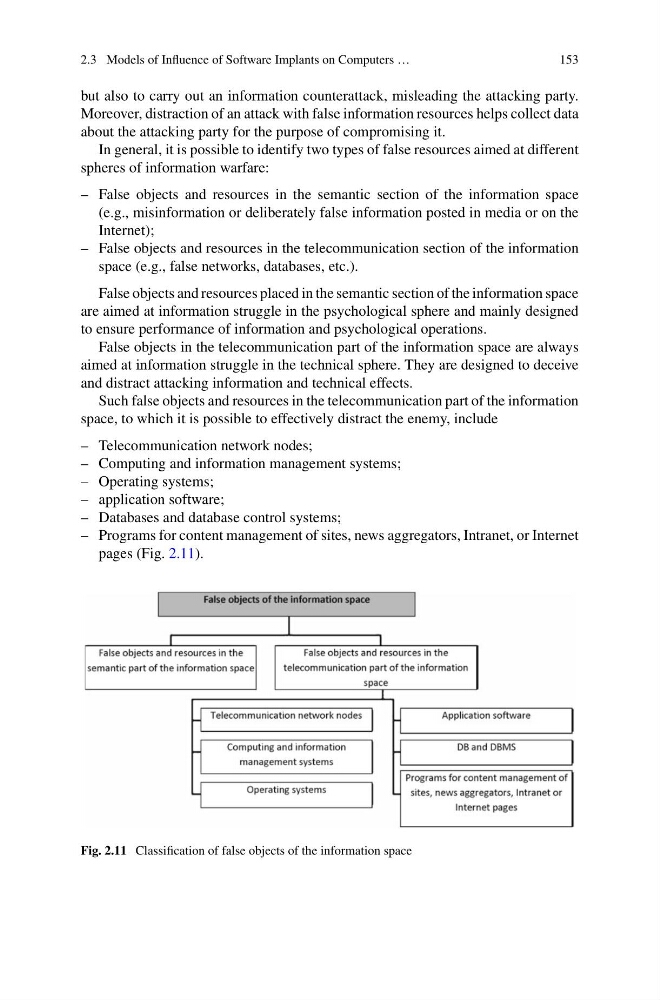
– Programs for content management of sites, news aggregators, Intranet, or Internet
pages (Fig. 2.11).
Fig. 2.11 Classification of false objects of the information space
153
but also to carry out an information counterattack, misleading the attacking party.
Moreover, distraction of an attack with false information resources helps collect data
about the attacking party for the purpose of compromising it.
In general, it is possible to identify two types of false resources aimed at different
spheres of information warfare:
– False objects and resources in the semantic section of the information space
(e.g., misinformation or deliberately false information posted in media or on the
Internet);
– False objects and resources in the telecommunication section of the information
space (e.g., false networks, databases, etc.).
False objects and resources placed in the semantic section of the information space
are aimed at information struggle in the psychological sphere and mainly designed
to ensure performance of information and psychological operations.
False objects in the telecommunication part of the information space are always
aimed at information struggle in the technical sphere. They are designed to deceive
and distract attacking information and technical effects.
Such false objects and resources in the telecommunication part of the information
space, to which it is possible to effectively distract the enemy, include
– Telecommunication network nodes;
– Computing and information management systems;
– Operating systems;
– application software;
– Databases and database control systems;
– Programs for content management of sites, news aggregators, Intranet, or Internet
pages (Fig. 2.11).
Fig. 2.11 Classification of false objects of the information space