

2.2 Implants: Types, Ways of Injection, and Methods of Protection
131
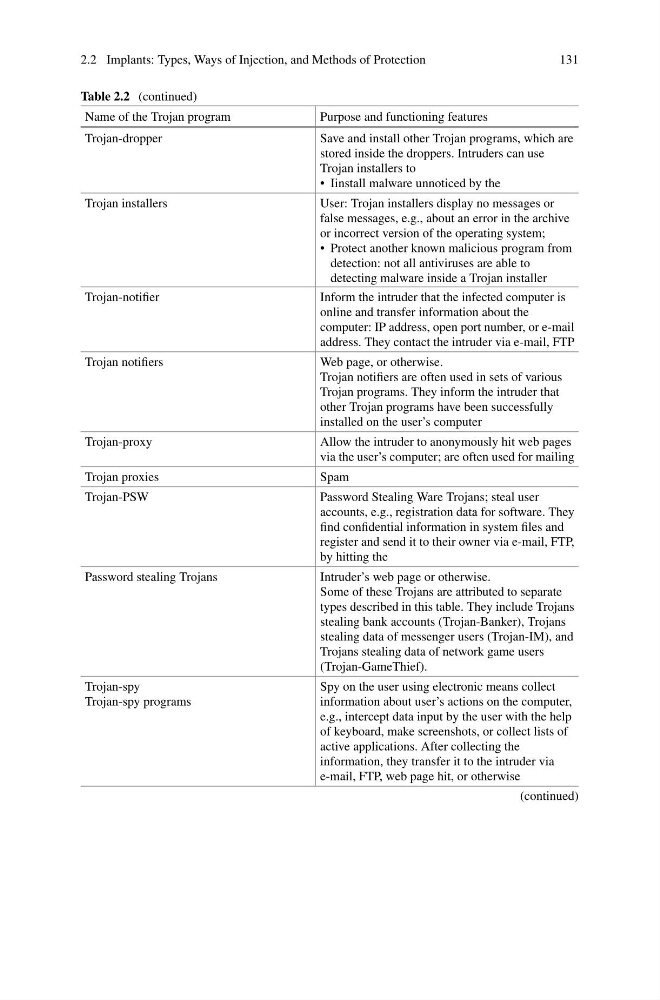
Table 2.2 (continued)
Name of the Trojan program
Purpose and functioning features
Trojan-dropper
Save and install other Trojan programs, which are
stored inside the droppers. Intruders can use
Trojan installers to
• Iinstall malware unnoticed by the
Trojan installers
User: Trojan installers display no messages or
false messages, e.g., about an error in the archive
or incorrect version of the operating system;
• Protect another known malicious program from
detection: not all antiviruses are able to
detecting malware inside a Trojan installer
Trojan-notifier
Inform the intruder that the infected computer is
online and transfer information about the
computer: IP address, open port number, or e-mail
address. They contact the intruder via e-mail, FTP
Trojan notifiers
Web page, or otherwise.
Trojan notifiers are often used in sets of various
Trojan programs. They inform the intruder that
other Trojan programs have been successfully
installed on the user’s computer
Trojan-proxy
Allow the intruder to anonymously hit web pages
via the user’s computer; are often used for mailing
Trojan proxies
Spam
Trojan-PSW
Password Stealing Ware Trojans; steal user
accounts, e.g., registration data for software. They
find confidential information in system files and
register and send it to their owner via e-mail, FTP,
by hitting the
Password stealing Trojans
Intruder’s web page or otherwise.
Some of these Trojans are attributed to separate
types described in this table. They include Trojans
stealing bank accounts (Trojan-Banker), Trojans
stealing data of messenger users (Trojan-IM), and
Trojans stealing data of network game users
(Trojan-GameThief).
Trojan-spy
Trojan-spy programs
Spy on the user using electronic means collect
information about user’s actions on the computer,
e.g., intercept data input by the user with the help
of keyboard, make screenshots, or collect lists of
active applications. After collecting the
information, they transfer it to the intruder via
e-mail, FTP, web page hit, or otherwise
(continued)
131
Table 2.2 (continued)
Name of the Trojan program
Purpose and functioning features
Trojan-dropper
Save and install other Trojan programs, which are
stored inside the droppers. Intruders can use
Trojan installers to
• Iinstall malware unnoticed by the
Trojan installers
User: Trojan installers display no messages or
false messages, e.g., about an error in the archive
or incorrect version of the operating system;
• Protect another known malicious program from
detection: not all antiviruses are able to
detecting malware inside a Trojan installer
Trojan-notifier
Inform the intruder that the infected computer is
online and transfer information about the
computer: IP address, open port number, or e-mail
address. They contact the intruder via e-mail, FTP
Trojan notifiers
Web page, or otherwise.
Trojan notifiers are often used in sets of various
Trojan programs. They inform the intruder that
other Trojan programs have been successfully
installed on the user’s computer
Trojan-proxy
Allow the intruder to anonymously hit web pages
via the user’s computer; are often used for mailing
Trojan proxies
Spam
Trojan-PSW
Password Stealing Ware Trojans; steal user
accounts, e.g., registration data for software. They
find confidential information in system files and
register and send it to their owner via e-mail, FTP,
by hitting the
Password stealing Trojans
Intruder’s web page or otherwise.
Some of these Trojans are attributed to separate
types described in this table. They include Trojans
stealing bank accounts (Trojan-Banker), Trojans
stealing data of messenger users (Trojan-IM), and
Trojans stealing data of network game users
(Trojan-GameThief).
Trojan-spy
Trojan-spy programs
Spy on the user using electronic means collect
information about user’s actions on the computer,
e.g., intercept data input by the user with the help
of keyboard, make screenshots, or collect lists of
active applications. After collecting the
information, they transfer it to the intruder via
e-mail, FTP, web page hit, or otherwise
(continued)