

124
2 Computer Viruses, Malicious Logic, and Spyware
Trojans [15] are distinguished by the effects they have on the infected PC.
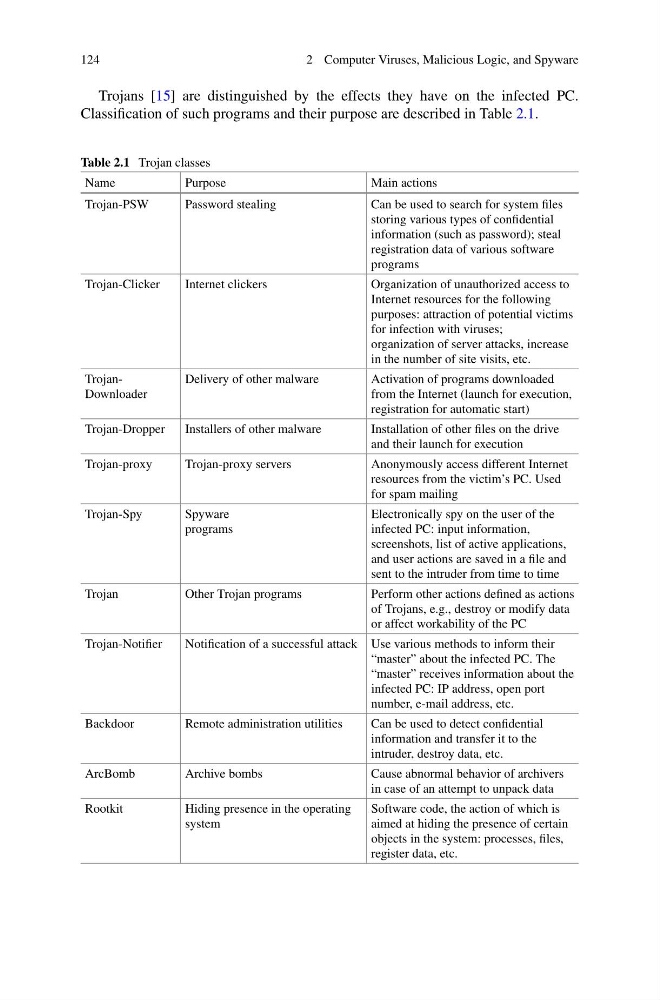
Classification of such programs and their purpose are described in Table 2.1.
Table 2.1 Trojan classes
Name
Purpose
Main actions
Trojan-PSW
Password stealing
Can be used to search for system files
storing various types of confidential
information (such as password); steal
registration data of various software
programs
Trojan-Clicker
Internet clickers
Organization of unauthorized access to
Internet resources for the following
purposes: attraction of potential victims
for infection with viruses;
organization of server attacks, increase
in the number of site visits, etc.
TrojanDownloader
Delivery of other malware
Activation of programs downloaded
from the Internet (launch for execution,
registration for automatic start)
Trojan-Dropper
Installers of other malware
Installation of other files on the drive
and their launch for execution
Trojan-proxy
Trojan-proxy servers
Anonymously access different Internet
resources from the victim’s PC. Used
for spam mailing
Trojan-Spy
Spyware
programs
Electronically spy on the user of the
infected PC: input information,
screenshots, list of active applications,
and user actions are saved in a file and
sent to the intruder from time to time
Trojan
Other Trojan programs
Perform other actions defined as actions
of Trojans, e.g., destroy or modify data
or affect workability of the PC
Trojan-Notifier
Notification of a successful attack Use various methods to inform their
“master” about the infected PC. The
“master” receives information about the
infected PC: IP address, open port
number, e-mail address, etc.
Backdoor
Remote administration utilities
Can be used to detect confidential
information and transfer it to the
intruder, destroy data, etc.
ArcBomb
Archive bombs
Cause abnormal behavior of archivers
in case of an attempt to unpack data
Rootkit
Hiding presence in the operating
system
Software code, the action of which is
aimed at hiding the presence of certain
objects in the system: processes, files,
register data, etc.
2 Computer Viruses, Malicious Logic, and Spyware
Trojans [15] are distinguished by the effects they have on the infected PC.
Classification of such programs and their purpose are described in Table 2.1.
Table 2.1 Trojan classes
Name
Purpose
Main actions
Trojan-PSW
Password stealing
Can be used to search for system files
storing various types of confidential
information (such as password); steal
registration data of various software
programs
Trojan-Clicker
Internet clickers
Organization of unauthorized access to
Internet resources for the following
purposes: attraction of potential victims
for infection with viruses;
organization of server attacks, increase
in the number of site visits, etc.
TrojanDownloader
Delivery of other malware
Activation of programs downloaded
from the Internet (launch for execution,
registration for automatic start)
Trojan-Dropper
Installers of other malware
Installation of other files on the drive
and their launch for execution
Trojan-proxy
Trojan-proxy servers
Anonymously access different Internet
resources from the victim’s PC. Used
for spam mailing
Trojan-Spy
Spyware
programs
Electronically spy on the user of the
infected PC: input information,
screenshots, list of active applications,
and user actions are saved in a file and
sent to the intruder from time to time
Trojan
Other Trojan programs
Perform other actions defined as actions
of Trojans, e.g., destroy or modify data
or affect workability of the PC
Trojan-Notifier
Notification of a successful attack Use various methods to inform their
“master” about the infected PC. The
“master” receives information about the
infected PC: IP address, open port
number, e-mail address, etc.
Backdoor
Remote administration utilities
Can be used to detect confidential
information and transfer it to the
intruder, destroy data, etc.
ArcBomb
Archive bombs
Cause abnormal behavior of archivers
in case of an attempt to unpack data
Rootkit
Hiding presence in the operating
system
Software code, the action of which is
aimed at hiding the presence of certain
objects in the system: processes, files,
register data, etc.