

84
C. Ozoegwu and P. Eberhard
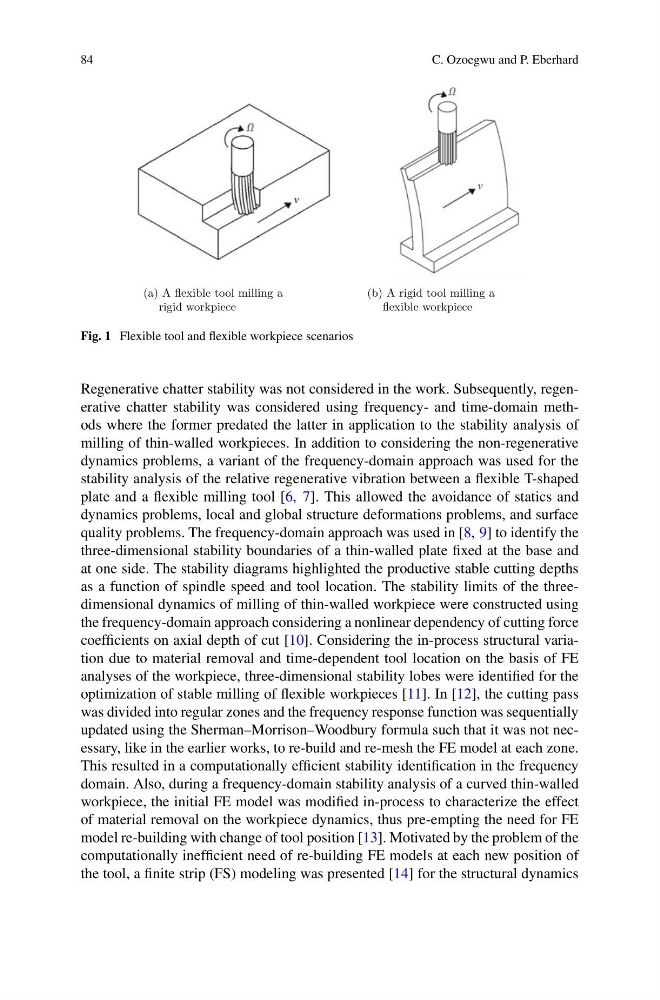
(a) A flexible tool milling a
rigid workpiece
(b) A rigid tool milling a
flexible workpiece
Fig. 1 Flexible tool and flexible workpiece scenarios
Regenerative chatter stability was not considered in the work. Subsequently, regenerative chatter stability was considered using frequency- and time-domain methods where the former predated the latter in application to the stability analysis of
milling of thin-walled workpieces. In addition to considering the non-regenerative
dynamics problems, a variant of the frequency-domain approach was used for the
stability analysis of the relative regenerative vibration between a flexible T-shaped
plate and a flexible milling tool [6, 7]. This allowed the avoidance of statics and
dynamics problems, local and global structure deformations problems, and surface
quality problems. The frequency-domain approach was used in [8, 9] to identify the
three-dimensional stability boundaries of a thin-walled plate fixed at the base and
at one side. The stability diagrams highlighted the productive stable cutting depths
as a function of spindle speed and tool location. The stability limits of the threedimensional dynamics of milling of thin-walled workpiece were constructed using
the frequency-domain approach considering a nonlinear dependency of cutting force
coefficients on axial depth of cut [10]. Considering the in-process structural variation due to material removal and time-dependent tool location on the basis of FE
analyses of the workpiece, three-dimensional stability lobes were identified for the
optimization of stable milling of flexible workpieces [11]. In [12], the cutting pass
was divided into regular zones and the frequency response function was sequentially
updated using the Sherman–Morrison–Woodbury formula such that it was not necessary, like in the earlier works, to re-build and re-mesh the FE model at each zone.
This resulted in a computationally efficient stability identification in the frequency
domain. Also, during a frequency-domain stability analysis of a curved thin-walled
workpiece, the initial FE model was modified in-process to characterize the effect
of material removal on the workpiece dynamics, thus pre-empting the need for FE
model re-building with change of tool position [13]. Motivated by the problem of the
computationally inefficient need of re-building FE models at each new position of
the tool, a finite strip (FS) modeling was presented [14] for the structural dynamics
C. Ozoegwu and P. Eberhard
(a) A flexible tool milling a
rigid workpiece
(b) A rigid tool milling a
flexible workpiece
Fig. 1 Flexible tool and flexible workpiece scenarios
Regenerative chatter stability was not considered in the work. Subsequently, regenerative chatter stability was considered using frequency- and time-domain methods where the former predated the latter in application to the stability analysis of
milling of thin-walled workpieces. In addition to considering the non-regenerative
dynamics problems, a variant of the frequency-domain approach was used for the
stability analysis of the relative regenerative vibration between a flexible T-shaped
plate and a flexible milling tool [6, 7]. This allowed the avoidance of statics and
dynamics problems, local and global structure deformations problems, and surface
quality problems. The frequency-domain approach was used in [8, 9] to identify the
three-dimensional stability boundaries of a thin-walled plate fixed at the base and
at one side. The stability diagrams highlighted the productive stable cutting depths
as a function of spindle speed and tool location. The stability limits of the threedimensional dynamics of milling of thin-walled workpiece were constructed using
the frequency-domain approach considering a nonlinear dependency of cutting force
coefficients on axial depth of cut [10]. Considering the in-process structural variation due to material removal and time-dependent tool location on the basis of FE
analyses of the workpiece, three-dimensional stability lobes were identified for the
optimization of stable milling of flexible workpieces [11]. In [12], the cutting pass
was divided into regular zones and the frequency response function was sequentially
updated using the Sherman–Morrison–Woodbury formula such that it was not necessary, like in the earlier works, to re-build and re-mesh the FE model at each zone.
This resulted in a computationally efficient stability identification in the frequency
domain. Also, during a frequency-domain stability analysis of a curved thin-walled
workpiece, the initial FE model was modified in-process to characterize the effect
of material removal on the workpiece dynamics, thus pre-empting the need for FE
model re-building with change of tool position [13]. Motivated by the problem of the
computationally inefficient need of re-building FE models at each new position of
the tool, a finite strip (FS) modeling was presented [14] for the structural dynamics