

Nonlinear Dynamics of Resonant Microelectromechanical System (MEMS): A Review
77
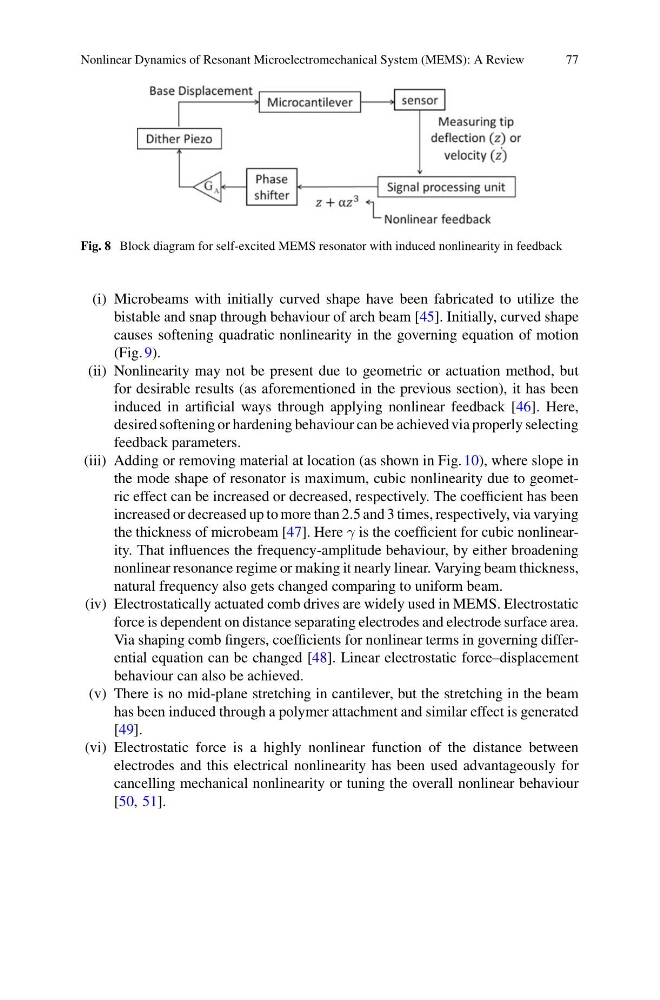
Fig. 8 Block diagram for self-excited MEMS resonator with induced nonlinearity in feedback
(i) Microbeams with initially curved shape have been fabricated to utilize the
bistable and snap through behaviour of arch beam [45]. Initially, curved shape
causes softening quadratic nonlinearity in the governing equation of motion
(Fig. 9).
(ii) Nonlinearity may not be present due to geometric or actuation method, but
for desirable results (as aforementioned in the previous section), it has been
induced in artificial ways through applying nonlinear feedback [46]. Here,
desired softening or hardening behaviour can be achieved via properly selecting
feedback parameters.
(iii) Adding or removing material at location (as shown in Fig. 10), where slope in
the mode shape of resonator is maximum, cubic nonlinearity due to geometric effect can be increased or decreased, respectively. The coefficient has been
increased or decreased up to more than 2.5 and 3 times, respectively, via varying
the thickness of microbeam [47]. Here γ is the coefficient for cubic nonlinearity. That influences the frequency-amplitude behaviour, by either broadening
nonlinear resonance regime or making it nearly linear. Varying beam thickness,
natural frequency also gets changed comparing to uniform beam.
(iv) Electrostatically actuated comb drives are widely used in MEMS. Electrostatic
force is dependent on distance separating electrodes and electrode surface area.
Via shaping comb fingers, coefficients for nonlinear terms in governing differential equation can be changed [48]. Linear electrostatic force–displacement
behaviour can also be achieved.
(v) There is no mid-plane stretching in cantilever, but the stretching in the beam
has been induced through a polymer attachment and similar effect is generated
[49].
(vi) Electrostatic force is a highly nonlinear function of the distance between
electrodes and this electrical nonlinearity has been used advantageously for
cancelling mechanical nonlinearity or tuning the overall nonlinear behaviour
[50, 51].
77
Fig. 8 Block diagram for self-excited MEMS resonator with induced nonlinearity in feedback
(i) Microbeams with initially curved shape have been fabricated to utilize the
bistable and snap through behaviour of arch beam [45]. Initially, curved shape
causes softening quadratic nonlinearity in the governing equation of motion
(Fig. 9).
(ii) Nonlinearity may not be present due to geometric or actuation method, but
for desirable results (as aforementioned in the previous section), it has been
induced in artificial ways through applying nonlinear feedback [46]. Here,
desired softening or hardening behaviour can be achieved via properly selecting
feedback parameters.
(iii) Adding or removing material at location (as shown in Fig. 10), where slope in
the mode shape of resonator is maximum, cubic nonlinearity due to geometric effect can be increased or decreased, respectively. The coefficient has been
increased or decreased up to more than 2.5 and 3 times, respectively, via varying
the thickness of microbeam [47]. Here γ is the coefficient for cubic nonlinearity. That influences the frequency-amplitude behaviour, by either broadening
nonlinear resonance regime or making it nearly linear. Varying beam thickness,
natural frequency also gets changed comparing to uniform beam.
(iv) Electrostatically actuated comb drives are widely used in MEMS. Electrostatic
force is dependent on distance separating electrodes and electrode surface area.
Via shaping comb fingers, coefficients for nonlinear terms in governing differential equation can be changed [48]. Linear electrostatic force–displacement
behaviour can also be achieved.
(v) There is no mid-plane stretching in cantilever, but the stretching in the beam
has been induced through a polymer attachment and similar effect is generated
[49].
(vi) Electrostatic force is a highly nonlinear function of the distance between
electrodes and this electrical nonlinearity has been used advantageously for
cancelling mechanical nonlinearity or tuning the overall nonlinear behaviour
[50, 51].