

Nonlinear Dynamics of Resonant Microelectromechanical System (MEMS): A Review
73
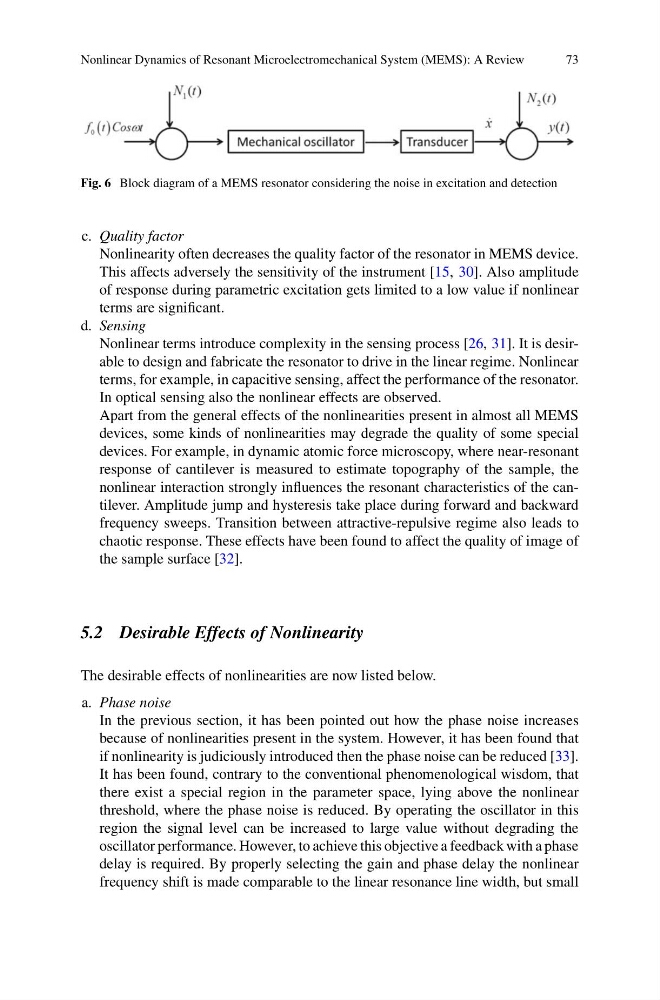
Fig. 6 Block diagram of a MEMS resonator considering the noise in excitation and detection
c. Quality factor
Nonlinearity often decreases the quality factor of the resonator in MEMS device.
This affects adversely the sensitivity of the instrument [15, 30]. Also amplitude
of response during parametric excitation gets limited to a low value if nonlinear
terms are significant.
d. Sensing
Nonlinear terms introduce complexity in the sensing process [26, 31]. It is desirable to design and fabricate the resonator to drive in the linear regime. Nonlinear
terms, for example, in capacitive sensing, affect the performance of the resonator.
In optical sensing also the nonlinear effects are observed.
Apart from the general effects of the nonlinearities present in almost all MEMS
devices, some kinds of nonlinearities may degrade the quality of some special
devices. For example, in dynamic atomic force microscopy, where near-resonant
response of cantilever is measured to estimate topography of the sample, the
nonlinear interaction strongly influences the resonant characteristics of the cantilever. Amplitude jump and hysteresis take place during forward and backward
frequency sweeps. Transition between attractive-repulsive regime also leads to
chaotic response. These effects have been found to affect the quality of image of
the sample surface [32].
5.2 Desirable Effects of Nonlinearity
The desirable effects of nonlinearities are now listed below.
a. Phase noise
In the previous section, it has been pointed out how the phase noise increases
because of nonlinearities present in the system. However, it has been found that
if nonlinearity is judiciously introduced then the phase noise can be reduced [33].
It has been found, contrary to the conventional phenomenological wisdom, that
there exist a special region in the parameter space, lying above the nonlinear
threshold, where the phase noise is reduced. By operating the oscillator in this
region the signal level can be increased to large value without degrading the
oscillator performance. However, to achieve this objective a feedback with a phase
delay is required. By properly selecting the gain and phase delay the nonlinear
frequency shift is made comparable to the linear resonance line width, but small
73
Fig. 6 Block diagram of a MEMS resonator considering the noise in excitation and detection
c. Quality factor
Nonlinearity often decreases the quality factor of the resonator in MEMS device.
This affects adversely the sensitivity of the instrument [15, 30]. Also amplitude
of response during parametric excitation gets limited to a low value if nonlinear
terms are significant.
d. Sensing
Nonlinear terms introduce complexity in the sensing process [26, 31]. It is desirable to design and fabricate the resonator to drive in the linear regime. Nonlinear
terms, for example, in capacitive sensing, affect the performance of the resonator.
In optical sensing also the nonlinear effects are observed.
Apart from the general effects of the nonlinearities present in almost all MEMS
devices, some kinds of nonlinearities may degrade the quality of some special
devices. For example, in dynamic atomic force microscopy, where near-resonant
response of cantilever is measured to estimate topography of the sample, the
nonlinear interaction strongly influences the resonant characteristics of the cantilever. Amplitude jump and hysteresis take place during forward and backward
frequency sweeps. Transition between attractive-repulsive regime also leads to
chaotic response. These effects have been found to affect the quality of image of
the sample surface [32].
5.2 Desirable Effects of Nonlinearity
The desirable effects of nonlinearities are now listed below.
a. Phase noise
In the previous section, it has been pointed out how the phase noise increases
because of nonlinearities present in the system. However, it has been found that
if nonlinearity is judiciously introduced then the phase noise can be reduced [33].
It has been found, contrary to the conventional phenomenological wisdom, that
there exist a special region in the parameter space, lying above the nonlinear
threshold, where the phase noise is reduced. By operating the oscillator in this
region the signal level can be increased to large value without degrading the
oscillator performance. However, to achieve this objective a feedback with a phase
delay is required. By properly selecting the gain and phase delay the nonlinear
frequency shift is made comparable to the linear resonance line width, but small