

Nonlinear Dynamics of Resonant Microelectromechanical System (MEMS): A Review
61
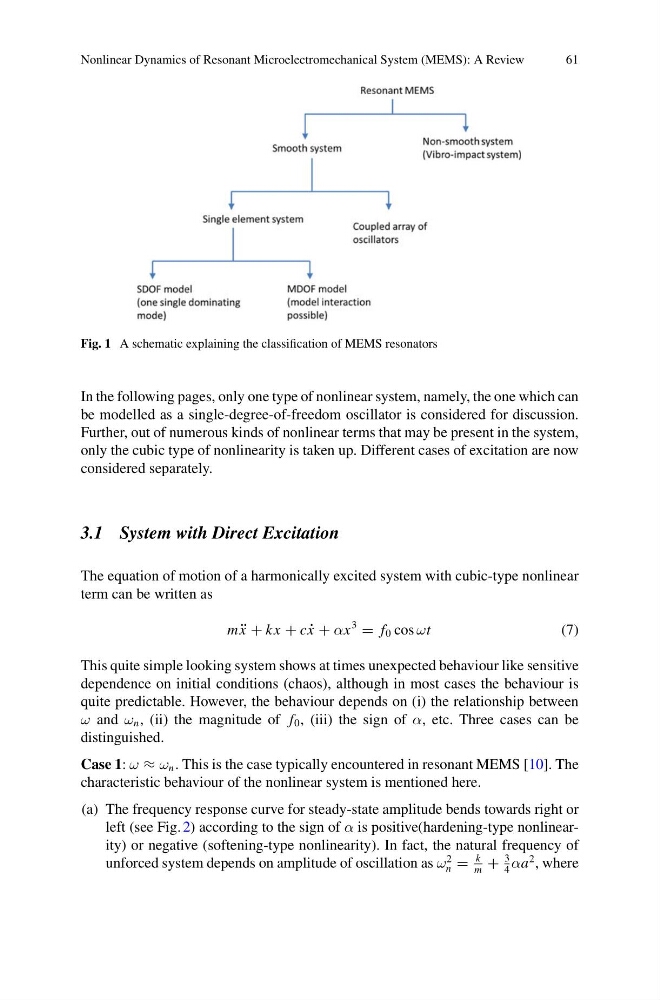
Fig. 1 A schematic explaining the classification of MEMS resonators
In the following pages, only one type of nonlinear system, namely, the one which can
be modelled as a single-degree-of-freedom oscillator is considered for discussion.
Further, out of numerous kinds of nonlinear terms that may be present in the system,
only the cubic type of nonlinearity is taken up. Different cases of excitation are now
considered separately.
3.1 System with Direct Excitation
The equation of motion of a harmonically excited system with cubic-type nonlinear
term can be written as
m ¨
x + kx + c ˙
x + αx
3
= f 0 cos ωt
(7)
This quite simple looking system shows at times unexpected behaviour like sensitive
dependence on initial conditions (chaos), although in most cases the behaviour is
quite predictable. However, the behaviour depends on (i) the relationship between
ω and ω n , (ii) the magnitude of f 0 , (iii) the sign of α, etc. Three cases can be
distinguished.
Case 1: ω ≈ ω n . This is the case typically encountered in resonant MEMS [10]. The
characteristic behaviour of the nonlinear system is mentioned here.
(a) The frequency response curve for steady-state amplitude bends towards right or
left (see Fig. 2) according to the sign of α is positive(hardening-type nonlinearity) or negative (softening-type nonlinearity). In fact, the natural frequency of
unforced system depends on amplitude of oscillation as ω
2
n =
k
m
+
3
4
αa
2 , where
61
Fig. 1 A schematic explaining the classification of MEMS resonators
In the following pages, only one type of nonlinear system, namely, the one which can
be modelled as a single-degree-of-freedom oscillator is considered for discussion.
Further, out of numerous kinds of nonlinear terms that may be present in the system,
only the cubic type of nonlinearity is taken up. Different cases of excitation are now
considered separately.
3.1 System with Direct Excitation
The equation of motion of a harmonically excited system with cubic-type nonlinear
term can be written as
m ¨
x + kx + c ˙
x + αx
3
= f 0 cos ωt
(7)
This quite simple looking system shows at times unexpected behaviour like sensitive
dependence on initial conditions (chaos), although in most cases the behaviour is
quite predictable. However, the behaviour depends on (i) the relationship between
ω and ω n , (ii) the magnitude of f 0 , (iii) the sign of α, etc. Three cases can be
distinguished.
Case 1: ω ≈ ω n . This is the case typically encountered in resonant MEMS [10]. The
characteristic behaviour of the nonlinear system is mentioned here.
(a) The frequency response curve for steady-state amplitude bends towards right or
left (see Fig. 2) according to the sign of α is positive(hardening-type nonlinearity) or negative (softening-type nonlinearity). In fact, the natural frequency of
unforced system depends on amplitude of oscillation as ω
2
n =
k
m
+
3
4
αa
2 , where