

Nonlinear Dynamics of Resonant Microelectromechanical System (MEMS): A Review
59
attains a maximum value X max =
F 0 /k
2ζ
√
1−ζ 2
, when ω = ω n
1 − 2ζ 2 . Usually for
resonant device the damping factor is kept small, so that X max ≈
F 0 /k
2ζ
for ω ≈ ω n .
It is customary to specify the damping factor in form of quality factor Q which is
approximately equal to
1
2ζ
. For resonant MEMS, the Q factor is very high.
In sensing devices, one of the physical parameters of the oscillator is changed
depending on the external stimuli that need to be estimated. For example, in chemical
gas sensor, the mass is altered when the gas is present near the vibrating body, in a
pressure sensor the stiffness is changed. This change in inertia or stiffness causes the
natural frequency to be shifted. The conditions for resonance of an initially resonating
oscillator now get changed, resulting in significant change in the response amplitude
and phase difference φ = tan
−1
2ζω/ω n
1−ω 2 /ω 2
n
. Measurement of this change can enable
one to quantitatively estimate the change in physical parameter and hence the stimuli.
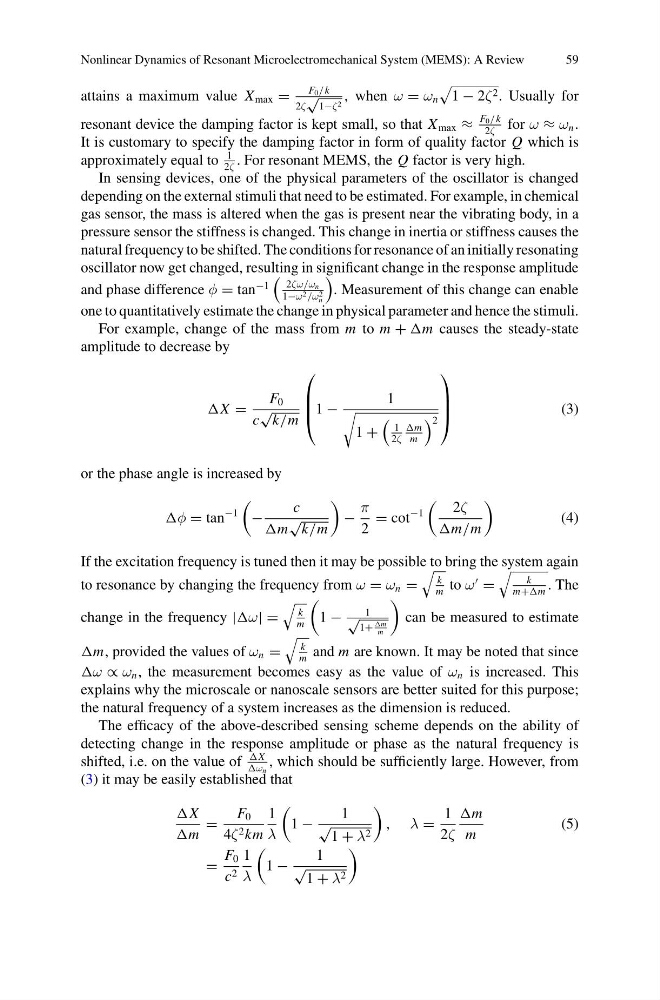
For example, change of the mass from m to m + m causes the steady-state
amplitude to decrease by
X =
F 0
c
√
k/m
⎛
⎜
⎜
⎝ 1 −
1
1 +
1
2ζ
m
m
2
⎞
⎟
⎟
⎠
(3)
or the phase angle is increased by
φ = tan
−1
−
c
m
√
k/m
−
π
2
= cot
−1
2ζ
m/m
(4)
If the excitation frequency is tuned then it may be possible to bring the system again
to resonance by changing the frequency from ω = ω n =
k
m
to ω
=
k
m+m
. The
change in the frequency |ω| =
k
m
1 −
1
√
1+
m
m
can be measured to estimate
m, provided the values of ω n =
k
m
and m are known. It may be noted that since
ω ∝ ω n , the measurement becomes easy as the value of ω n is increased. This
explains why the microscale or nanoscale sensors are better suited for this purpose;
the natural frequency of a system increases as the dimension is reduced.
The efficacy of the above-described sensing scheme depends on the ability of
detecting change in the response amplitude or phase as the natural frequency is
shifted, i.e. on the value of
X
ω n
, which should be sufficiently large. However, from
(3) it may be easily established that
X
m
=
F 0
4ζ 2 km
1
λ
1 −
1
√
1 + λ 2
, λ =
1
2ζ
m
m
(5)
=
F 0
c 2
1
λ
1 −
1
√
1 + λ 2
59
attains a maximum value X max =
F 0 /k
2ζ
√
1−ζ 2
, when ω = ω n
1 − 2ζ 2 . Usually for
resonant device the damping factor is kept small, so that X max ≈
F 0 /k
2ζ
for ω ≈ ω n .
It is customary to specify the damping factor in form of quality factor Q which is
approximately equal to
1
2ζ
. For resonant MEMS, the Q factor is very high.
In sensing devices, one of the physical parameters of the oscillator is changed
depending on the external stimuli that need to be estimated. For example, in chemical
gas sensor, the mass is altered when the gas is present near the vibrating body, in a
pressure sensor the stiffness is changed. This change in inertia or stiffness causes the
natural frequency to be shifted. The conditions for resonance of an initially resonating
oscillator now get changed, resulting in significant change in the response amplitude
and phase difference φ = tan
−1
2ζω/ω n
1−ω 2 /ω 2
n
. Measurement of this change can enable
one to quantitatively estimate the change in physical parameter and hence the stimuli.
For example, change of the mass from m to m + m causes the steady-state
amplitude to decrease by
X =
F 0
c
√
k/m
⎛
⎜
⎜
⎝ 1 −
1
1 +
1
2ζ
m
m
2
⎞
⎟
⎟
⎠
(3)
or the phase angle is increased by
φ = tan
−1
−
c
m
√
k/m
−
π
2
= cot
−1
2ζ
m/m
(4)
If the excitation frequency is tuned then it may be possible to bring the system again
to resonance by changing the frequency from ω = ω n =
k
m
to ω
=
k
m+m
. The
change in the frequency |ω| =
k
m
1 −
1
√
1+
m
m
can be measured to estimate
m, provided the values of ω n =
k
m
and m are known. It may be noted that since
ω ∝ ω n , the measurement becomes easy as the value of ω n is increased. This
explains why the microscale or nanoscale sensors are better suited for this purpose;
the natural frequency of a system increases as the dimension is reduced.
The efficacy of the above-described sensing scheme depends on the ability of
detecting change in the response amplitude or phase as the natural frequency is
shifted, i.e. on the value of
X
ω n
, which should be sufficiently large. However, from
(3) it may be easily established that
X
m
=
F 0
4ζ 2 km
1
λ
1 −
1
√
1 + λ 2
, λ =
1
2ζ
m
m
(5)
=
F 0
c 2
1
λ
1 −
1
√
1 + λ 2