

32
G. K. Ananthasuresh
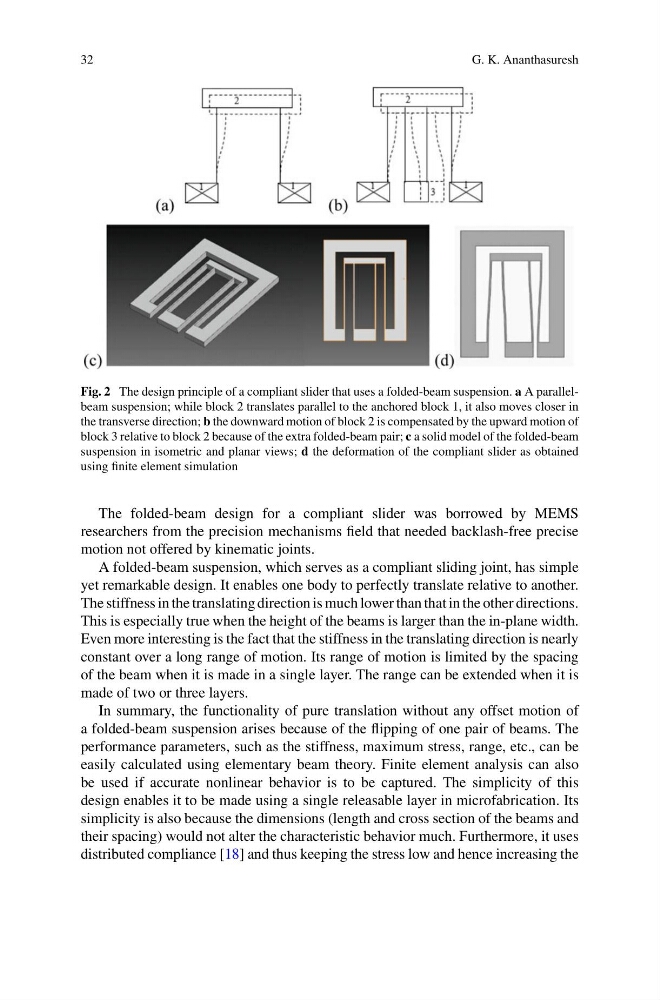
Fig. 2 The design principle of a compliant slider that uses a folded-beam suspension. a A parallelbeam suspension; while block 2 translates parallel to the anchored block 1, it also moves closer in
the transverse direction; b the downward motion of block 2 is compensated by the upward motion of
block 3 relative to block 2 because of the extra folded-beam pair; c a solid model of the folded-beam
suspension in isometric and planar views; d the deformation of the compliant slider as obtained
using finite element simulation
The folded-beam design for a compliant slider was borrowed by MEMS
researchers from the precision mechanisms field that needed backlash-free precise
motion not offered by kinematic joints.
A folded-beam suspension, which serves as a compliant sliding joint, has simple
yet remarkable design. It enables one body to perfectly translate relative to another.
The stiffness in the translating direction is much lower than that in the other directions.
This is especially true when the height of the beams is larger than the in-plane width.
Even more interesting is the fact that the stiffness in the translating direction is nearly
constant over a long range of motion. Its range of motion is limited by the spacing
of the beam when it is made in a single layer. The range can be extended when it is
made of two or three layers.
In summary, the functionality of pure translation without any offset motion of
a folded-beam suspension arises because of the flipping of one pair of beams. The
performance parameters, such as the stiffness, maximum stress, range, etc., can be
easily calculated using elementary beam theory. Finite element analysis can also
be used if accurate nonlinear behavior is to be captured. The simplicity of this
design enables it to be made using a single releasable layer in microfabrication. Its
simplicity is also because the dimensions (length and cross section of the beams and
their spacing) would not alter the characteristic behavior much. Furthermore, it uses
distributed compliance [18] and thus keeping the stress low and hence increasing the
G. K. Ananthasuresh
Fig. 2 The design principle of a compliant slider that uses a folded-beam suspension. a A parallelbeam suspension; while block 2 translates parallel to the anchored block 1, it also moves closer in
the transverse direction; b the downward motion of block 2 is compensated by the upward motion of
block 3 relative to block 2 because of the extra folded-beam pair; c a solid model of the folded-beam
suspension in isometric and planar views; d the deformation of the compliant slider as obtained
using finite element simulation
The folded-beam design for a compliant slider was borrowed by MEMS
researchers from the precision mechanisms field that needed backlash-free precise
motion not offered by kinematic joints.
A folded-beam suspension, which serves as a compliant sliding joint, has simple
yet remarkable design. It enables one body to perfectly translate relative to another.
The stiffness in the translating direction is much lower than that in the other directions.
This is especially true when the height of the beams is larger than the in-plane width.
Even more interesting is the fact that the stiffness in the translating direction is nearly
constant over a long range of motion. Its range of motion is limited by the spacing
of the beam when it is made in a single layer. The range can be extended when it is
made of two or three layers.
In summary, the functionality of pure translation without any offset motion of
a folded-beam suspension arises because of the flipping of one pair of beams. The
performance parameters, such as the stiffness, maximum stress, range, etc., can be
easily calculated using elementary beam theory. Finite element analysis can also
be used if accurate nonlinear behavior is to be captured. The simplicity of this
design enables it to be made using a single releasable layer in microfabrication. Its
simplicity is also because the dimensions (length and cross section of the beams and
their spacing) would not alter the characteristic behavior much. Furthermore, it uses
distributed compliance [18] and thus keeping the stress low and hence increasing the