

30
G. K. Ananthasuresh
in MEMS are so clever that there were no such designs before in other disciplines.
Some, of course, were taken from other disciplines to fulfill a need in MEMS. In this
chapter, we consider a few good designs of both kinds. As we examine them, it might
reinforce the idea that design is mostly an art. But that is not entirely true. There are
systematic methods to obtain novel designs that are elusive to human designers [2].
And there are logical extensions of elegant concepts that point to new designs. It
is thus important to notice the characteristics of good designs. Therefore, several
mechanical designs used in MEMS are presented with an eye toward nine indicative
attributes of good designs:
Simplicity
Ease of making
Generality
The “wow” factor
Optimality
Economy
Ubiquity
Modularity
Hierarchy
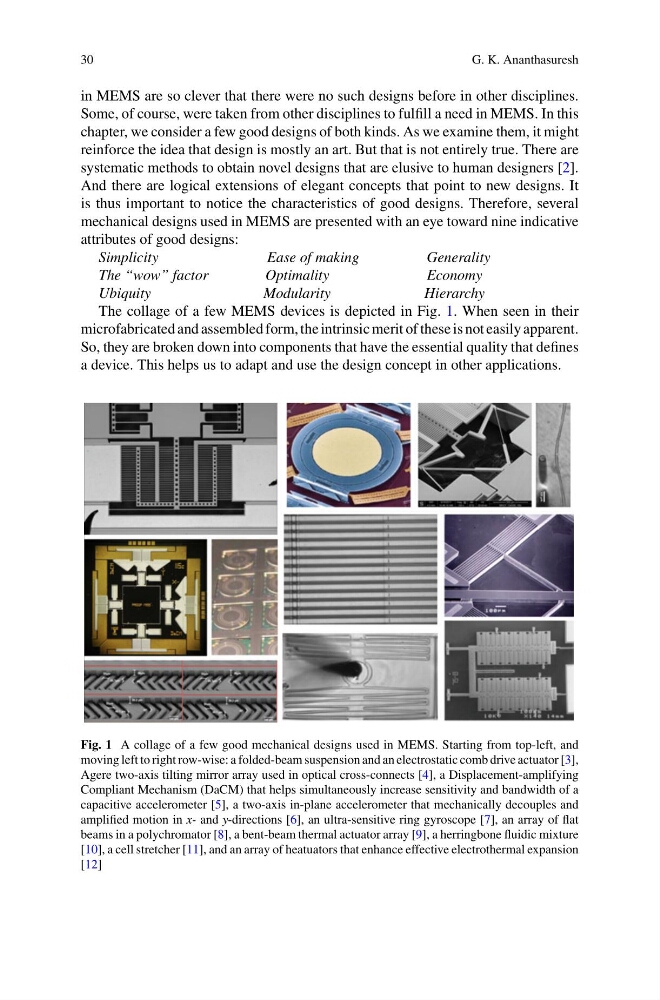
The collage of a few MEMS devices is depicted in Fig. 1. When seen in their
microfabricated and assembled form, the intrinsic merit of these is not easily apparent.
So, they are broken down into components that have the essential quality that defines
a device. This helps us to adapt and use the design concept in other applications.
Fig. 1 A collage of a few good mechanical designs used in MEMS. Starting from top-left, and
moving left to right row-wise: a folded-beam suspension and an electrostatic comb drive actuator [3],
Agere two-axis tilting mirror array used in optical cross-connects [4], a Displacement-amplifying
Compliant Mechanism (DaCM) that helps simultaneously increase sensitivity and bandwidth of a
capacitive accelerometer [5], a two-axis in-plane accelerometer that mechanically decouples and
amplified motion in x- and y-directions [6], an ultra-sensitive ring gyroscope [7], an array of flat
beams in a polychromator [8], a bent-beam thermal actuator array [9], a herringbone fluidic mixture
[10], a cell stretcher [11], and an array of heatuators that enhance effective electrothermal expansion
[12]
G. K. Ananthasuresh
in MEMS are so clever that there were no such designs before in other disciplines.
Some, of course, were taken from other disciplines to fulfill a need in MEMS. In this
chapter, we consider a few good designs of both kinds. As we examine them, it might
reinforce the idea that design is mostly an art. But that is not entirely true. There are
systematic methods to obtain novel designs that are elusive to human designers [2].
And there are logical extensions of elegant concepts that point to new designs. It
is thus important to notice the characteristics of good designs. Therefore, several
mechanical designs used in MEMS are presented with an eye toward nine indicative
attributes of good designs:
Simplicity
Ease of making
Generality
The “wow” factor
Optimality
Economy
Ubiquity
Modularity
Hierarchy
The collage of a few MEMS devices is depicted in Fig. 1. When seen in their
microfabricated and assembled form, the intrinsic merit of these is not easily apparent.
So, they are broken down into components that have the essential quality that defines
a device. This helps us to adapt and use the design concept in other applications.
Fig. 1 A collage of a few good mechanical designs used in MEMS. Starting from top-left, and
moving left to right row-wise: a folded-beam suspension and an electrostatic comb drive actuator [3],
Agere two-axis tilting mirror array used in optical cross-connects [4], a Displacement-amplifying
Compliant Mechanism (DaCM) that helps simultaneously increase sensitivity and bandwidth of a
capacitive accelerometer [5], a two-axis in-plane accelerometer that mechanically decouples and
amplified motion in x- and y-directions [6], an ultra-sensitive ring gyroscope [7], an array of flat
beams in a polychromator [8], a bent-beam thermal actuator array [9], a herringbone fluidic mixture
[10], a cell stretcher [11], and an array of heatuators that enhance effective electrothermal expansion
[12]