

262
J. Mazumder
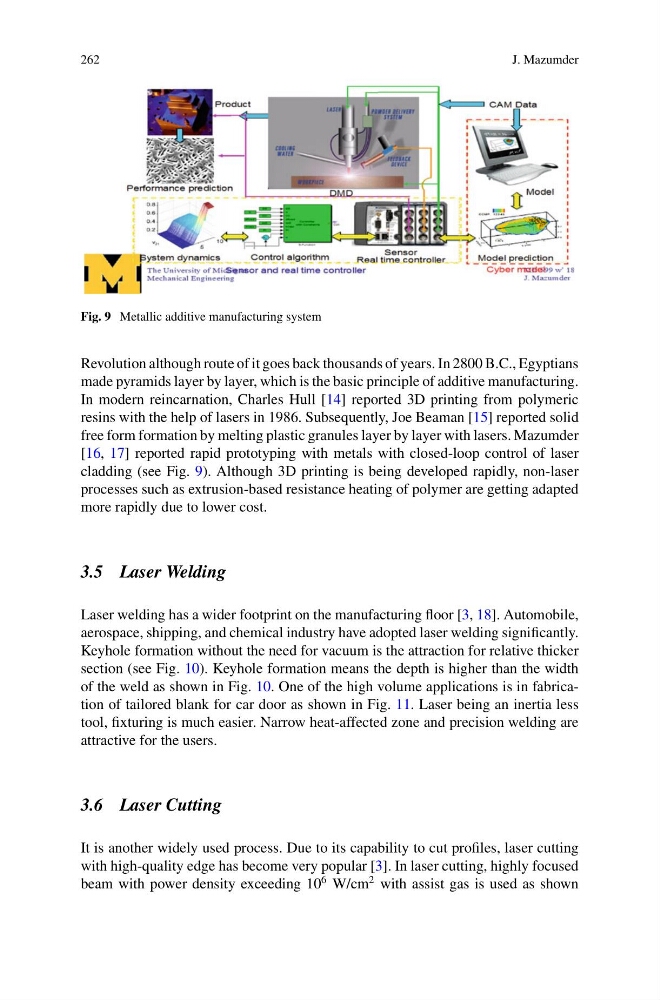
Fig. 9 Metallic additive manufacturing system
Revolution although route of it goes back thousands of years. In 2800 B.C., Egyptians
made pyramids layer by layer, which is the basic principle of additive manufacturing.
In modern reincarnation, Charles Hull [14] reported 3D printing from polymeric
resins with the help of lasers in 1986. Subsequently, Joe Beaman [15] reported solid
free form formation by melting plastic granules layer by layer with lasers. Mazumder
[16, 17] reported rapid prototyping with metals with closed-loop control of laser
cladding (see Fig. 9). Although 3D printing is being developed rapidly, non-laser
processes such as extrusion-based resistance heating of polymer are getting adapted
more rapidly due to lower cost.
3.5 Laser Welding
Laser welding has a wider footprint on the manufacturing floor [3, 18]. Automobile,
aerospace, shipping, and chemical industry have adopted laser welding significantly.
Keyhole formation without the need for vacuum is the attraction for relative thicker
section (see Fig. 10). Keyhole formation means the depth is higher than the width
of the weld as shown in Fig. 10. One of the high volume applications is in fabrication of tailored blank for car door as shown in Fig. 11. Laser being an inertia less
tool, fixturing is much easier. Narrow heat-affected zone and precision welding are
attractive for the users.
3.6 Laser Cutting
It is another widely used process. Due to its capability to cut profiles, laser cutting
with high-quality edge has become very popular [3]. In laser cutting, highly focused
beam with power density exceeding 10
6 W/cm
2 with assist gas is used as shown
J. Mazumder
Fig. 9 Metallic additive manufacturing system
Revolution although route of it goes back thousands of years. In 2800 B.C., Egyptians
made pyramids layer by layer, which is the basic principle of additive manufacturing.
In modern reincarnation, Charles Hull [14] reported 3D printing from polymeric
resins with the help of lasers in 1986. Subsequently, Joe Beaman [15] reported solid
free form formation by melting plastic granules layer by layer with lasers. Mazumder
[16, 17] reported rapid prototyping with metals with closed-loop control of laser
cladding (see Fig. 9). Although 3D printing is being developed rapidly, non-laser
processes such as extrusion-based resistance heating of polymer are getting adapted
more rapidly due to lower cost.
3.5 Laser Welding
Laser welding has a wider footprint on the manufacturing floor [3, 18]. Automobile,
aerospace, shipping, and chemical industry have adopted laser welding significantly.
Keyhole formation without the need for vacuum is the attraction for relative thicker
section (see Fig. 10). Keyhole formation means the depth is higher than the width
of the weld as shown in Fig. 10. One of the high volume applications is in fabrication of tailored blank for car door as shown in Fig. 11. Laser being an inertia less
tool, fixturing is much easier. Narrow heat-affected zone and precision welding are
attractive for the users.
3.6 Laser Cutting
It is another widely used process. Due to its capability to cut profiles, laser cutting
with high-quality edge has become very popular [3]. In laser cutting, highly focused
beam with power density exceeding 10
6 W/cm
2 with assist gas is used as shown