

260
J. Mazumder
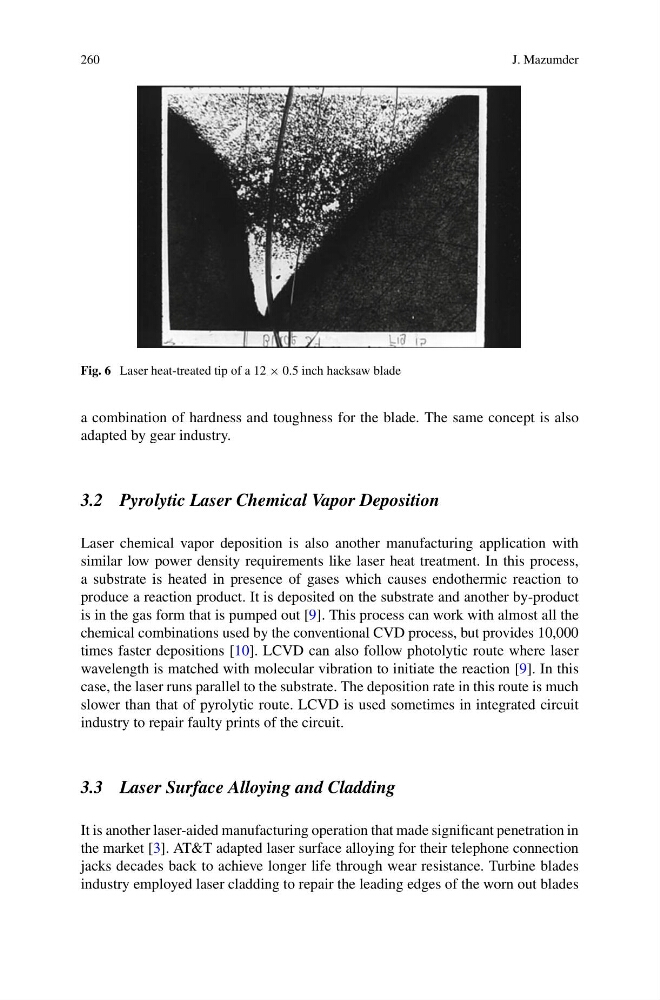
Fig. 6 Laser heat-treated tip of a 12 × 0.5 inch hacksaw blade
a combination of hardness and toughness for the blade. The same concept is also
adapted by gear industry.
3.2 Pyrolytic Laser Chemical Vapor Deposition
Laser chemical vapor deposition is also another manufacturing application with
similar low power density requirements like laser heat treatment. In this process,
a substrate is heated in presence of gases which causes endothermic reaction to
produce a reaction product. It is deposited on the substrate and another by-product
is in the gas form that is pumped out [9]. This process can work with almost all the
chemical combinations used by the conventional CVD process, but provides 10,000
times faster depositions [10]. LCVD can also follow photolytic route where laser
wavelength is matched with molecular vibration to initiate the reaction [9]. In this
case, the laser runs parallel to the substrate. The deposition rate in this route is much
slower than that of pyrolytic route. LCVD is used sometimes in integrated circuit
industry to repair faulty prints of the circuit.
3.3 Laser Surface Alloying and Cladding
It is another laser-aided manufacturing operation that made significant penetration in
the market [3]. AT&T adapted laser surface alloying for their telephone connection
jacks decades back to achieve longer life through wear resistance. Turbine blades
industry employed laser cladding to repair the leading edges of the worn out blades
J. Mazumder
Fig. 6 Laser heat-treated tip of a 12 × 0.5 inch hacksaw blade
a combination of hardness and toughness for the blade. The same concept is also
adapted by gear industry.
3.2 Pyrolytic Laser Chemical Vapor Deposition
Laser chemical vapor deposition is also another manufacturing application with
similar low power density requirements like laser heat treatment. In this process,
a substrate is heated in presence of gases which causes endothermic reaction to
produce a reaction product. It is deposited on the substrate and another by-product
is in the gas form that is pumped out [9]. This process can work with almost all the
chemical combinations used by the conventional CVD process, but provides 10,000
times faster depositions [10]. LCVD can also follow photolytic route where laser
wavelength is matched with molecular vibration to initiate the reaction [9]. In this
case, the laser runs parallel to the substrate. The deposition rate in this route is much
slower than that of pyrolytic route. LCVD is used sometimes in integrated circuit
industry to repair faulty prints of the circuit.
3.3 Laser Surface Alloying and Cladding
It is another laser-aided manufacturing operation that made significant penetration in
the market [3]. AT&T adapted laser surface alloying for their telephone connection
jacks decades back to achieve longer life through wear resistance. Turbine blades
industry employed laser cladding to repair the leading edges of the worn out blades