

258
J. Mazumder
Table 2 Laser power density
versus different
manufacturing processes.
LCVD stands for Laser
Chemical Vapor Deposition
Power intensity
(W/cm 2 )
Stage of heating Associated
processes
<10 5
Thermal
conduction
Transformation
hard, bending,
LCVD
10 5
Melting
Welding, cladding
10 6
Vaporization
Cutting, drilling
10 7
Plasma
production
Cleaning, shock
hardening
10 9
Solid-state
plasma
Shock hardening
>10 9
Atomic fusion
Femto second
processes
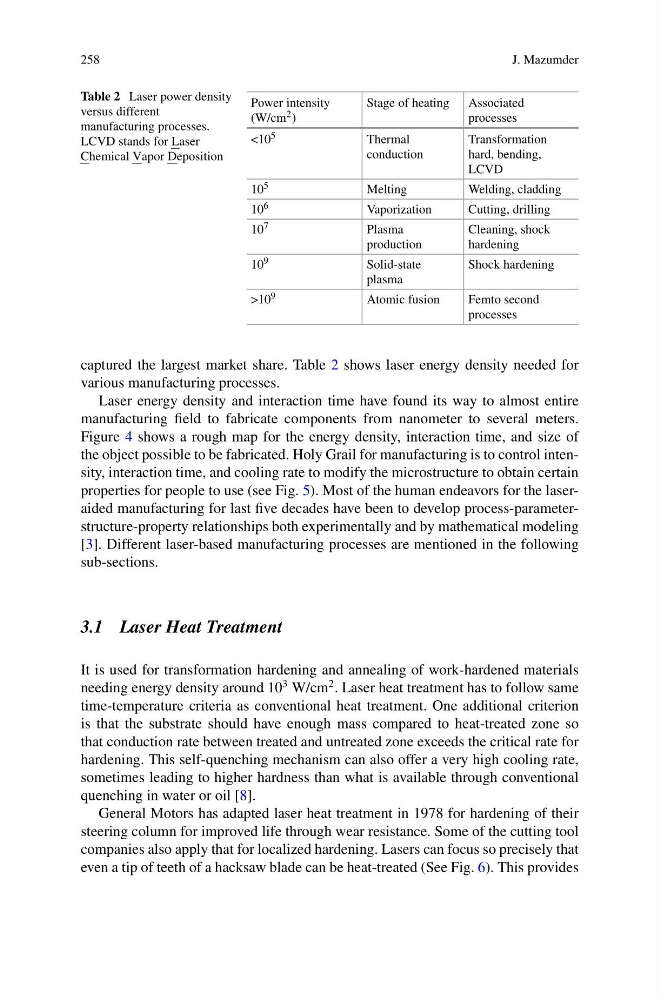
captured the largest market share. Table 2 shows laser energy density needed for
various manufacturing processes.
Laser energy density and interaction time have found its way to almost entire
manufacturing field to fabricate components from nanometer to several meters.
Figure 4 shows a rough map for the energy density, interaction time, and size of
the object possible to be fabricated. Holy Grail for manufacturing is to control intensity, interaction time, and cooling rate to modify the microstructure to obtain certain
properties for people to use (see Fig. 5). Most of the human endeavors for the laseraided manufacturing for last five decades have been to develop process-parameterstructure-property relationships both experimentally and by mathematical modeling
[3]. Different laser-based manufacturing processes are mentioned in the following
sub-sections.
3.1 Laser Heat Treatment
It is used for transformation hardening and annealing of work-hardened materials
needing energy density around 10
3 W/cm
2 . Laser heat treatment has to follow same
time-temperature criteria as conventional heat treatment. One additional criterion
is that the substrate should have enough mass compared to heat-treated zone so
that conduction rate between treated and untreated zone exceeds the critical rate for
hardening. This self-quenching mechanism can also offer a very high cooling rate,
sometimes leading to higher hardness than what is available through conventional
quenching in water or oil [8].
General Motors has adapted laser heat treatment in 1978 for hardening of their
steering column for improved life through wear resistance. Some of the cutting tool
companies also apply that for localized hardening. Lasers can focus so precisely that
even a tip of teeth of a hacksaw blade can be heat-treated (See Fig. 6). This provides
J. Mazumder
Table 2 Laser power density
versus different
manufacturing processes.
LCVD stands for Laser
Chemical Vapor Deposition
Power intensity
(W/cm 2 )
Stage of heating Associated
processes
<10 5
Thermal
conduction
Transformation
hard, bending,
LCVD
10 5
Melting
Welding, cladding
10 6
Vaporization
Cutting, drilling
10 7
Plasma
production
Cleaning, shock
hardening
10 9
Solid-state
plasma
Shock hardening
>10 9
Atomic fusion
Femto second
processes
captured the largest market share. Table 2 shows laser energy density needed for
various manufacturing processes.
Laser energy density and interaction time have found its way to almost entire
manufacturing field to fabricate components from nanometer to several meters.
Figure 4 shows a rough map for the energy density, interaction time, and size of
the object possible to be fabricated. Holy Grail for manufacturing is to control intensity, interaction time, and cooling rate to modify the microstructure to obtain certain
properties for people to use (see Fig. 5). Most of the human endeavors for the laseraided manufacturing for last five decades have been to develop process-parameterstructure-property relationships both experimentally and by mathematical modeling
[3]. Different laser-based manufacturing processes are mentioned in the following
sub-sections.
3.1 Laser Heat Treatment
It is used for transformation hardening and annealing of work-hardened materials
needing energy density around 10
3 W/cm
2 . Laser heat treatment has to follow same
time-temperature criteria as conventional heat treatment. One additional criterion
is that the substrate should have enough mass compared to heat-treated zone so
that conduction rate between treated and untreated zone exceeds the critical rate for
hardening. This self-quenching mechanism can also offer a very high cooling rate,
sometimes leading to higher hardness than what is available through conventional
quenching in water or oil [8].
General Motors has adapted laser heat treatment in 1978 for hardening of their
steering column for improved life through wear resistance. Some of the cutting tool
companies also apply that for localized hardening. Lasers can focus so precisely that
even a tip of teeth of a hacksaw blade can be heat-treated (See Fig. 6). This provides