

Origami MEMS
217
Swelling-based
Residual stress-based
LCE-based
Shape memory-based
Release
Solvent
exchange
Heating
Exposure
Origami by
photopolymerization
(Zhao et al., 2016)
Solvent transfer in differentially
crosslinked polymers
(Jamal et al., 2013)
Folding by local field gradient
(Lu et al., 2018)
Folding or unfolding by heating
(Yu et al., 2015)
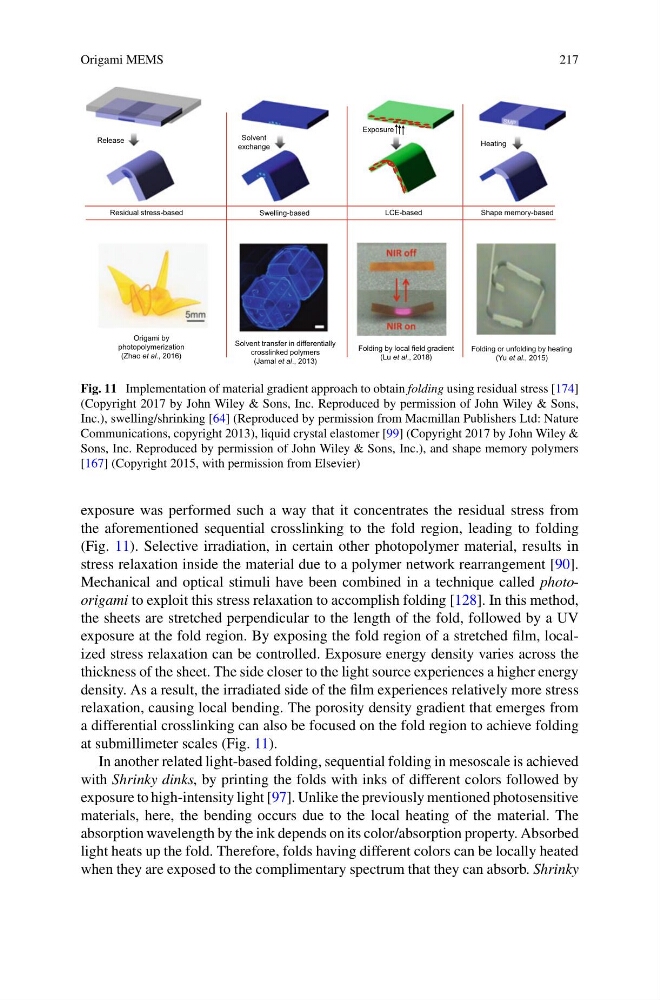
Fig. 11 Implementation of material gradient approach to obtain folding using residual stress [174]
(Copyright 2017 by John Wiley & Sons, Inc. Reproduced by permission of John Wiley & Sons,
Inc.), swelling/shrinking [64] (Reproduced by permission from Macmillan Publishers Ltd: Nature
Communications, copyright 2013), liquid crystal elastomer [99] (Copyright 2017 by John Wiley &
Sons, Inc. Reproduced by permission of John Wiley & Sons, Inc.), and shape memory polymers
[167] (Copyright 2015, with permission from Elsevier)
exposure was performed such a way that it concentrates the residual stress from
the aforementioned sequential crosslinking to the fold region, leading to folding
(Fig. 11). Selective irradiation, in certain other photopolymer material, results in
stress relaxation inside the material due to a polymer network rearrangement [90].
Mechanical and optical stimuli have been combined in a technique called photoorigami to exploit this stress relaxation to accomplish folding [128]. In this method,
the sheets are stretched perpendicular to the length of the fold, followed by a UV
exposure at the fold region. By exposing the fold region of a stretched film, localized stress relaxation can be controlled. Exposure energy density varies across the
thickness of the sheet. The side closer to the light source experiences a higher energy
density. As a result, the irradiated side of the film experiences relatively more stress
relaxation, causing local bending. The porosity density gradient that emerges from
a differential crosslinking can also be focused on the fold region to achieve folding
at submillimeter scales (Fig. 11).
In another related light-based folding, sequential folding in mesoscale is achieved
with Shrinky dinks, by printing the folds with inks of different colors followed by
exposure to high-intensity light [97]. Unlike the previously mentioned photosensitive
materials, here, the bending occurs due to the local heating of the material. The
absorption wavelength by the ink depends on its color/absorption property. Absorbed
light heats up the fold. Therefore, folds having different colors can be locally heated
when they are exposed to the complimentary spectrum that they can absorb. Shrinky
217
Swelling-based
Residual stress-based
LCE-based
Shape memory-based
Release
Solvent
exchange
Heating
Exposure
Origami by
photopolymerization
(Zhao et al., 2016)
Solvent transfer in differentially
crosslinked polymers
(Jamal et al., 2013)
Folding by local field gradient
(Lu et al., 2018)
Folding or unfolding by heating
(Yu et al., 2015)
Fig. 11 Implementation of material gradient approach to obtain folding using residual stress [174]
(Copyright 2017 by John Wiley & Sons, Inc. Reproduced by permission of John Wiley & Sons,
Inc.), swelling/shrinking [64] (Reproduced by permission from Macmillan Publishers Ltd: Nature
Communications, copyright 2013), liquid crystal elastomer [99] (Copyright 2017 by John Wiley &
Sons, Inc. Reproduced by permission of John Wiley & Sons, Inc.), and shape memory polymers
[167] (Copyright 2015, with permission from Elsevier)
exposure was performed such a way that it concentrates the residual stress from
the aforementioned sequential crosslinking to the fold region, leading to folding
(Fig. 11). Selective irradiation, in certain other photopolymer material, results in
stress relaxation inside the material due to a polymer network rearrangement [90].
Mechanical and optical stimuli have been combined in a technique called photoorigami to exploit this stress relaxation to accomplish folding [128]. In this method,
the sheets are stretched perpendicular to the length of the fold, followed by a UV
exposure at the fold region. By exposing the fold region of a stretched film, localized stress relaxation can be controlled. Exposure energy density varies across the
thickness of the sheet. The side closer to the light source experiences a higher energy
density. As a result, the irradiated side of the film experiences relatively more stress
relaxation, causing local bending. The porosity density gradient that emerges from
a differential crosslinking can also be focused on the fold region to achieve folding
at submillimeter scales (Fig. 11).
In another related light-based folding, sequential folding in mesoscale is achieved
with Shrinky dinks, by printing the folds with inks of different colors followed by
exposure to high-intensity light [97]. Unlike the previously mentioned photosensitive
materials, here, the bending occurs due to the local heating of the material. The
absorption wavelength by the ink depends on its color/absorption property. Absorbed
light heats up the fold. Therefore, folds having different colors can be locally heated
when they are exposed to the complimentary spectrum that they can absorb. Shrinky