

Origami MEMS
215
Temporary property gradient
Permanent property gradient
External field
gradient
External field-driven
Residual stress-based
Swelling-based
Release
Solvent
exchange
Heating
Shape memory-based
LCE exposed to UV
(Wang et al., 2016)
Origami by
photopolymerization
(Zhao et al., 2016)
Solvent transfer in differentially
crosslinked polymers
(Jamal et al., 2013)
Shape memory polymer
bending
(Behl et al., 2013)
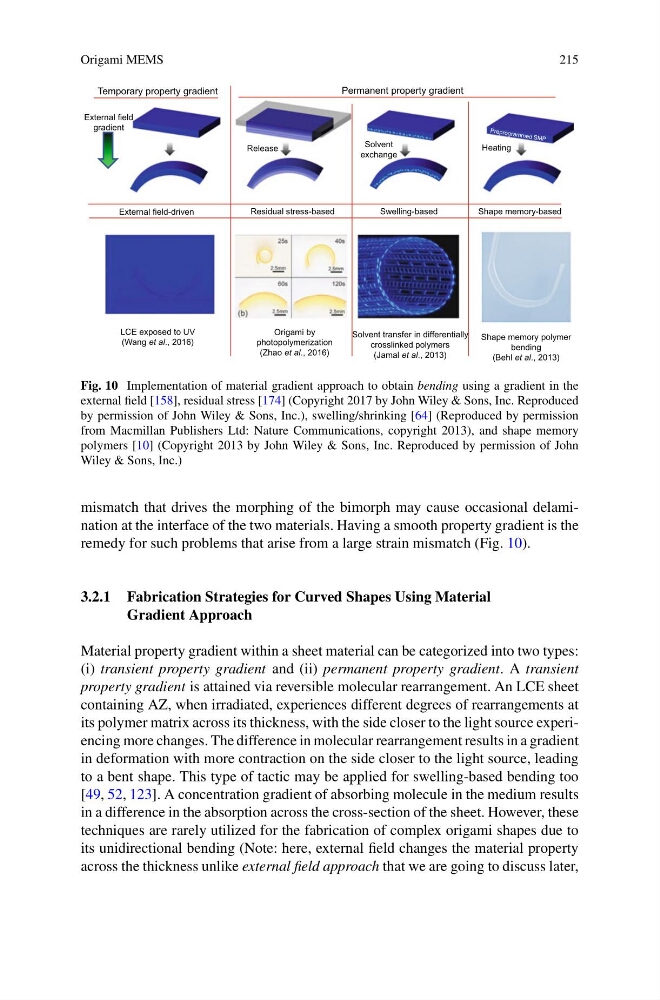
Fig. 10 Implementation of material gradient approach to obtain bending using a gradient in the
external field [158], residual stress [174] (Copyright 2017 by John Wiley & Sons, Inc. Reproduced
by permission of John Wiley & Sons, Inc.), swelling/shrinking [64] (Reproduced by permission
from Macmillan Publishers Ltd: Nature Communications, copyright 2013), and shape memory
polymers [10] (Copyright 2013 by John Wiley & Sons, Inc. Reproduced by permission of John
Wiley & Sons, Inc.)
mismatch that drives the morphing of the bimorph may cause occasional delamination at the interface of the two materials. Having a smooth property gradient is the
remedy for such problems that arise from a large strain mismatch (Fig. 10).
3.2.1 Fabrication Strategies for Curved Shapes Using Material
Gradient Approach
Material property gradient within a sheet material can be categorized into two types:
(i) transient property gradient and (ii) permanent property gradient. A transient
property gradient is attained via reversible molecular rearrangement. An LCE sheet
containing AZ, when irradiated, experiences different degrees of rearrangements at
its polymer matrix across its thickness, with the side closer to the light source experiencing more changes. The difference in molecular rearrangement results in a gradient
in deformation with more contraction on the side closer to the light source, leading
to a bent shape. This type of tactic may be applied for swelling-based bending too
[49, 52, 123]. A concentration gradient of absorbing molecule in the medium results
in a difference in the absorption across the cross-section of the sheet. However, these
techniques are rarely utilized for the fabrication of complex origami shapes due to
its unidirectional bending (Note: here, external field changes the material property
across the thickness unlike external field approach that we are going to discuss later,
215
Temporary property gradient
Permanent property gradient
External field
gradient
External field-driven
Residual stress-based
Swelling-based
Release
Solvent
exchange
Heating
Shape memory-based
LCE exposed to UV
(Wang et al., 2016)
Origami by
photopolymerization
(Zhao et al., 2016)
Solvent transfer in differentially
crosslinked polymers
(Jamal et al., 2013)
Shape memory polymer
bending
(Behl et al., 2013)
Fig. 10 Implementation of material gradient approach to obtain bending using a gradient in the
external field [158], residual stress [174] (Copyright 2017 by John Wiley & Sons, Inc. Reproduced
by permission of John Wiley & Sons, Inc.), swelling/shrinking [64] (Reproduced by permission
from Macmillan Publishers Ltd: Nature Communications, copyright 2013), and shape memory
polymers [10] (Copyright 2013 by John Wiley & Sons, Inc. Reproduced by permission of John
Wiley & Sons, Inc.)
mismatch that drives the morphing of the bimorph may cause occasional delamination at the interface of the two materials. Having a smooth property gradient is the
remedy for such problems that arise from a large strain mismatch (Fig. 10).
3.2.1 Fabrication Strategies for Curved Shapes Using Material
Gradient Approach
Material property gradient within a sheet material can be categorized into two types:
(i) transient property gradient and (ii) permanent property gradient. A transient
property gradient is attained via reversible molecular rearrangement. An LCE sheet
containing AZ, when irradiated, experiences different degrees of rearrangements at
its polymer matrix across its thickness, with the side closer to the light source experiencing more changes. The difference in molecular rearrangement results in a gradient
in deformation with more contraction on the side closer to the light source, leading
to a bent shape. This type of tactic may be applied for swelling-based bending too
[49, 52, 123]. A concentration gradient of absorbing molecule in the medium results
in a difference in the absorption across the cross-section of the sheet. However, these
techniques are rarely utilized for the fabrication of complex origami shapes due to
its unidirectional bending (Note: here, external field changes the material property
across the thickness unlike external field approach that we are going to discuss later,