

134
G. Biswas and K. C. Sahu
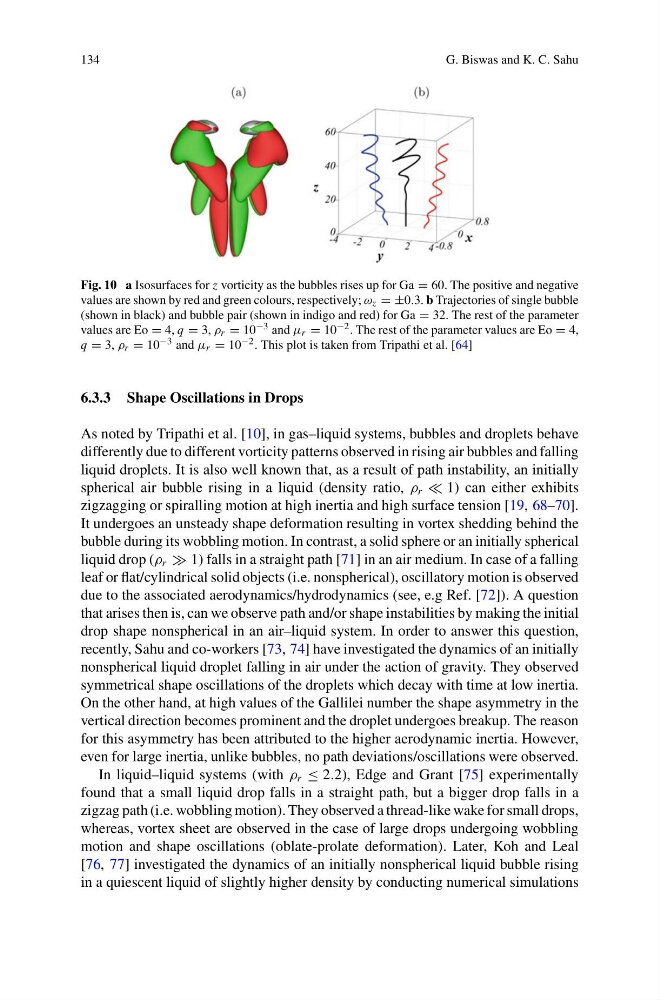
Fig. 10 a Isosurfaces for z vorticity as the bubbles rises up for Ga = 60. The positive and negative
values are shown by red and green colours, respectively; ω z = ±0.3. b Trajectories of single bubble
(shown in black) and bubble pair (shown in indigo and red) for Ga = 32. The rest of the parameter
values are Eo = 4, q = 3, ρ r = 10 −3 and μ r = 10 −2 . The rest of the parameter values are Eo = 4,
q = 3, ρ r = 10 −3 and μ r = 10 −2 . This plot is taken from Tripathi et al. [64]
6.3.3 Shape Oscillations in Drops
As noted by Tripathi et al. [10], in gas–liquid systems, bubbles and droplets behave
differently due to different vorticity patterns observed in rising air bubbles and falling
liquid droplets. It is also well known that, as a result of path instability, an initially
spherical air bubble rising in a liquid (density ratio, ρ r 1) can either exhibits
zigzagging or spiralling motion at high inertia and high surface tension [19, 68–70].
It undergoes an unsteady shape deformation resulting in vortex shedding behind the
bubble during its wobbling motion. In contrast, a solid sphere or an initially spherical
liquid drop (ρ r 1) falls in a straight path [71] in an air medium. In case of a falling
leaf or flat/cylindrical solid objects (i.e. nonspherical), oscillatory motion is observed
due to the associated aerodynamics/hydrodynamics (see, e.g Ref. [72]). A question
that arises then is, can we observe path and/or shape instabilities by making the initial
drop shape nonspherical in an air–liquid system. In order to answer this question,
recently, Sahu and co-workers [73, 74] have investigated the dynamics of an initially
nonspherical liquid droplet falling in air under the action of gravity. They observed
symmetrical shape oscillations of the droplets which decay with time at low inertia.
On the other hand, at high values of the Gallilei number the shape asymmetry in the
vertical direction becomes prominent and the droplet undergoes breakup. The reason
for this asymmetry has been attributed to the higher aerodynamic inertia. However,
even for large inertia, unlike bubbles, no path deviations/oscillations were observed.
In liquid–liquid systems (with ρ r ≤ 2.2), Edge and Grant [75] experimentally
found that a small liquid drop falls in a straight path, but a bigger drop falls in a
zigzag path (i.e. wobbling motion). They observed a thread-like wake for small drops,
whereas, vortex sheet are observed in the case of large drops undergoing wobbling
motion and shape oscillations (oblate-prolate deformation). Later, Koh and Leal
[76, 77] investigated the dynamics of an initially nonspherical liquid bubble rising
in a quiescent liquid of slightly higher density by conducting numerical simulations
G. Biswas and K. C. Sahu
Fig. 10 a Isosurfaces for z vorticity as the bubbles rises up for Ga = 60. The positive and negative
values are shown by red and green colours, respectively; ω z = ±0.3. b Trajectories of single bubble
(shown in black) and bubble pair (shown in indigo and red) for Ga = 32. The rest of the parameter
values are Eo = 4, q = 3, ρ r = 10 −3 and μ r = 10 −2 . The rest of the parameter values are Eo = 4,
q = 3, ρ r = 10 −3 and μ r = 10 −2 . This plot is taken from Tripathi et al. [64]
6.3.3 Shape Oscillations in Drops
As noted by Tripathi et al. [10], in gas–liquid systems, bubbles and droplets behave
differently due to different vorticity patterns observed in rising air bubbles and falling
liquid droplets. It is also well known that, as a result of path instability, an initially
spherical air bubble rising in a liquid (density ratio, ρ r 1) can either exhibits
zigzagging or spiralling motion at high inertia and high surface tension [19, 68–70].
It undergoes an unsteady shape deformation resulting in vortex shedding behind the
bubble during its wobbling motion. In contrast, a solid sphere or an initially spherical
liquid drop (ρ r 1) falls in a straight path [71] in an air medium. In case of a falling
leaf or flat/cylindrical solid objects (i.e. nonspherical), oscillatory motion is observed
due to the associated aerodynamics/hydrodynamics (see, e.g Ref. [72]). A question
that arises then is, can we observe path and/or shape instabilities by making the initial
drop shape nonspherical in an air–liquid system. In order to answer this question,
recently, Sahu and co-workers [73, 74] have investigated the dynamics of an initially
nonspherical liquid droplet falling in air under the action of gravity. They observed
symmetrical shape oscillations of the droplets which decay with time at low inertia.
On the other hand, at high values of the Gallilei number the shape asymmetry in the
vertical direction becomes prominent and the droplet undergoes breakup. The reason
for this asymmetry has been attributed to the higher aerodynamic inertia. However,
even for large inertia, unlike bubbles, no path deviations/oscillations were observed.
In liquid–liquid systems (with ρ r ≤ 2.2), Edge and Grant [75] experimentally
found that a small liquid drop falls in a straight path, but a bigger drop falls in a
zigzag path (i.e. wobbling motion). They observed a thread-like wake for small drops,
whereas, vortex sheet are observed in the case of large drops undergoing wobbling
motion and shape oscillations (oblate-prolate deformation). Later, Koh and Leal
[76, 77] investigated the dynamics of an initially nonspherical liquid bubble rising
in a quiescent liquid of slightly higher density by conducting numerical simulations