

122
G. Biswas and K. C. Sahu
Refs. [1, 5]). Due to its complexity and rich underlying physics, this topic has been
attracting the attention of many researchers since mid 1800. The interface between
two immiscible liquids can also be treated as free surface.
The objectives of this chapter are to (i) review the numerical and experimental
advances on free surface flows, (ii) highlight the mathematical models and common
numerical techniques used to study interfacial flows and (iii) discuss few examples
of complex phenomena involving free-surface flows. In the next section, we will
discuss about the representation of a free surface mathematically and the associated
boundary conditions at the interface.
2 Mathematical Representation
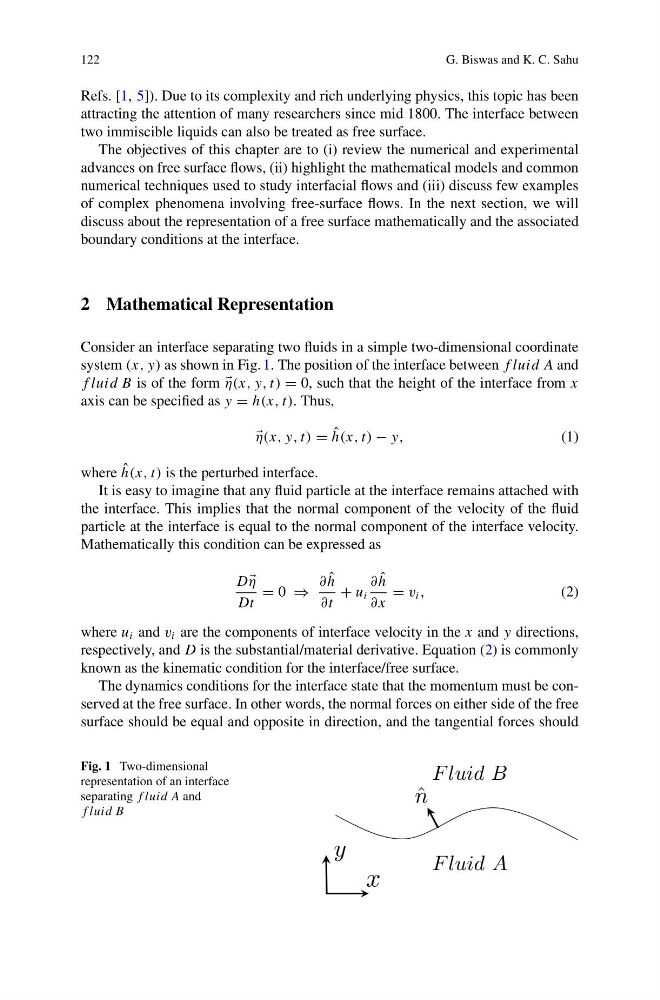
Consider an interface separating two fluids in a simple two-dimensional coordinate
system (x, y) as shown in Fig. 1. The position of the interface between f luid A and
f luid B is of the form
η(x, y, t) = 0, such that the height of the interface from x
axis can be specified as y = h(x, t). Thus,
η(x, y, t) = ˆ
h(x, t) − y,
(1)
where ˆ
h(x, t) is the perturbed interface.
It is easy to imagine that any fluid particle at the interface remains attached with
the interface. This implies that the normal component of the velocity of the fluid
particle at the interface is equal to the normal component of the interface velocity.
Mathematically this condition can be expressed as
D
η
Dt
= 0 ⇒
∂ ˆ
h
∂t
+ u i
∂ ˆ
h
∂ x
= v i ,
(2)
where u i and v i are the components of interface velocity in the x and y directions,
respectively, and D is the substantial/material derivative. Equation (2) is commonly
known as the kinematic condition for the interface/free surface.
The dynamics conditions for the interface state that the momentum must be conserved at the free surface. In other words, the normal forces on either side of the free
surface should be equal and opposite in direction, and the tangential forces should
Fig. 1 Two-dimensional
representation of an interface
separating f luid A and
f luid B
F luid A
F luid B
ˆ
n
x
y
G. Biswas and K. C. Sahu
Refs. [1, 5]). Due to its complexity and rich underlying physics, this topic has been
attracting the attention of many researchers since mid 1800. The interface between
two immiscible liquids can also be treated as free surface.
The objectives of this chapter are to (i) review the numerical and experimental
advances on free surface flows, (ii) highlight the mathematical models and common
numerical techniques used to study interfacial flows and (iii) discuss few examples
of complex phenomena involving free-surface flows. In the next section, we will
discuss about the representation of a free surface mathematically and the associated
boundary conditions at the interface.
2 Mathematical Representation
Consider an interface separating two fluids in a simple two-dimensional coordinate
system (x, y) as shown in Fig. 1. The position of the interface between f luid A and
f luid B is of the form
η(x, y, t) = 0, such that the height of the interface from x
axis can be specified as y = h(x, t). Thus,
η(x, y, t) = ˆ
h(x, t) − y,
(1)
where ˆ
h(x, t) is the perturbed interface.
It is easy to imagine that any fluid particle at the interface remains attached with
the interface. This implies that the normal component of the velocity of the fluid
particle at the interface is equal to the normal component of the interface velocity.
Mathematically this condition can be expressed as
D
η
Dt
= 0 ⇒
∂ ˆ
h
∂t
+ u i
∂ ˆ
h
∂ x
= v i ,
(2)
where u i and v i are the components of interface velocity in the x and y directions,
respectively, and D is the substantial/material derivative. Equation (2) is commonly
known as the kinematic condition for the interface/free surface.
The dynamics conditions for the interface state that the momentum must be conserved at the free surface. In other words, the normal forces on either side of the free
surface should be equal and opposite in direction, and the tangential forces should
Fig. 1 Two-dimensional
representation of an interface
separating f luid A and
f luid B
F luid A
F luid B
ˆ
n
x
y