

Space Elevator—A Revolutionary Space Transportation System
115
where
u L = u(L 0 , t)
(26)
The velocity vectors relative to the inertial frame are given by
v R (s) = [R E Ω sin α + ˙
u − (Ω + ˙
α)v]i + [R E Ω cos α + ˙
v + (Ω + ˙
α)(s + u)]j
(27)
and
v C = [R E Ω sin α + ˙
u L ]i + [R E Ω cos α + (Ω + ˙
α)(L 0 + u L )]j
(28)
The total kinetic energy of the system can then be written as
K = 1/2γ
L 0
0
A(s)[v R (s) · v R (s)]ds +
1
2
m c (v C · v C )
(29)
The total potential energy of the system is given by
P = −μγ
L 0
0
A(s)
√
r R (s) · r R (s)
−
μm c
√ r C · r C
+ P st
(30)
where the strain energy stored in the ribbon, P st , is given by
P st =
1
2
E
L 0
0
A(s)
∂u
∂s
2
+
∂u
∂s
∂v
∂s
2
+
1
2
(
∂v
∂s
2
+
∂u
∂s
2 ∂v
∂s
2
ds (31)
For a system without external excitations, Lagrange’s equations can be written as
d
dt
∂ K
∂ ˙
q i
−
∂ K
∂q i
+
∂ P
∂q i
= 0
( 3 2 )
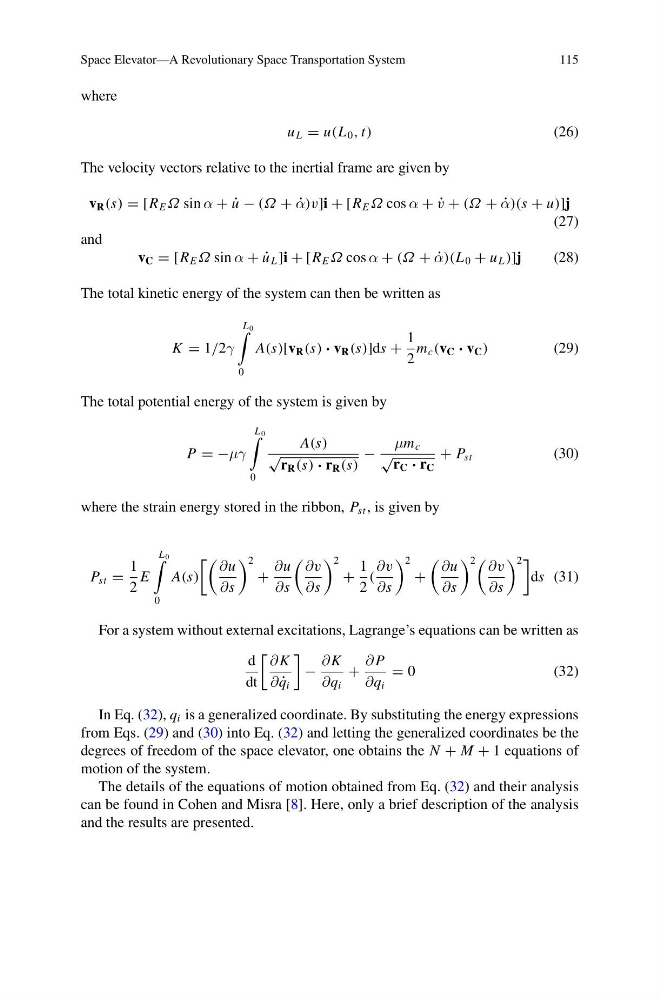
In Eq. (32), q i is a generalized coordinate. By substituting the energy expressions
from Eqs. (29) and (30) into Eq. (32) and letting the generalized coordinates be the
degrees of freedom of the space elevator, one obtains the N + M + 1 equations of
motion of the system.
The details of the equations of motion obtained from Eq. (32) and their analysis
can be found in Cohen and Misra [8]. Here, only a brief description of the analysis
and the results are presented.
115
where
u L = u(L 0 , t)
(26)
The velocity vectors relative to the inertial frame are given by
v R (s) = [R E Ω sin α + ˙
u − (Ω + ˙
α)v]i + [R E Ω cos α + ˙
v + (Ω + ˙
α)(s + u)]j
(27)
and
v C = [R E Ω sin α + ˙
u L ]i + [R E Ω cos α + (Ω + ˙
α)(L 0 + u L )]j
(28)
The total kinetic energy of the system can then be written as
K = 1/2γ
L 0
0
A(s)[v R (s) · v R (s)]ds +
1
2
m c (v C · v C )
(29)
The total potential energy of the system is given by
P = −μγ
L 0
0
A(s)
√
r R (s) · r R (s)
−
μm c
√ r C · r C
+ P st
(30)
where the strain energy stored in the ribbon, P st , is given by
P st =
1
2
E
L 0
0
A(s)
∂u
∂s
2
+
∂u
∂s
∂v
∂s
2
+
1
2
(
∂v
∂s
2
+
∂u
∂s
2 ∂v
∂s
2
ds (31)
For a system without external excitations, Lagrange’s equations can be written as
d
dt
∂ K
∂ ˙
q i
−
∂ K
∂q i
+
∂ P
∂q i
= 0
( 3 2 )
In Eq. (32), q i is a generalized coordinate. By substituting the energy expressions
from Eqs. (29) and (30) into Eq. (32) and letting the generalized coordinates be the
degrees of freedom of the space elevator, one obtains the N + M + 1 equations of
motion of the system.
The details of the equations of motion obtained from Eq. (32) and their analysis
can be found in Cohen and Misra [8]. Here, only a brief description of the analysis
and the results are presented.