

102
C. Ozoegwu and P. Eberhard
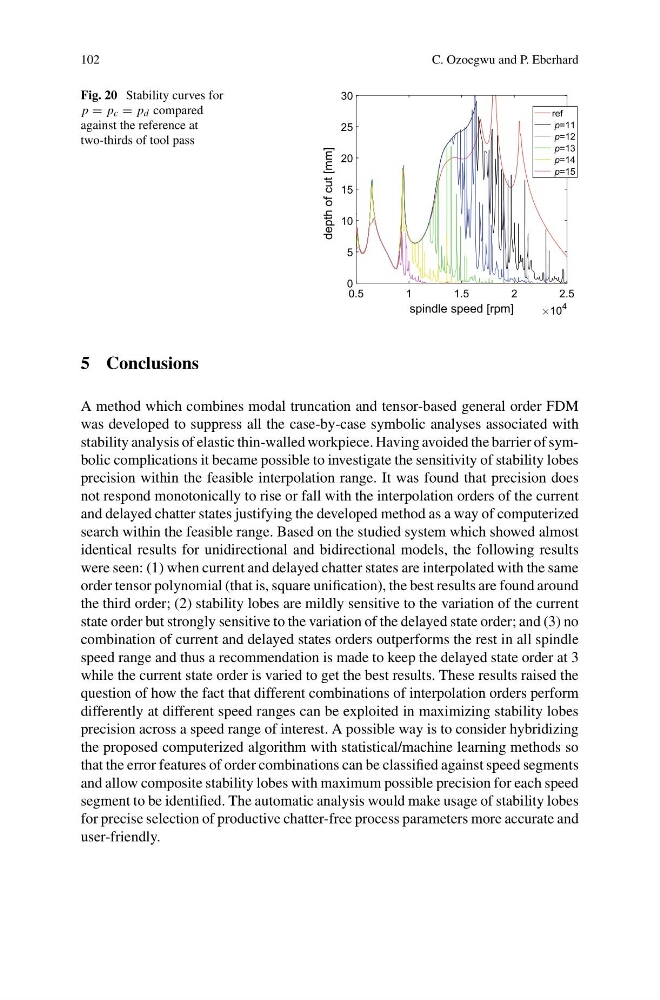
Fig. 20 Stability curves for
p = p c = p d compared
against the reference at
two-thirds of tool pass
0.5
1
1.5
2
2.5
spindle speed [rpm]
10
4
0
5
10
15
20
25
30
depth of cut [mm]
ref
p=11
p=12
p=13
p=14
p=15
5 Conclusions
A method which combines modal truncation and tensor-based general order FDM
was developed to suppress all the case-by-case symbolic analyses associated with
stability analysis of elastic thin-walled workpiece. Having avoided the barrier of symbolic complications it became possible to investigate the sensitivity of stability lobes
precision within the feasible interpolation range. It was found that precision does
not respond monotonically to rise or fall with the interpolation orders of the current
and delayed chatter states justifying the developed method as a way of computerized
search within the feasible range. Based on the studied system which showed almost
identical results for unidirectional and bidirectional models, the following results
were seen: (1) when current and delayed chatter states are interpolated with the same
order tensor polynomial (that is, square unification), the best results are found around
the third order; (2) stability lobes are mildly sensitive to the variation of the current
state order but strongly sensitive to the variation of the delayed state order; and (3) no
combination of current and delayed states orders outperforms the rest in all spindle
speed range and thus a recommendation is made to keep the delayed state order at 3
while the current state order is varied to get the best results. These results raised the
question of how the fact that different combinations of interpolation orders perform
differently at different speed ranges can be exploited in maximizing stability lobes
precision across a speed range of interest. A possible way is to consider hybridizing
the proposed computerized algorithm with statistical/machine learning methods so
that the error features of order combinations can be classified against speed segments
and allow composite stability lobes with maximum possible precision for each speed
segment to be identified. The automatic analysis would make usage of stability lobes
for precise selection of productive chatter-free process parameters more accurate and
user-friendly.
C. Ozoegwu and P. Eberhard
Fig. 20 Stability curves for
p = p c = p d compared
against the reference at
two-thirds of tool pass
0.5
1
1.5
2
2.5
spindle speed [rpm]
10
4
0
5
10
15
20
25
30
depth of cut [mm]
ref
p=11
p=12
p=13
p=14
p=15
5 Conclusions
A method which combines modal truncation and tensor-based general order FDM
was developed to suppress all the case-by-case symbolic analyses associated with
stability analysis of elastic thin-walled workpiece. Having avoided the barrier of symbolic complications it became possible to investigate the sensitivity of stability lobes
precision within the feasible interpolation range. It was found that precision does
not respond monotonically to rise or fall with the interpolation orders of the current
and delayed chatter states justifying the developed method as a way of computerized
search within the feasible range. Based on the studied system which showed almost
identical results for unidirectional and bidirectional models, the following results
were seen: (1) when current and delayed chatter states are interpolated with the same
order tensor polynomial (that is, square unification), the best results are found around
the third order; (2) stability lobes are mildly sensitive to the variation of the current
state order but strongly sensitive to the variation of the delayed state order; and (3) no
combination of current and delayed states orders outperforms the rest in all spindle
speed range and thus a recommendation is made to keep the delayed state order at 3
while the current state order is varied to get the best results. These results raised the
question of how the fact that different combinations of interpolation orders perform
differently at different speed ranges can be exploited in maximizing stability lobes
precision across a speed range of interest. A possible way is to consider hybridizing
the proposed computerized algorithm with statistical/machine learning methods so
that the error features of order combinations can be classified against speed segments
and allow composite stability lobes with maximum possible precision for each speed
segment to be identified. The automatic analysis would make usage of stability lobes
for precise selection of productive chatter-free process parameters more accurate and
user-friendly.