

2 The Smart “Things” in IoT
59
2.3 Actuators
While sensors provide data, actuators are devices responsible for acting or controlling systems. Actuators take data or sources of energy (i.e., hydraulic fluid pressure)
and convert it into motion. The most well-known actuators in IoT applications
include relays and electric motors (e.g., DC motors, servo motors, and stepper
motors).
2.3.1 Switches and Relays
Switches control the flow of electrons to open/close the connection in an electric
circuit. While a switch is usually a mechanical device, relays are a kind of switch
that is controlled electronically. Depending on the operational mode, relays can be
categorized as “normally open” or “normally closed.” A normally open switch does
not conduct electricity until energized and normally closed switches will conduct
electricity until energized. Based on the structure of their inputs and outputs, relays
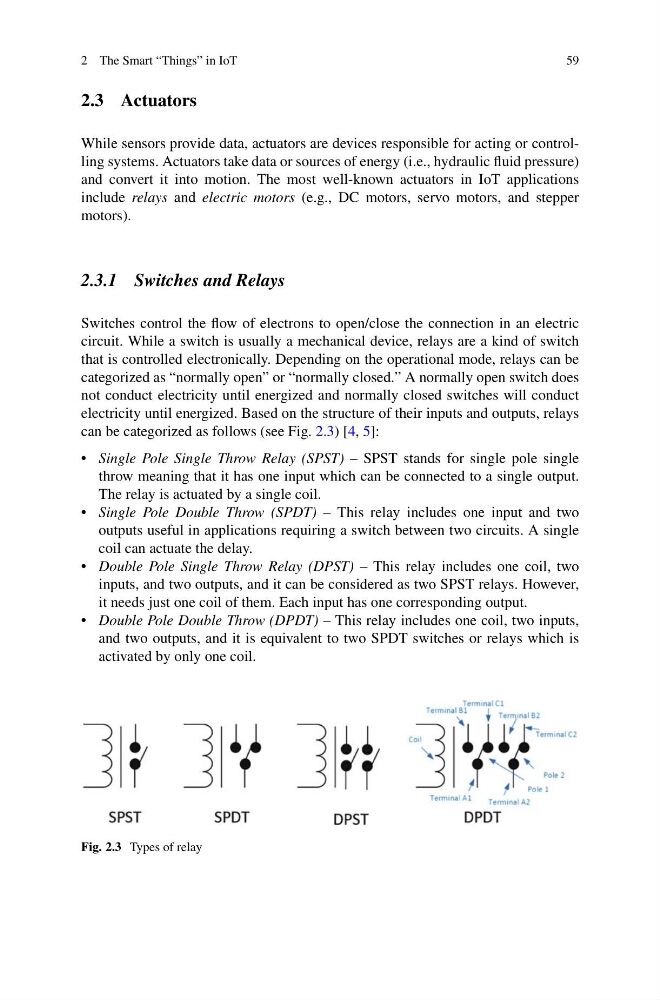
can be categorized as follows (see Fig. 2.3) [4, 5]:
• Single Pole Single Throw Relay (SPST) – SPST stands for single pole single
throw meaning that it has one input which can be connected to a single output.
The relay is actuated by a single coil.
• Single Pole Double Throw (SPDT) – This relay includes one input and two
outputs useful in applications requiring a switch between two circuits. A single
coil can actuate the delay.
• Double Pole Single Throw Relay (DPST) – This relay includes one coil, two
inputs, and two outputs, and it can be considered as two SPST relays. However,
it needs just one coil of them. Each input has one corresponding output.
• Double Pole Double Throw (DPDT) – This relay includes one coil, two inputs,
and two outputs, and it is equivalent to two SPDT switches or relays which is
activated by only one coil.
Fig. 2.3 Types of relay
59
2.3 Actuators
While sensors provide data, actuators are devices responsible for acting or controlling systems. Actuators take data or sources of energy (i.e., hydraulic fluid pressure)
and convert it into motion. The most well-known actuators in IoT applications
include relays and electric motors (e.g., DC motors, servo motors, and stepper
motors).
2.3.1 Switches and Relays
Switches control the flow of electrons to open/close the connection in an electric
circuit. While a switch is usually a mechanical device, relays are a kind of switch
that is controlled electronically. Depending on the operational mode, relays can be
categorized as “normally open” or “normally closed.” A normally open switch does
not conduct electricity until energized and normally closed switches will conduct
electricity until energized. Based on the structure of their inputs and outputs, relays
can be categorized as follows (see Fig. 2.3) [4, 5]:
• Single Pole Single Throw Relay (SPST) – SPST stands for single pole single
throw meaning that it has one input which can be connected to a single output.
The relay is actuated by a single coil.
• Single Pole Double Throw (SPDT) – This relay includes one input and two
outputs useful in applications requiring a switch between two circuits. A single
coil can actuate the delay.
• Double Pole Single Throw Relay (DPST) – This relay includes one coil, two
inputs, and two outputs, and it can be considered as two SPST relays. However,
it needs just one coil of them. Each input has one corresponding output.
• Double Pole Double Throw (DPDT) – This relay includes one coil, two inputs,
and two outputs, and it is equivalent to two SPDT switches or relays which is
activated by only one coil.
Fig. 2.3 Types of relay