

13 Smart Learning Using Big and Small Data for Mobile and IOT e-Health
629
13.5 Discussion
Generally, a smart learning framework consists of three major components –
representation, evaluation, and optimization [37]. Using the above three themes of
case studies, we provided a snapshot of three major applications using state-of-theart smart learning methods in this framework on mobile and IOT e-health.
By incorporating N-of-1 analytics and actionable learning methods, the smart
learning framework helps uncover the previously implicit behavioral pathways
that depict the sequential bidirectional relationship between stress perception and
exercise behavior. It also helps improve the experience of using the actionable and
interpretable insights learned from mobile and IOT e-health data, leading to better
integration of data science and science of care for patient-centered care.
By incorporating knowledge-enhanced learning methods, the framework can
leverage the injected knowledge bases to provide a better learning performance with
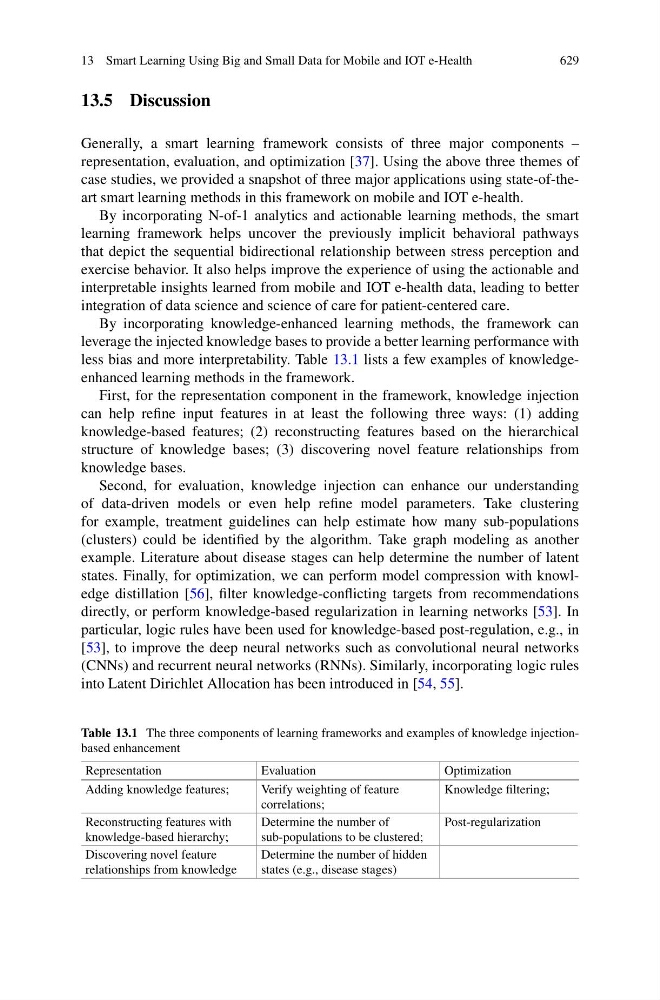
less bias and more interpretability. Table 13.1 lists a few examples of knowledgeenhanced learning methods in the framework.
First, for the representation component in the framework, knowledge injection
can help refine input features in at least the following three ways: (1) adding
knowledge-based features; (2) reconstructing features based on the hierarchical
structure of knowledge bases; (3) discovering novel feature relationships from
knowledge bases.
Second, for evaluation, knowledge injection can enhance our understanding
of data-driven models or even help refine model parameters. Take clustering
for example, treatment guidelines can help estimate how many sub-populations
(clusters) could be identified by the algorithm. Take graph modeling as another
example. Literature about disease stages can help determine the number of latent
states. Finally, for optimization, we can perform model compression with knowledge distillation [56], filter knowledge-conflicting targets from recommendations
directly, or perform knowledge-based regularization in learning networks [53]. In
particular, logic rules have been used for knowledge-based post-regulation, e.g., in
[53], to improve the deep neural networks such as convolutional neural networks
(CNNs) and recurrent neural networks (RNNs). Similarly, incorporating logic rules
into Latent Dirichlet Allocation has been introduced in [54, 55].
Table 13.1 The three components of learning frameworks and examples of knowledge injectionbased enhancement
Representation
Evaluation
Optimization
Adding knowledge features;
Verify weighting of feature
correlations;
Knowledge filtering;
Reconstructing features with
knowledge-based hierarchy;
Determine the number of
sub-populations to be clustered;
Post-regularization
Discovering novel feature
relationships from knowledge
Determine the number of hidden
states (e.g., disease stages)
629
13.5 Discussion
Generally, a smart learning framework consists of three major components –
representation, evaluation, and optimization [37]. Using the above three themes of
case studies, we provided a snapshot of three major applications using state-of-theart smart learning methods in this framework on mobile and IOT e-health.
By incorporating N-of-1 analytics and actionable learning methods, the smart
learning framework helps uncover the previously implicit behavioral pathways
that depict the sequential bidirectional relationship between stress perception and
exercise behavior. It also helps improve the experience of using the actionable and
interpretable insights learned from mobile and IOT e-health data, leading to better
integration of data science and science of care for patient-centered care.
By incorporating knowledge-enhanced learning methods, the framework can
leverage the injected knowledge bases to provide a better learning performance with
less bias and more interpretability. Table 13.1 lists a few examples of knowledgeenhanced learning methods in the framework.
First, for the representation component in the framework, knowledge injection
can help refine input features in at least the following three ways: (1) adding
knowledge-based features; (2) reconstructing features based on the hierarchical
structure of knowledge bases; (3) discovering novel feature relationships from
knowledge bases.
Second, for evaluation, knowledge injection can enhance our understanding
of data-driven models or even help refine model parameters. Take clustering
for example, treatment guidelines can help estimate how many sub-populations
(clusters) could be identified by the algorithm. Take graph modeling as another
example. Literature about disease stages can help determine the number of latent
states. Finally, for optimization, we can perform model compression with knowledge distillation [56], filter knowledge-conflicting targets from recommendations
directly, or perform knowledge-based regularization in learning networks [53]. In
particular, logic rules have been used for knowledge-based post-regulation, e.g., in
[53], to improve the deep neural networks such as convolutional neural networks
(CNNs) and recurrent neural networks (RNNs). Similarly, incorporating logic rules
into Latent Dirichlet Allocation has been introduced in [54, 55].
Table 13.1 The three components of learning frameworks and examples of knowledge injectionbased enhancement
Representation
Evaluation
Optimization
Adding knowledge features;
Verify weighting of feature
correlations;
Knowledge filtering;
Reconstructing features with
knowledge-based hierarchy;
Determine the number of
sub-populations to be clustered;
Post-regularization
Discovering novel feature
relationships from knowledge
Determine the number of hidden
states (e.g., disease stages)