

13 Smart Learning Using Big and Small Data for Mobile and IOT e-Health
627
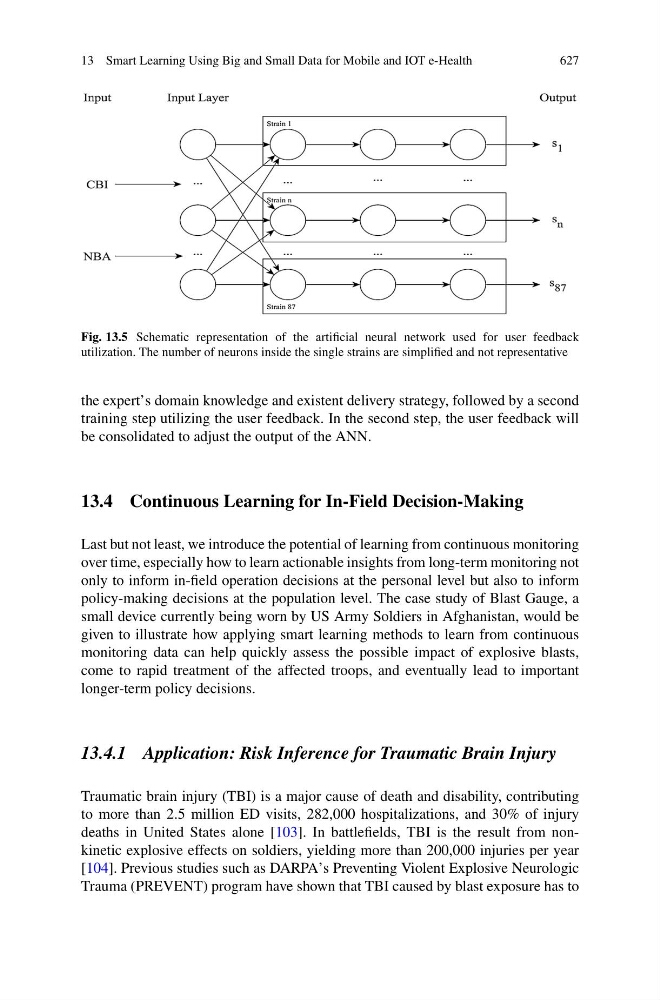
Fig. 13.5 Schematic representation of the artificial neural network used for user feedback
utilization. The number of neurons inside the single strains are simplified and not representative
the expert’s domain knowledge and existent delivery strategy, followed by a second
training step utilizing the user feedback. In the second step, the user feedback will
be consolidated to adjust the output of the ANN.
13.4 Continuous Learning for In-Field Decision-Making
Last but not least, we introduce the potential of learning from continuous monitoring
over time, especially how to learn actionable insights from long-term monitoring not
only to inform in-field operation decisions at the personal level but also to inform
policy-making decisions at the population level. The case study of Blast Gauge, a
small device currently being worn by US Army Soldiers in Afghanistan, would be
given to illustrate how applying smart learning methods to learn from continuous
monitoring data can help quickly assess the possible impact of explosive blasts,
come to rapid treatment of the affected troops, and eventually lead to important
longer-term policy decisions.
13.4.1 Application: Risk Inference for Traumatic Brain Injury
Traumatic brain injury (TBI) is a major cause of death and disability, contributing
to more than 2.5 million ED visits, 282,000 hospitalizations, and 30% of injury
deaths in United States alone [103]. In battlefields, TBI is the result from nonkinetic explosive effects on soldiers, yielding more than 200,000 injuries per year
[104]. Previous studies such as DARPA’s Preventing Violent Explosive Neurologic
Trauma (PREVENT) program have shown that TBI caused by blast exposure has to
627
Fig. 13.5 Schematic representation of the artificial neural network used for user feedback
utilization. The number of neurons inside the single strains are simplified and not representative
the expert’s domain knowledge and existent delivery strategy, followed by a second
training step utilizing the user feedback. In the second step, the user feedback will
be consolidated to adjust the output of the ANN.
13.4 Continuous Learning for In-Field Decision-Making
Last but not least, we introduce the potential of learning from continuous monitoring
over time, especially how to learn actionable insights from long-term monitoring not
only to inform in-field operation decisions at the personal level but also to inform
policy-making decisions at the population level. The case study of Blast Gauge, a
small device currently being worn by US Army Soldiers in Afghanistan, would be
given to illustrate how applying smart learning methods to learn from continuous
monitoring data can help quickly assess the possible impact of explosive blasts,
come to rapid treatment of the affected troops, and eventually lead to important
longer-term policy decisions.
13.4.1 Application: Risk Inference for Traumatic Brain Injury
Traumatic brain injury (TBI) is a major cause of death and disability, contributing
to more than 2.5 million ED visits, 282,000 hospitalizations, and 30% of injury
deaths in United States alone [103]. In battlefields, TBI is the result from nonkinetic explosive effects on soldiers, yielding more than 200,000 injuries per year
[104]. Previous studies such as DARPA’s Preventing Violent Explosive Neurologic
Trauma (PREVENT) program have shown that TBI caused by blast exposure has to