

614
P.-Y. S. Hsueh et al.
To gain insights of how stress influences exercise behavior, [63] has proposed
to incorporate into the smart learning framework an N-of-1 method, which uses
random forest and classification tree techniques to model the individual trajectories. The understanding of stress-behavior pathway is traditionally attained at the
population level; thus, it ignores individual heterogeneity and may lead to biased
estimation.
The proposed approach explores whether an N-of-1 model can better capture
an individual’s stress-behavior pathway, thus providing useful individual-specific
pattern of stress to predict exercise behavior. This method consists of three steps:
First, a classification decision tree is built for each participant. Second, a ranking of
variable importance is measured by classification accuracy; only those variables that
achieve significant decrease in classification accuracy would be kept. Third, another
classification tree is built for exercise prediction using the selected variables. The
experiment result shows that the proposed N-of-1 approach achieved an average
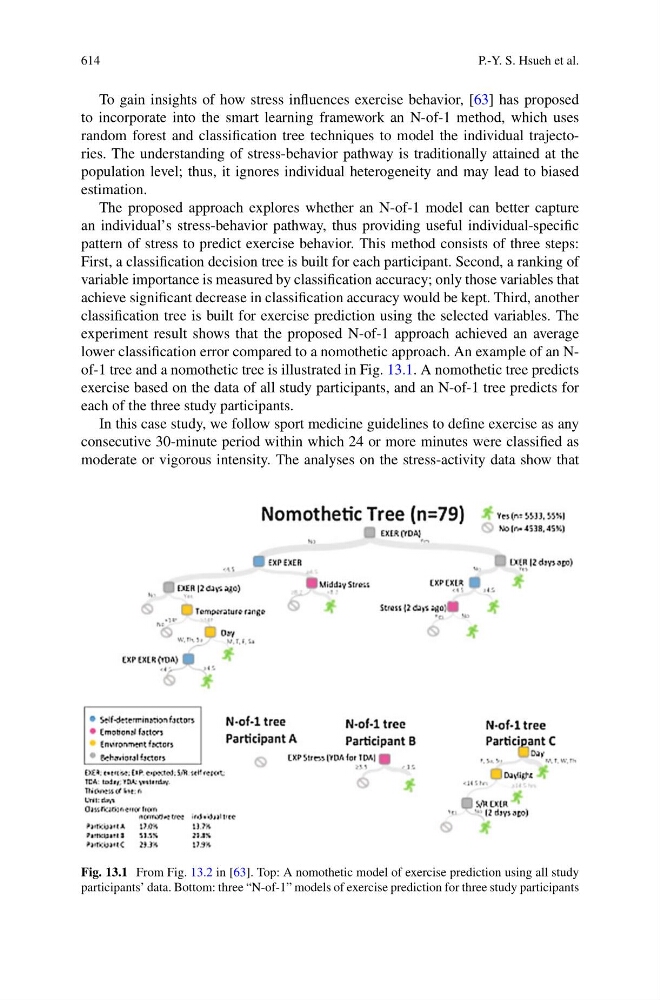
lower classification error compared to a nomothetic approach. An example of an Nof-1 tree and a nomothetic tree is illustrated in Fig. 13.1. A nomothetic tree predicts
exercise based on the data of all study participants, and an N-of-1 tree predicts for
each of the three study participants.
In this case study, we follow sport medicine guidelines to define exercise as any
consecutive 30-minute period within which 24 or more minutes were classified as
moderate or vigorous intensity. The analyses on the stress-activity data show that
Fig. 13.1 From Fig. 13.2 in [63]. Top: A nomothetic model of exercise prediction using all study
participants’ data. Bottom: three “N-of-1” models of exercise prediction for three study participants
P.-Y. S. Hsueh et al.
To gain insights of how stress influences exercise behavior, [63] has proposed
to incorporate into the smart learning framework an N-of-1 method, which uses
random forest and classification tree techniques to model the individual trajectories. The understanding of stress-behavior pathway is traditionally attained at the
population level; thus, it ignores individual heterogeneity and may lead to biased
estimation.
The proposed approach explores whether an N-of-1 model can better capture
an individual’s stress-behavior pathway, thus providing useful individual-specific
pattern of stress to predict exercise behavior. This method consists of three steps:
First, a classification decision tree is built for each participant. Second, a ranking of
variable importance is measured by classification accuracy; only those variables that
achieve significant decrease in classification accuracy would be kept. Third, another
classification tree is built for exercise prediction using the selected variables. The
experiment result shows that the proposed N-of-1 approach achieved an average
lower classification error compared to a nomothetic approach. An example of an Nof-1 tree and a nomothetic tree is illustrated in Fig. 13.1. A nomothetic tree predicts
exercise based on the data of all study participants, and an N-of-1 tree predicts for
each of the three study participants.
In this case study, we follow sport medicine guidelines to define exercise as any
consecutive 30-minute period within which 24 or more minutes were classified as
moderate or vigorous intensity. The analyses on the stress-activity data show that
Fig. 13.1 From Fig. 13.2 in [63]. Top: A nomothetic model of exercise prediction using all study
participants’ data. Bottom: three “N-of-1” models of exercise prediction for three study participants