

562
R. B. Pachori and V. Gupta
x odd (t) =
x(t) − x (−t)
2
(12.7)
12.3.1.5 Energy and Power Signals
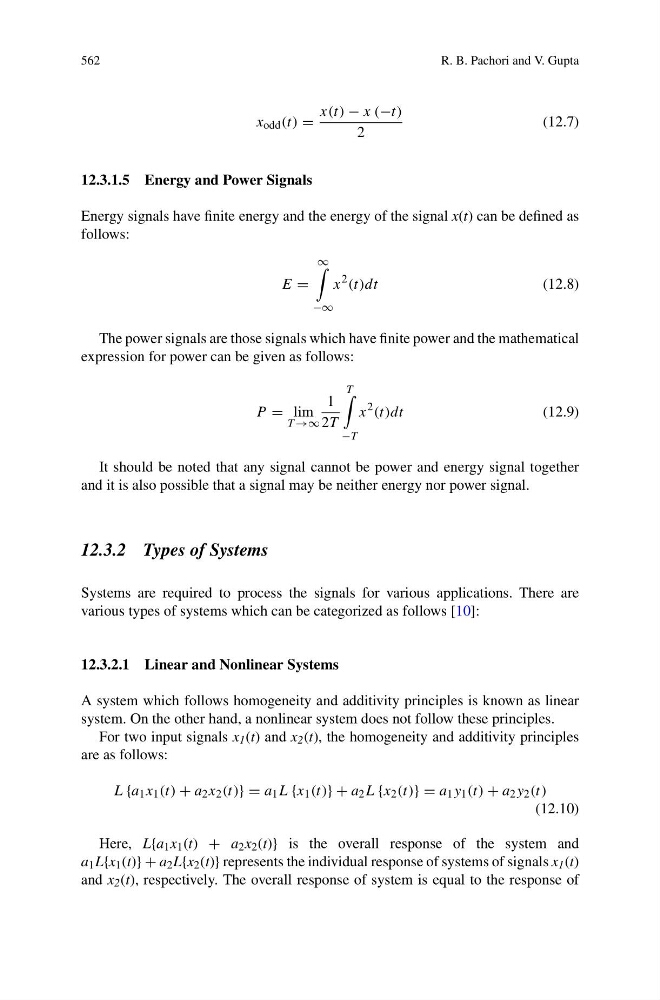
Energy signals have finite energy and the energy of the signal x(t) can be defined as
follows:
E =
∞
−∞
x
2 (t)dt
(12.8)
The power signals are those signals which have finite power and the mathematical
expression for power can be given as follows:
P = lim
T →∞
1
2T
T
−T
x
2 (t)dt
(12.9)
It should be noted that any signal cannot be power and energy signal together
and it is also possible that a signal may be neither energy nor power signal.
12.3.2 Types of Systems
Systems are required to process the signals for various applications. There are
various types of systems which can be categorized as follows [10]:
12.3.2.1 Linear and Nonlinear Systems
A system which follows homogeneity and additivity principles is known as linear
system. On the other hand, a nonlinear system does not follow these principles.
For two input signals x 1 (t) and x 2 (t), the homogeneity and additivity principles
are as follows:
L {a 1 x 1 (t) + a 2 x 2 (t)} = a 1 L {x 1 (t)} + a 2 L {x 2 (t)} = a 1 y 1 (t) + a 2 y 2 (t)
(12.10)
Here, L{a 1 x 1 (t) + a 2 x 2 (t)} is the overall response of the system and
a 1 L{x 1 (t)} + a 2 L{x 2 (t)} represents the individual response of systems of signals x 1 (t)
and x 2 (t), respectively. The overall response of system is equal to the response of
R. B. Pachori and V. Gupta
x odd (t) =
x(t) − x (−t)
2
(12.7)
12.3.1.5 Energy and Power Signals
Energy signals have finite energy and the energy of the signal x(t) can be defined as
follows:
E =
∞
−∞
x
2 (t)dt
(12.8)
The power signals are those signals which have finite power and the mathematical
expression for power can be given as follows:
P = lim
T →∞
1
2T
T
−T
x
2 (t)dt
(12.9)
It should be noted that any signal cannot be power and energy signal together
and it is also possible that a signal may be neither energy nor power signal.
12.3.2 Types of Systems
Systems are required to process the signals for various applications. There are
various types of systems which can be categorized as follows [10]:
12.3.2.1 Linear and Nonlinear Systems
A system which follows homogeneity and additivity principles is known as linear
system. On the other hand, a nonlinear system does not follow these principles.
For two input signals x 1 (t) and x 2 (t), the homogeneity and additivity principles
are as follows:
L {a 1 x 1 (t) + a 2 x 2 (t)} = a 1 L {x 1 (t)} + a 2 L {x 2 (t)} = a 1 y 1 (t) + a 2 y 2 (t)
(12.10)
Here, L{a 1 x 1 (t) + a 2 x 2 (t)} is the overall response of the system and
a 1 L{x 1 (t)} + a 2 L{x 2 (t)} represents the individual response of systems of signals x 1 (t)
and x 2 (t), respectively. The overall response of system is equal to the response of