

542
B. Farahani et al.
of machine learning is not high, it can increase the lifetime of the battery. In the
fog node, we utilize an advance convolutional neural network (CNN) to identity
anomalies with the maximum accuracy. Fog nodes (e.g., smartphones) usually
have enough power and processing resource to be able to run CNNs. Finally, we
perform all the machine learning trainings in the cloud. The reason is that cloud
has unlimited resources to ingest and process a large amount of data collected from
several patients and the results (machine learning models) are dispatched to the edge
of the system. With this approach we can make a trade-off between response time,
power consumption, and accuracy.
• Machine learning on chip (IoT device): As mentioned, endpoint IoT devices
suffer from enough processing power. Therefore, we design and execute a light
machine learning algorithm to meet this limitation. To do so, we train and
implement a three-layer neural network to detect any heart anomalies based on
ECG signals. In particular, we implement the following functions in device:
– Signal pre-processing: In this stage we remove any unwanted noise from ECG
recordings. In particular we perform:
• DC noise removal
• High-frequency noise removal
• Low-frequency noise removal
• Power line interference removal
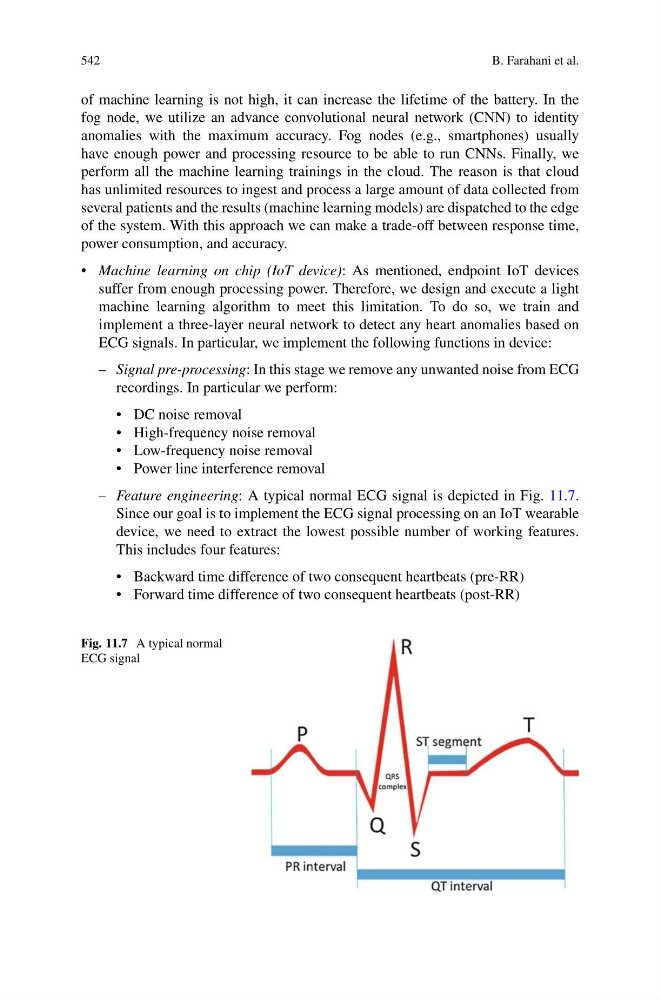
– Feature engineering: A typical normal ECG signal is depicted in Fig. 11.7.
Since our goal is to implement the ECG signal processing on an IoT wearable
device, we need to extract the lowest possible number of working features.
This includes four features:
• Backward time difference of two consequent heartbeats (pre-RR)
• Forward time difference of two consequent heartbeats (post-RR)
Fig. 11.7 A typical normal
ECG signal
B. Farahani et al.
of machine learning is not high, it can increase the lifetime of the battery. In the
fog node, we utilize an advance convolutional neural network (CNN) to identity
anomalies with the maximum accuracy. Fog nodes (e.g., smartphones) usually
have enough power and processing resource to be able to run CNNs. Finally, we
perform all the machine learning trainings in the cloud. The reason is that cloud
has unlimited resources to ingest and process a large amount of data collected from
several patients and the results (machine learning models) are dispatched to the edge
of the system. With this approach we can make a trade-off between response time,
power consumption, and accuracy.
• Machine learning on chip (IoT device): As mentioned, endpoint IoT devices
suffer from enough processing power. Therefore, we design and execute a light
machine learning algorithm to meet this limitation. To do so, we train and
implement a three-layer neural network to detect any heart anomalies based on
ECG signals. In particular, we implement the following functions in device:
– Signal pre-processing: In this stage we remove any unwanted noise from ECG
recordings. In particular we perform:
• DC noise removal
• High-frequency noise removal
• Low-frequency noise removal
• Power line interference removal
– Feature engineering: A typical normal ECG signal is depicted in Fig. 11.7.
Since our goal is to implement the ECG signal processing on an IoT wearable
device, we need to extract the lowest possible number of working features.
This includes four features:
• Backward time difference of two consequent heartbeats (pre-RR)
• Forward time difference of two consequent heartbeats (post-RR)
Fig. 11.7 A typical normal
ECG signal