

1 IoT Fundamentals: Definitions, Architectures, Challenges, and Promises
45
Who?
How?
Why?
What?
Value
Proposition
Value
Chain
Revenue
Model
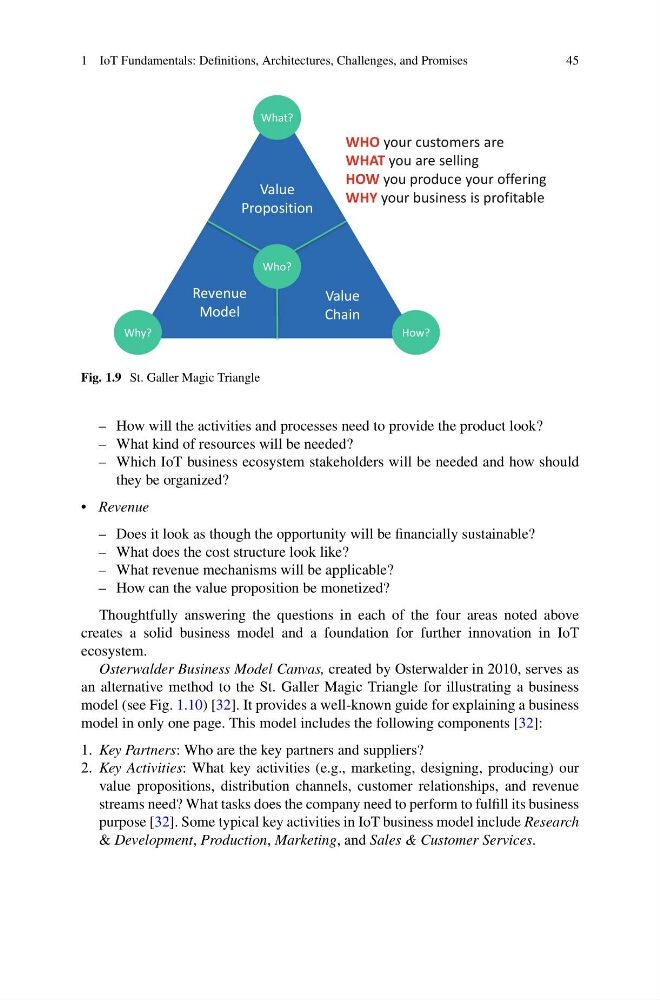
WHO your customers are
WHAT you are selling
HOW you produce your offering
WHY your business is profitable
Fig. 1.9 St. Galler Magic Triangle
– How will the activities and processes need to provide the product look?
– What kind of resources will be needed?
– Which IoT business ecosystem stakeholders will be needed and how should
they be organized?
• Revenue
– Does it look as though the opportunity will be financially sustainable?
– What does the cost structure look like?
– What revenue mechanisms will be applicable?
– How can the value proposition be monetized?
Thoughtfully answering the questions in each of the four areas noted above
creates a solid business model and a foundation for further innovation in IoT
ecosystem.
Osterwalder Business Model Canvas, created by Osterwalder in 2010, serves as
an alternative method to the St. Galler Magic Triangle for illustrating a business
model (see Fig. 1.10) [32]. It provides a well-known guide for explaining a business
model in only one page. This model includes the following components [32]:
1. Key Partners: Who are the key partners and suppliers?
2. Key Activities: What key activities (e.g., marketing, designing, producing) our
value propositions, distribution channels, customer relationships, and revenue
streams need? What tasks does the company need to perform to fulfill its business
purpose [32]. Some typical key activities in IoT business model include Research
& Development, Production, Marketing, and Sales & Customer Services.
45
Who?
How?
Why?
What?
Value
Proposition
Value
Chain
Revenue
Model
WHO your customers are
WHAT you are selling
HOW you produce your offering
WHY your business is profitable
Fig. 1.9 St. Galler Magic Triangle
– How will the activities and processes need to provide the product look?
– What kind of resources will be needed?
– Which IoT business ecosystem stakeholders will be needed and how should
they be organized?
• Revenue
– Does it look as though the opportunity will be financially sustainable?
– What does the cost structure look like?
– What revenue mechanisms will be applicable?
– How can the value proposition be monetized?
Thoughtfully answering the questions in each of the four areas noted above
creates a solid business model and a foundation for further innovation in IoT
ecosystem.
Osterwalder Business Model Canvas, created by Osterwalder in 2010, serves as
an alternative method to the St. Galler Magic Triangle for illustrating a business
model (see Fig. 1.10) [32]. It provides a well-known guide for explaining a business
model in only one page. This model includes the following components [32]:
1. Key Partners: Who are the key partners and suppliers?
2. Key Activities: What key activities (e.g., marketing, designing, producing) our
value propositions, distribution channels, customer relationships, and revenue
streams need? What tasks does the company need to perform to fulfill its business
purpose [32]. Some typical key activities in IoT business model include Research
& Development, Production, Marketing, and Sales & Customer Services.