

11 Healthcare IoT
533
11.5.6 IoT for Early Warning Score (EWS)
Because a large variety of bio-sensors create a huge volume of medical data from
thousands of patients, it is not practical to monitor every patient directly. An
IoT-based early warning score (EWS) is able to assist medical professionals by
accurately predicting or quickly detecting the deterioration of a patient’s health [15].
Basically, EWS processes and analyzes six basic vital signs including respiratory
rate, body temperature, pulse rate, systolic blood pressure, oxygen saturation level,
and degree of consciousness. These signs are then translated to a composite
patient deterioration risk score. Each processed vital sign is scored so that the
size of the score corresponds to the level of divergence from its established norm.
When all the scores are combined, a composite score is created, reflecting the
total level of deterioration risk for a particular patient. The EWS approach is in
widespread use in hospitals around the world, and many studies have indicated that
EWS is able to forecast patient complications approximately 24 hours before the
actual complication arises. In this context, IoT e-Health systems allow medical
professionals to constantly monitor vital signs remotely and then calculate the
patient’s deterioration risk level remotely as well. This is a revolutionary model
able to spot deterioration early enough to save lives and reduce mortality rates.
11.5.7 IoT-Based Anomaly Detection
There are two apparent drawbacks related to EWS. First, EWS does not evaluate
all biosignals such as hydration and sweat levels. In addition, EWS is based on
supervised machine learning and may not be able to accurately capture deviations
that are outside the supervisor’s real knowledge. Overcoming these drawbacks could
be addressed by utilizing an anomaly detection system that learns and evolves
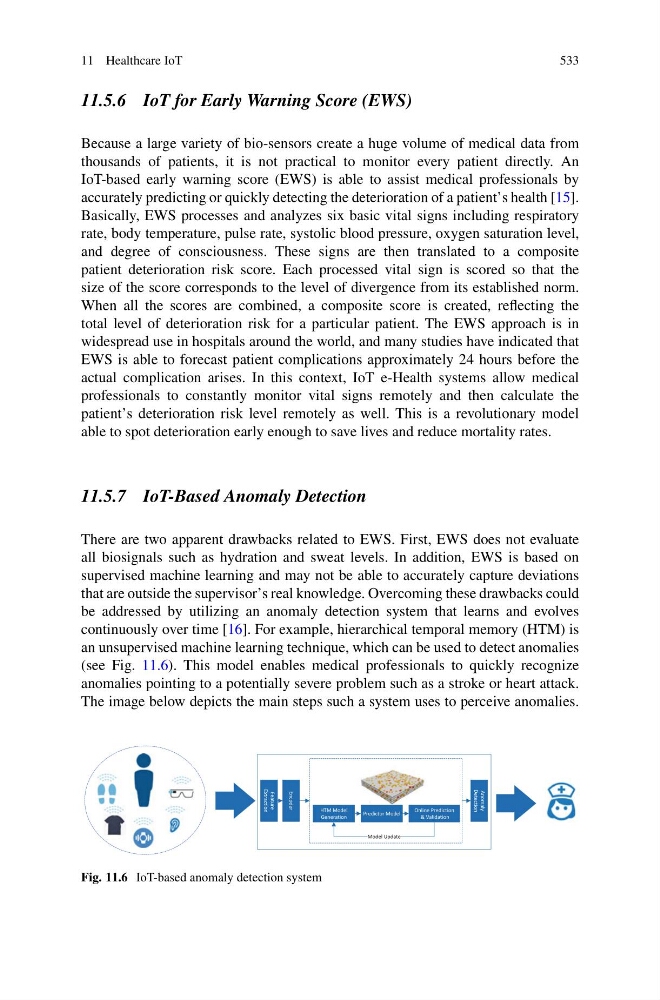
continuously over time [16]. For example, hierarchical temporal memory (HTM) is
an unsupervised machine learning technique, which can be used to detect anomalies
(see Fig. 11.6). This model enables medical professionals to quickly recognize
anomalies pointing to a potentially severe problem such as a stroke or heart attack.
The image below depicts the main steps such a system uses to perceive anomalies.
Fig. 11.6 IoT-based anomaly detection system
533
11.5.6 IoT for Early Warning Score (EWS)
Because a large variety of bio-sensors create a huge volume of medical data from
thousands of patients, it is not practical to monitor every patient directly. An
IoT-based early warning score (EWS) is able to assist medical professionals by
accurately predicting or quickly detecting the deterioration of a patient’s health [15].
Basically, EWS processes and analyzes six basic vital signs including respiratory
rate, body temperature, pulse rate, systolic blood pressure, oxygen saturation level,
and degree of consciousness. These signs are then translated to a composite
patient deterioration risk score. Each processed vital sign is scored so that the
size of the score corresponds to the level of divergence from its established norm.
When all the scores are combined, a composite score is created, reflecting the
total level of deterioration risk for a particular patient. The EWS approach is in
widespread use in hospitals around the world, and many studies have indicated that
EWS is able to forecast patient complications approximately 24 hours before the
actual complication arises. In this context, IoT e-Health systems allow medical
professionals to constantly monitor vital signs remotely and then calculate the
patient’s deterioration risk level remotely as well. This is a revolutionary model
able to spot deterioration early enough to save lives and reduce mortality rates.
11.5.7 IoT-Based Anomaly Detection
There are two apparent drawbacks related to EWS. First, EWS does not evaluate
all biosignals such as hydration and sweat levels. In addition, EWS is based on
supervised machine learning and may not be able to accurately capture deviations
that are outside the supervisor’s real knowledge. Overcoming these drawbacks could
be addressed by utilizing an anomaly detection system that learns and evolves
continuously over time [16]. For example, hierarchical temporal memory (HTM) is
an unsupervised machine learning technique, which can be used to detect anomalies
(see Fig. 11.6). This model enables medical professionals to quickly recognize
anomalies pointing to a potentially severe problem such as a stroke or heart attack.
The image below depicts the main steps such a system uses to perceive anomalies.
Fig. 11.6 IoT-based anomaly detection system