

526
B. Farahani et al.
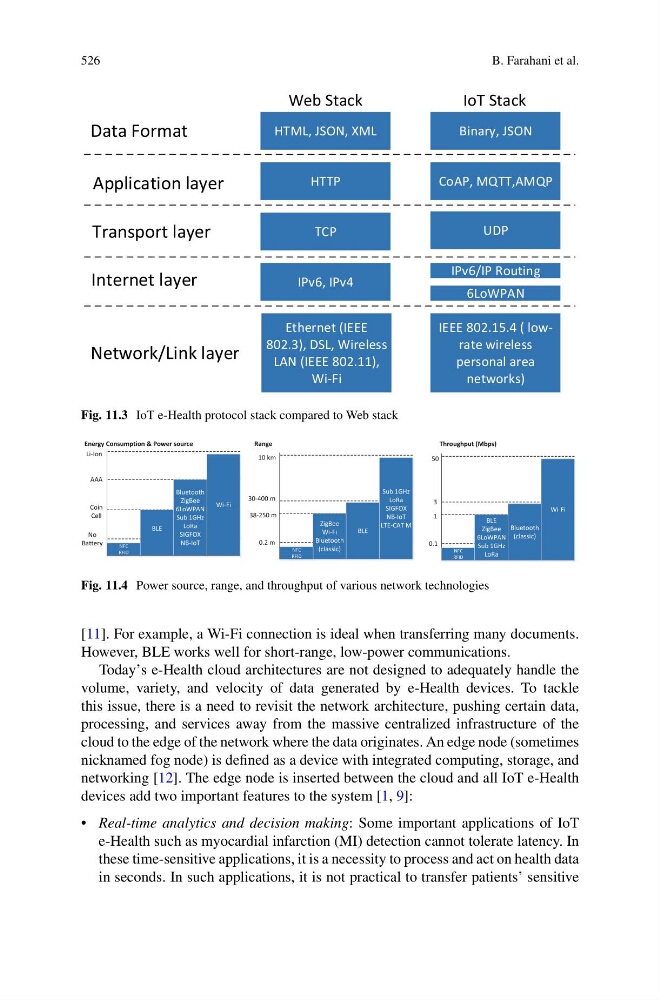
Fig. 11.3 IoT e-Health protocol stack compared to Web stack
Fig. 11.4 Power source, range, and throughput of various network technologies
[11]. For example, a Wi-Fi connection is ideal when transferring many documents.
However, BLE works well for short-range, low-power communications.
Today’s e-Health cloud architectures are not designed to adequately handle the
volume, variety, and velocity of data generated by e-Health devices. To tackle
this issue, there is a need to revisit the network architecture, pushing certain data,
processing, and services away from the massive centralized infrastructure of the
cloud to the edge of the network where the data originates. An edge node (sometimes
nicknamed fog node) is defined as a device with integrated computing, storage, and
networking [12]. The edge node is inserted between the cloud and all IoT e-Health
devices add two important features to the system [1, 9]:
• Real-time analytics and decision making: Some important applications of IoT
e-Health such as myocardial infarction (MI) detection cannot tolerate latency. In
these time-sensitive applications, it is a necessity to process and act on health data
in seconds. In such applications, it is not practical to transfer patients’ sensitive
B. Farahani et al.
Fig. 11.3 IoT e-Health protocol stack compared to Web stack
Fig. 11.4 Power source, range, and throughput of various network technologies
[11]. For example, a Wi-Fi connection is ideal when transferring many documents.
However, BLE works well for short-range, low-power communications.
Today’s e-Health cloud architectures are not designed to adequately handle the
volume, variety, and velocity of data generated by e-Health devices. To tackle
this issue, there is a need to revisit the network architecture, pushing certain data,
processing, and services away from the massive centralized infrastructure of the
cloud to the edge of the network where the data originates. An edge node (sometimes
nicknamed fog node) is defined as a device with integrated computing, storage, and
networking [12]. The edge node is inserted between the cloud and all IoT e-Health
devices add two important features to the system [1, 9]:
• Real-time analytics and decision making: Some important applications of IoT
e-Health such as myocardial infarction (MI) detection cannot tolerate latency. In
these time-sensitive applications, it is a necessity to process and act on health data
in seconds. In such applications, it is not practical to transfer patients’ sensitive