

1 IoT Fundamentals: Definitions, Architectures, Challenges, and Promises
41
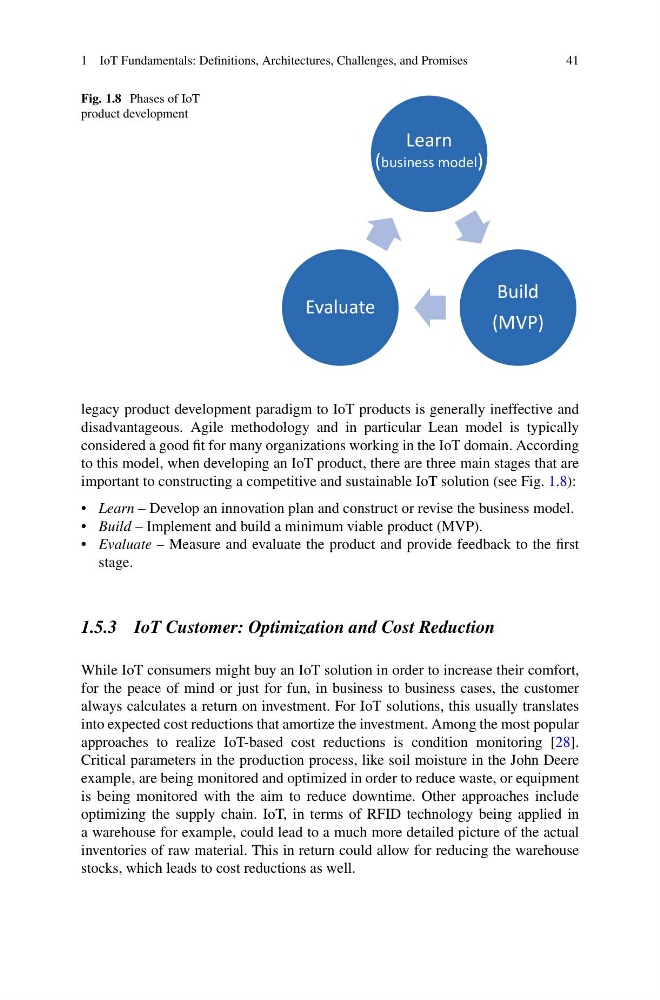
Fig. 1.8 Phases of IoT
product development
Learn
(business model)
Build
(MVP)
Evaluate
legacy product development paradigm to IoT products is generally ineffective and
disadvantageous. Agile methodology and in particular Lean model is typically
considered a good fit for many organizations working in the IoT domain. According
to this model, when developing an IoT product, there are three main stages that are
important to constructing a competitive and sustainable IoT solution (see Fig. 1.8):
• Learn – Develop an innovation plan and construct or revise the business model.
• Build – Implement and build a minimum viable product (MVP).
• Evaluate – Measure and evaluate the product and provide feedback to the first
stage.
1.5.3 IoT Customer: Optimization and Cost Reduction
While IoT consumers might buy an IoT solution in order to increase their comfort,
for the peace of mind or just for fun, in business to business cases, the customer
always calculates a return on investment. For IoT solutions, this usually translates
into expected cost reductions that amortize the investment. Among the most popular
approaches to realize IoT-based cost reductions is condition monitoring [28].
Critical parameters in the production process, like soil moisture in the John Deere
example, are being monitored and optimized in order to reduce waste, or equipment
is being monitored with the aim to reduce downtime. Other approaches include
optimizing the supply chain. IoT, in terms of RFID technology being applied in
a warehouse for example, could lead to a much more detailed picture of the actual
inventories of raw material. This in return could allow for reducing the warehouse
stocks, which leads to cost reductions as well.
41
Fig. 1.8 Phases of IoT
product development
Learn
(business model)
Build
(MVP)
Evaluate
legacy product development paradigm to IoT products is generally ineffective and
disadvantageous. Agile methodology and in particular Lean model is typically
considered a good fit for many organizations working in the IoT domain. According
to this model, when developing an IoT product, there are three main stages that are
important to constructing a competitive and sustainable IoT solution (see Fig. 1.8):
• Learn – Develop an innovation plan and construct or revise the business model.
• Build – Implement and build a minimum viable product (MVP).
• Evaluate – Measure and evaluate the product and provide feedback to the first
stage.
1.5.3 IoT Customer: Optimization and Cost Reduction
While IoT consumers might buy an IoT solution in order to increase their comfort,
for the peace of mind or just for fun, in business to business cases, the customer
always calculates a return on investment. For IoT solutions, this usually translates
into expected cost reductions that amortize the investment. Among the most popular
approaches to realize IoT-based cost reductions is condition monitoring [28].
Critical parameters in the production process, like soil moisture in the John Deere
example, are being monitored and optimized in order to reduce waste, or equipment
is being monitored with the aim to reduce downtime. Other approaches include
optimizing the supply chain. IoT, in terms of RFID technology being applied in
a warehouse for example, could lead to a much more detailed picture of the actual
inventories of raw material. This in return could allow for reducing the warehouse
stocks, which leads to cost reductions as well.