

10 IoT Cyber Security
493
from simple seals or locked covers to piezo-electric circuits depending on the threat
environment.
Authenticated or Disabled Debug Ports The ability to disable debug/test ports or
at minimum apply password restrictions (JTAG, UART, etc.)
10.4.4 Deploy Confidentiality Protections
Artifacts from your threat model provide detailed information on the data flows
within your IoT system. These artifacts will guide security engineers in determining
whether sensitive information is generated, processed or stored at points within
the system. Once sensitive data flows are identified, confidentiality controls can be
put in place to secure data. One of the key methods of securing data is through
cryptography.
Cryptography works at various layers of the communication stack. At Layer 2 of
the OSI model, link layer encryption protects network packets completely. Layer 3
network encryption protects the Internet Payload (IP) packet payload – for example,
using the IPsec protocol. Layer 4 Session Layer encryption encrypts UDP and TCP
communications. At Layer 7 Application layer encryption can be applied to enable
end-to-end encrypted and authenticated communications.
IoT protocols make extensive use of cryptography. Machines may use cryptography to support authentication of devices to peers or to network services,
for data integrity, for non-repudiation, or for confidentiality of data at rest or in
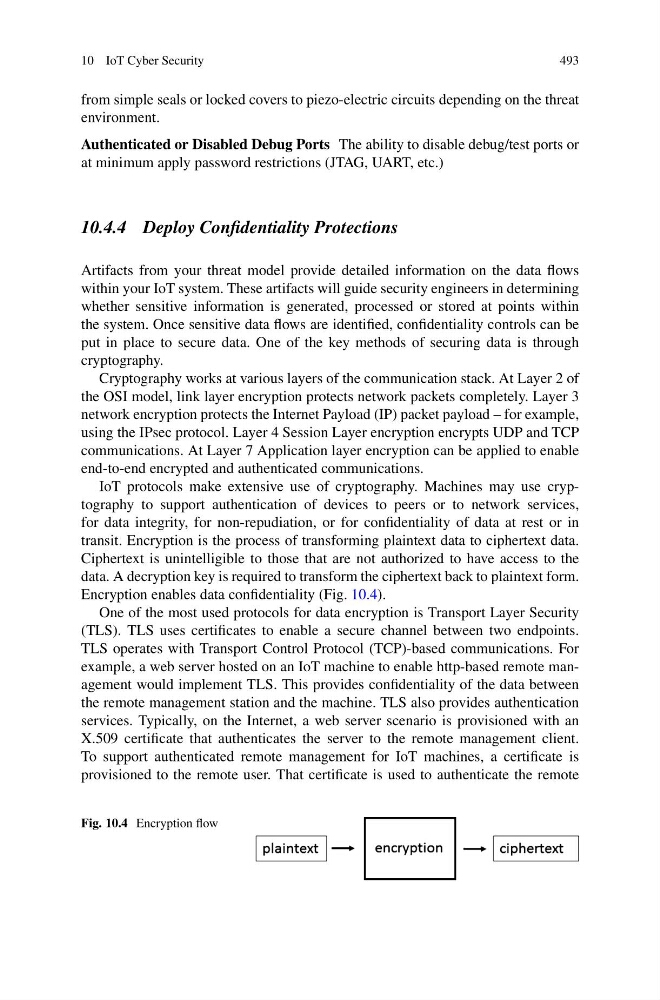
transit. Encryption is the process of transforming plaintext data to ciphertext data.
Ciphertext is unintelligible to those that are not authorized to have access to the
data. A decryption key is required to transform the ciphertext back to plaintext form.
Encryption enables data confidentiality (Fig. 10.4).
One of the most used protocols for data encryption is Transport Layer Security
(TLS). TLS uses certificates to enable a secure channel between two endpoints.
TLS operates with Transport Control Protocol (TCP)-based communications. For
example, a web server hosted on an IoT machine to enable http-based remote management would implement TLS. This provides confidentiality of the data between
the remote management station and the machine. TLS also provides authentication
services. Typically, on the Internet, a web server scenario is provisioned with an
X.509 certificate that authenticates the server to the remote management client.
To support authenticated remote management for IoT machines, a certificate is
provisioned to the remote user. That certificate is used to authenticate the remote
Fig. 10.4 Encryption flow
493
from simple seals or locked covers to piezo-electric circuits depending on the threat
environment.
Authenticated or Disabled Debug Ports The ability to disable debug/test ports or
at minimum apply password restrictions (JTAG, UART, etc.)
10.4.4 Deploy Confidentiality Protections
Artifacts from your threat model provide detailed information on the data flows
within your IoT system. These artifacts will guide security engineers in determining
whether sensitive information is generated, processed or stored at points within
the system. Once sensitive data flows are identified, confidentiality controls can be
put in place to secure data. One of the key methods of securing data is through
cryptography.
Cryptography works at various layers of the communication stack. At Layer 2 of
the OSI model, link layer encryption protects network packets completely. Layer 3
network encryption protects the Internet Payload (IP) packet payload – for example,
using the IPsec protocol. Layer 4 Session Layer encryption encrypts UDP and TCP
communications. At Layer 7 Application layer encryption can be applied to enable
end-to-end encrypted and authenticated communications.
IoT protocols make extensive use of cryptography. Machines may use cryptography to support authentication of devices to peers or to network services,
for data integrity, for non-repudiation, or for confidentiality of data at rest or in
transit. Encryption is the process of transforming plaintext data to ciphertext data.
Ciphertext is unintelligible to those that are not authorized to have access to the
data. A decryption key is required to transform the ciphertext back to plaintext form.
Encryption enables data confidentiality (Fig. 10.4).
One of the most used protocols for data encryption is Transport Layer Security
(TLS). TLS uses certificates to enable a secure channel between two endpoints.
TLS operates with Transport Control Protocol (TCP)-based communications. For
example, a web server hosted on an IoT machine to enable http-based remote management would implement TLS. This provides confidentiality of the data between
the remote management station and the machine. TLS also provides authentication
services. Typically, on the Internet, a web server scenario is provisioned with an
X.509 certificate that authenticates the server to the remote management client.
To support authenticated remote management for IoT machines, a certificate is
provisioned to the remote user. That certificate is used to authenticate the remote
Fig. 10.4 Encryption flow