

8 Distributed Ledger Technology
421
8.8 Applications of Blockchain
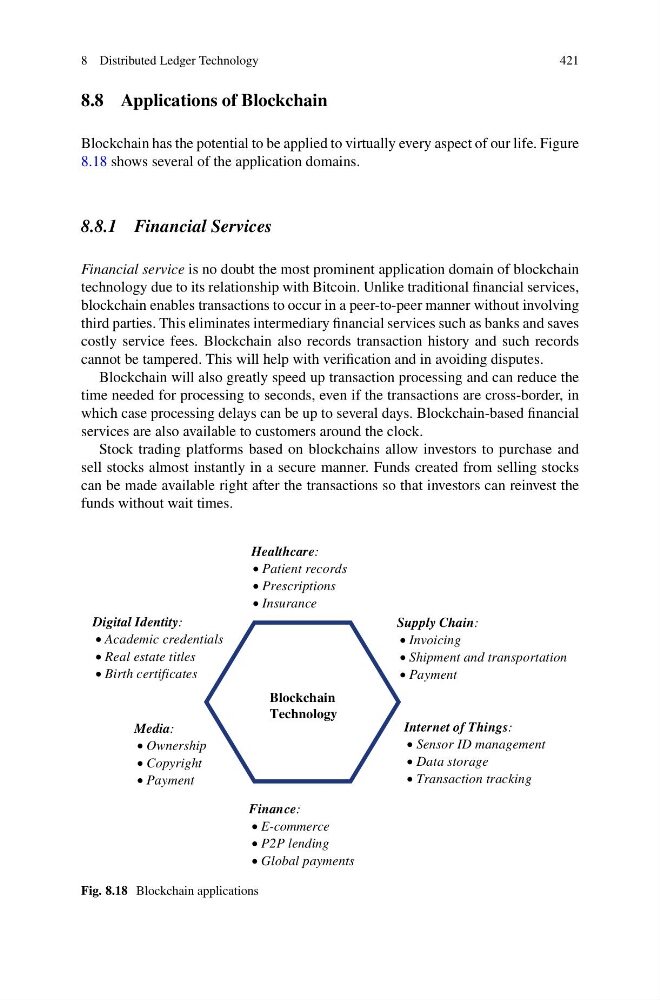
Blockchain has the potential to be applied to virtually every aspect of our life. Figure
8.18 shows several of the application domains.
8.8.1 Financial Services
Financial service is no doubt the most prominent application domain of blockchain
technology due to its relationship with Bitcoin. Unlike traditional financial services,
blockchain enables transactions to occur in a peer-to-peer manner without involving
third parties. This eliminates intermediary financial services such as banks and saves
costly service fees. Blockchain also records transaction history and such records
cannot be tampered. This will help with verification and in avoiding disputes.
Blockchain will also greatly speed up transaction processing and can reduce the
time needed for processing to seconds, even if the transactions are cross-border, in
which case processing delays can be up to several days. Blockchain-based financial
services are also available to customers around the clock.
Stock trading platforms based on blockchains allow investors to purchase and
sell stocks almost instantly in a secure manner. Funds created from selling stocks
can be made available right after the transactions so that investors can reinvest the
funds without wait times.
Blockchain
Technology
Digital Identity:
xxAcademic credentials
xxReal estate titles
xxBirth certificates
Healthcare:
xxPatient records
xxPrescriptions
xxInsurance
Supply Chain:
xxInvoicing
xxShipment and transportation
xxPayment
Media:
xxOwnership
xxCopyright
xxPayment
Internet of Things:
xxSensor ID management
xxData storage
xxTransaction tracking
Finance:
xxE-commerce
xxP2P lending
xxGlobal payments
Fig. 8.18 Blockchain applications
421
8.8 Applications of Blockchain
Blockchain has the potential to be applied to virtually every aspect of our life. Figure
8.18 shows several of the application domains.
8.8.1 Financial Services
Financial service is no doubt the most prominent application domain of blockchain
technology due to its relationship with Bitcoin. Unlike traditional financial services,
blockchain enables transactions to occur in a peer-to-peer manner without involving
third parties. This eliminates intermediary financial services such as banks and saves
costly service fees. Blockchain also records transaction history and such records
cannot be tampered. This will help with verification and in avoiding disputes.
Blockchain will also greatly speed up transaction processing and can reduce the
time needed for processing to seconds, even if the transactions are cross-border, in
which case processing delays can be up to several days. Blockchain-based financial
services are also available to customers around the clock.
Stock trading platforms based on blockchains allow investors to purchase and
sell stocks almost instantly in a secure manner. Funds created from selling stocks
can be made available right after the transactions so that investors can reinvest the
funds without wait times.
Blockchain
Technology
Digital Identity:
xxAcademic credentials
xxReal estate titles
xxBirth certificates
Healthcare:
xxPatient records
xxPrescriptions
xxInsurance
Supply Chain:
xxInvoicing
xxShipment and transportation
xxPayment
Media:
xxOwnership
xxCopyright
xxPayment
Internet of Things:
xxSensor ID management
xxData storage
xxTransaction tracking
Finance:
xxE-commerce
xxP2P lending
xxGlobal payments
Fig. 8.18 Blockchain applications