

404
X. Liu et al.
Hash of Header
of Block n-2
Other data
Hash of Header
of Block n-1
Other data
Hash of Header
of Block n
Other data
Block n-1
Block n
Block n+1
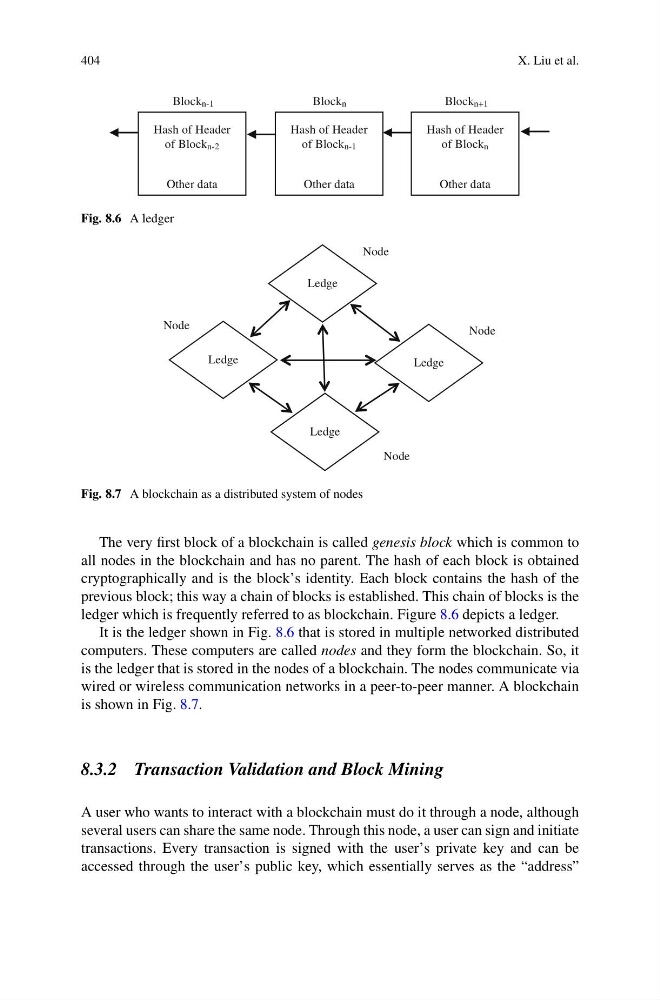
Fig. 8.6 A ledger
Node
Node
Node
Ledge
Ledge
Ledge
Ledge
Node
Fig. 8.7 A blockchain as a distributed system of nodes
The very first block of a blockchain is called genesis block which is common to
all nodes in the blockchain and has no parent. The hash of each block is obtained
cryptographically and is the block’s identity. Each block contains the hash of the
previous block; this way a chain of blocks is established. This chain of blocks is the
ledger which is frequently referred to as blockchain. Figure 8.6 depicts a ledger.
It is the ledger shown in Fig. 8.6 that is stored in multiple networked distributed
computers. These computers are called nodes and they form the blockchain. So, it
is the ledger that is stored in the nodes of a blockchain. The nodes communicate via
wired or wireless communication networks in a peer-to-peer manner. A blockchain
is shown in Fig. 8.7.
8.3.2 Transaction Validation and Block Mining
A user who wants to interact with a blockchain must do it through a node, although
several users can share the same node. Through this node, a user can sign and initiate
transactions. Every transaction is signed with the user’s private key and can be
accessed through the user’s public key, which essentially serves as the “address”
X. Liu et al.
Hash of Header
of Block n-2
Other data
Hash of Header
of Block n-1
Other data
Hash of Header
of Block n
Other data
Block n-1
Block n
Block n+1
Fig. 8.6 A ledger
Node
Node
Node
Ledge
Ledge
Ledge
Ledge
Node
Fig. 8.7 A blockchain as a distributed system of nodes
The very first block of a blockchain is called genesis block which is common to
all nodes in the blockchain and has no parent. The hash of each block is obtained
cryptographically and is the block’s identity. Each block contains the hash of the
previous block; this way a chain of blocks is established. This chain of blocks is the
ledger which is frequently referred to as blockchain. Figure 8.6 depicts a ledger.
It is the ledger shown in Fig. 8.6 that is stored in multiple networked distributed
computers. These computers are called nodes and they form the blockchain. So, it
is the ledger that is stored in the nodes of a blockchain. The nodes communicate via
wired or wireless communication networks in a peer-to-peer manner. A blockchain
is shown in Fig. 8.7.
8.3.2 Transaction Validation and Block Mining
A user who wants to interact with a blockchain must do it through a node, although
several users can share the same node. Through this node, a user can sign and initiate
transactions. Every transaction is signed with the user’s private key and can be
accessed through the user’s public key, which essentially serves as the “address”