

402
X. Liu et al.
cryptography and consensus algorithms which are breakable by quantum computers.
Table 8.2 lists the differences between DAG and blockchains.
8.3 How Blockchain Works
The functionality of a blockchain in Bitcoin is to facilitate money transactions and
the recording of the transactions. A slightly simplified microscopic operation of a
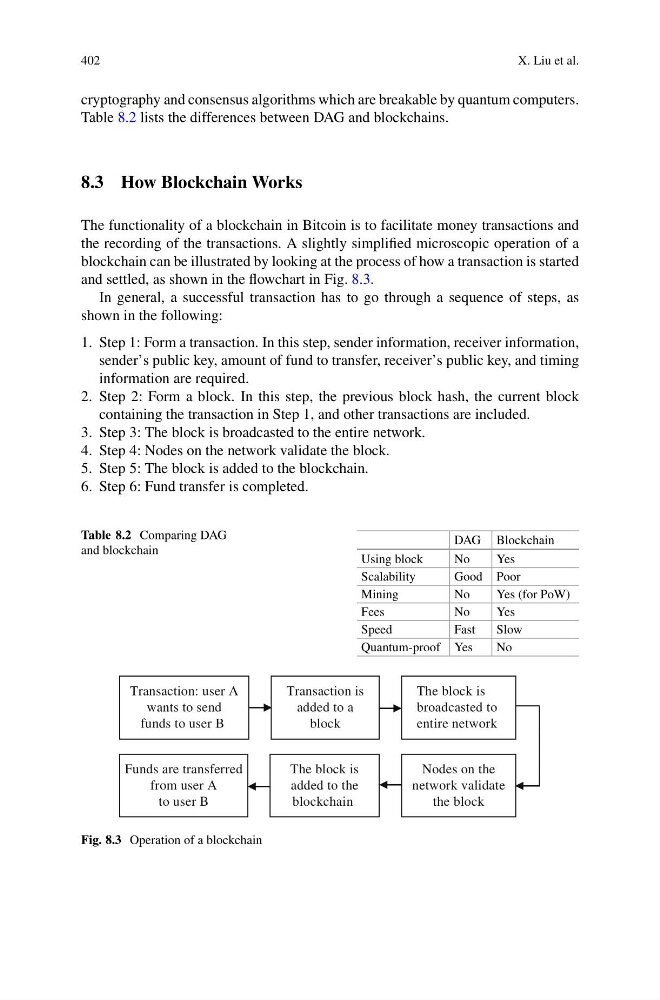
blockchain can be illustrated by looking at the process of how a transaction is started
and settled, as shown in the flowchart in Fig. 8.3.
In general, a successful transaction has to go through a sequence of steps, as
shown in the following:
1. Step 1: Form a transaction. In this step, sender information, receiver information,
sender’s public key, amount of fund to transfer, receiver’s public key, and timing
information are required.
2. Step 2: Form a block. In this step, the previous block hash, the current block
containing the transaction in Step 1, and other transactions are included.
3. Step 3: The block is broadcasted to the entire network.
4. Step 4: Nodes on the network validate the block.
5. Step 5: The block is added to the blockchain.
6. Step 6: Fund transfer is completed.
Table 8.2 Comparing DAG
and blockchain
DAG Blockchain
Using block
No
Yes
Scalability
Good Poor
Mining
No
Yes (for PoW)
Fees
No
Yes
Speed
Fast
Slow
Quantum-proof Yes
No
Transaction: user A
wants to send
funds to user B
Transaction is
added to a
block
The block is
broadcasted to
entire network
Nodes on the
network validate
the block
The block is
added to the
blockchain
Funds are transferred
from user A
to user B
Fig. 8.3 Operation of a blockchain
X. Liu et al.
cryptography and consensus algorithms which are breakable by quantum computers.
Table 8.2 lists the differences between DAG and blockchains.
8.3 How Blockchain Works
The functionality of a blockchain in Bitcoin is to facilitate money transactions and
the recording of the transactions. A slightly simplified microscopic operation of a
blockchain can be illustrated by looking at the process of how a transaction is started
and settled, as shown in the flowchart in Fig. 8.3.
In general, a successful transaction has to go through a sequence of steps, as
shown in the following:
1. Step 1: Form a transaction. In this step, sender information, receiver information,
sender’s public key, amount of fund to transfer, receiver’s public key, and timing
information are required.
2. Step 2: Form a block. In this step, the previous block hash, the current block
containing the transaction in Step 1, and other transactions are included.
3. Step 3: The block is broadcasted to the entire network.
4. Step 4: Nodes on the network validate the block.
5. Step 5: The block is added to the blockchain.
6. Step 6: Fund transfer is completed.
Table 8.2 Comparing DAG
and blockchain
DAG Blockchain
Using block
No
Yes
Scalability
Good Poor
Mining
No
Yes (for PoW)
Fees
No
Yes
Speed
Fast
Slow
Quantum-proof Yes
No
Transaction: user A
wants to send
funds to user B
Transaction is
added to a
block
The block is
broadcasted to
entire network
Nodes on the
network validate
the block
The block is
added to the
blockchain
Funds are transferred
from user A
to user B
Fig. 8.3 Operation of a blockchain