

8 Distributed Ledger Technology
397
8.1.3.2 Permissioned Blockchains
Blockchains can be permissioned as well. Permissioned blockchains can be further
divided into two types: federated and private.
• Federated – Federated blockchains are usually operated by a special group of
participants. They do not allow the arbitrary participant to validate transactions.
Only preselected participants are involved in the process and are responsible for
the validity of transactions. In federated blockchains, the public can be granted
the right to read the transactions, but only the selected participants can write the
transactions. Examples of federated blockchains are R3 which is for banking and
EWF which is designed to be used in the energy sector.
• Private: A private blockchain is typically centralized to one organization and
only this organization can validate transactions. The public can be allowed to
read the transactions, or only some selected parties can read the transactions.
Multichain is an example of private blockchains.
The difference between a federated blockchain and a private blockchain is
the number of organizations that operate the blockchain. A private blockchain
is operated by one organization. However, a federated blockchain is operated by
multiple organizations, although federated blockchains can still be considered to be
private blockchains.
Private and public blockchains differ in the execution of consensus algorithms,
maintenance of the common ledger, and the authorization to join to the blockchain
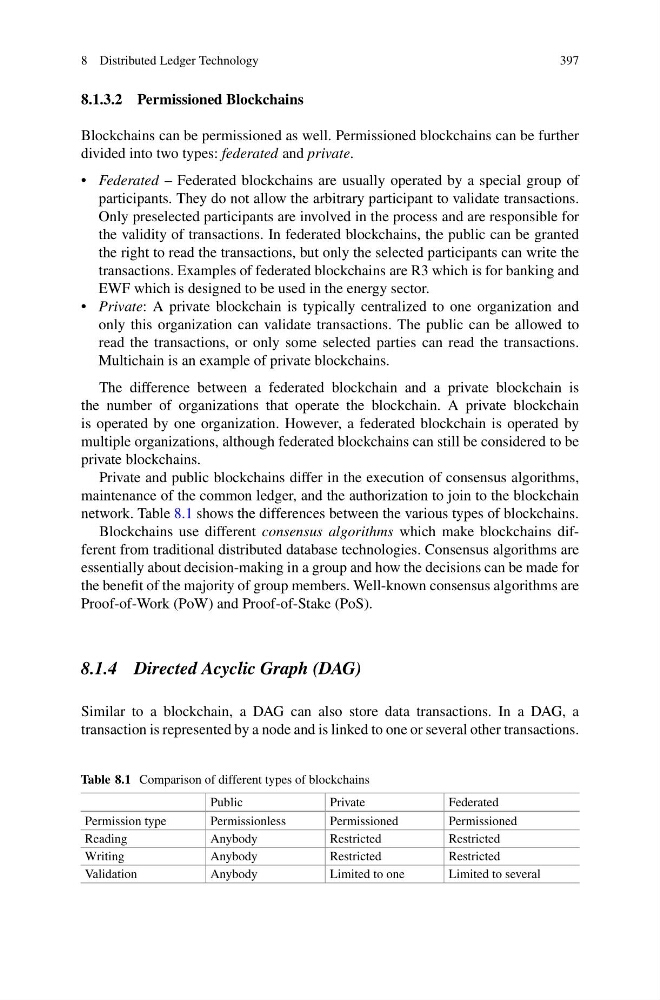
network. Table 8.1 shows the differences between the various types of blockchains.
Blockchains use different consensus algorithms which make blockchains different from traditional distributed database technologies. Consensus algorithms are
essentially about decision-making in a group and how the decisions can be made for
the benefit of the majority of group members. Well-known consensus algorithms are
Proof-of-Work (PoW) and Proof-of-Stake (PoS).
8.1.4 Directed Acyclic Graph (DAG)
Similar to a blockchain, a DAG can also store data transactions. In a DAG, a
transaction is represented by a node and is linked to one or several other transactions.
Table 8.1 Comparison of different types of blockchains
Public
Private
Federated
Permission type
Permissionless
Permissioned
Permissioned
Reading
Anybody
Restricted
Restricted
Writing
Anybody
Restricted
Restricted
Validation
Anybody
Limited to one
Limited to several
397
8.1.3.2 Permissioned Blockchains
Blockchains can be permissioned as well. Permissioned blockchains can be further
divided into two types: federated and private.
• Federated – Federated blockchains are usually operated by a special group of
participants. They do not allow the arbitrary participant to validate transactions.
Only preselected participants are involved in the process and are responsible for
the validity of transactions. In federated blockchains, the public can be granted
the right to read the transactions, but only the selected participants can write the
transactions. Examples of federated blockchains are R3 which is for banking and
EWF which is designed to be used in the energy sector.
• Private: A private blockchain is typically centralized to one organization and
only this organization can validate transactions. The public can be allowed to
read the transactions, or only some selected parties can read the transactions.
Multichain is an example of private blockchains.
The difference between a federated blockchain and a private blockchain is
the number of organizations that operate the blockchain. A private blockchain
is operated by one organization. However, a federated blockchain is operated by
multiple organizations, although federated blockchains can still be considered to be
private blockchains.
Private and public blockchains differ in the execution of consensus algorithms,
maintenance of the common ledger, and the authorization to join to the blockchain
network. Table 8.1 shows the differences between the various types of blockchains.
Blockchains use different consensus algorithms which make blockchains different from traditional distributed database technologies. Consensus algorithms are
essentially about decision-making in a group and how the decisions can be made for
the benefit of the majority of group members. Well-known consensus algorithms are
Proof-of-Work (PoW) and Proof-of-Stake (PoS).
8.1.4 Directed Acyclic Graph (DAG)
Similar to a blockchain, a DAG can also store data transactions. In a DAG, a
transaction is represented by a node and is linked to one or several other transactions.
Table 8.1 Comparison of different types of blockchains
Public
Private
Federated
Permission type
Permissionless
Permissioned
Permissioned
Reading
Anybody
Restricted
Restricted
Writing
Anybody
Restricted
Restricted
Validation
Anybody
Limited to one
Limited to several