

7 Intelligent and Connected Cyber-Physical Systems: A Perspective. . .
385
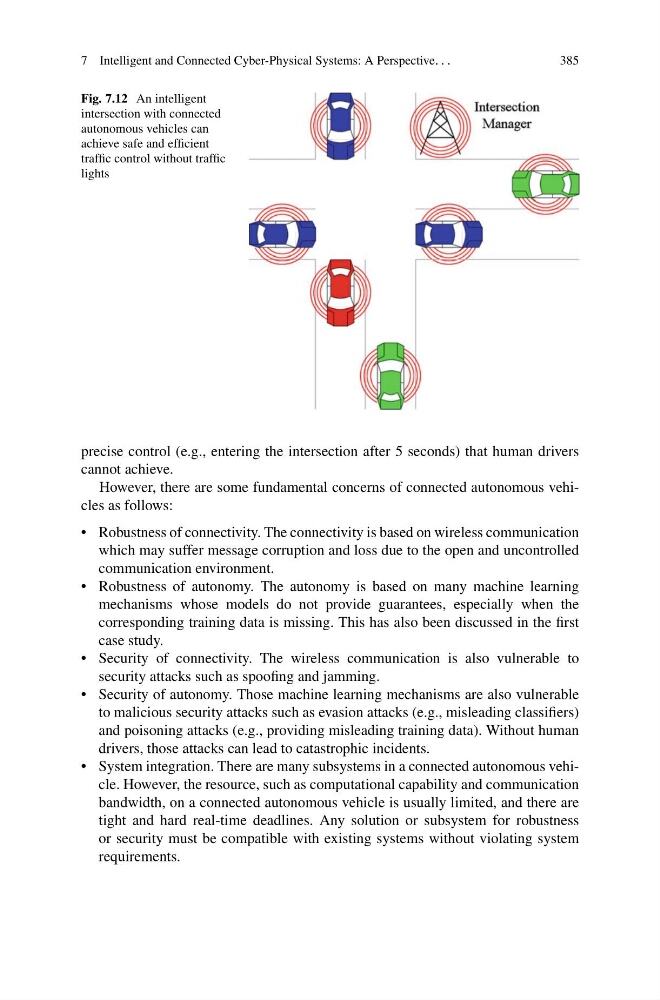
Fig. 7.12 An intelligent
intersection with connected
autonomous vehicles can
achieve safe and efficient
traffic control without traffic
lights
precise control (e.g., entering the intersection after 5 seconds) that human drivers
cannot achieve.
However, there are some fundamental concerns of connected autonomous vehicles as follows:
• Robustness of connectivity. The connectivity is based on wireless communication
which may suffer message corruption and loss due to the open and uncontrolled
communication environment.
• Robustness of autonomy. The autonomy is based on many machine learning
mechanisms whose models do not provide guarantees, especially when the
corresponding training data is missing. This has also been discussed in the first
case study.
• Security of connectivity. The wireless communication is also vulnerable to
security attacks such as spoofing and jamming.
• Security of autonomy. Those machine learning mechanisms are also vulnerable
to malicious security attacks such as evasion attacks (e.g., misleading classifiers)
and poisoning attacks (e.g., providing misleading training data). Without human
drivers, those attacks can lead to catastrophic incidents.
• System integration. There are many subsystems in a connected autonomous vehicle. However, the resource, such as computational capability and communication
bandwidth, on a connected autonomous vehicle is usually limited, and there are
tight and hard real-time deadlines. Any solution or subsystem for robustness
or security must be compatible with existing systems without violating system
requirements.
385
Fig. 7.12 An intelligent
intersection with connected
autonomous vehicles can
achieve safe and efficient
traffic control without traffic
lights
precise control (e.g., entering the intersection after 5 seconds) that human drivers
cannot achieve.
However, there are some fundamental concerns of connected autonomous vehicles as follows:
• Robustness of connectivity. The connectivity is based on wireless communication
which may suffer message corruption and loss due to the open and uncontrolled
communication environment.
• Robustness of autonomy. The autonomy is based on many machine learning
mechanisms whose models do not provide guarantees, especially when the
corresponding training data is missing. This has also been discussed in the first
case study.
• Security of connectivity. The wireless communication is also vulnerable to
security attacks such as spoofing and jamming.
• Security of autonomy. Those machine learning mechanisms are also vulnerable
to malicious security attacks such as evasion attacks (e.g., misleading classifiers)
and poisoning attacks (e.g., providing misleading training data). Without human
drivers, those attacks can lead to catastrophic incidents.
• System integration. There are many subsystems in a connected autonomous vehicle. However, the resource, such as computational capability and communication
bandwidth, on a connected autonomous vehicle is usually limited, and there are
tight and hard real-time deadlines. Any solution or subsystem for robustness
or security must be compatible with existing systems without violating system
requirements.