

378
W. Chang et al.
context systems is a non-trivial task in itself, systematic approaches to systems
engineering are therefore indispensable. Incorrect functioning of the pedestrian
detection function can cause hazards such as “unnecessary emergency breaking or
steering” and “too late or no emergency braking when necessary.” These hazards
potentially violate the safety goal “do not harm pedestrians” of the automated
driving system. Thus, we consider the pedestrian detection function as safety
relevant.
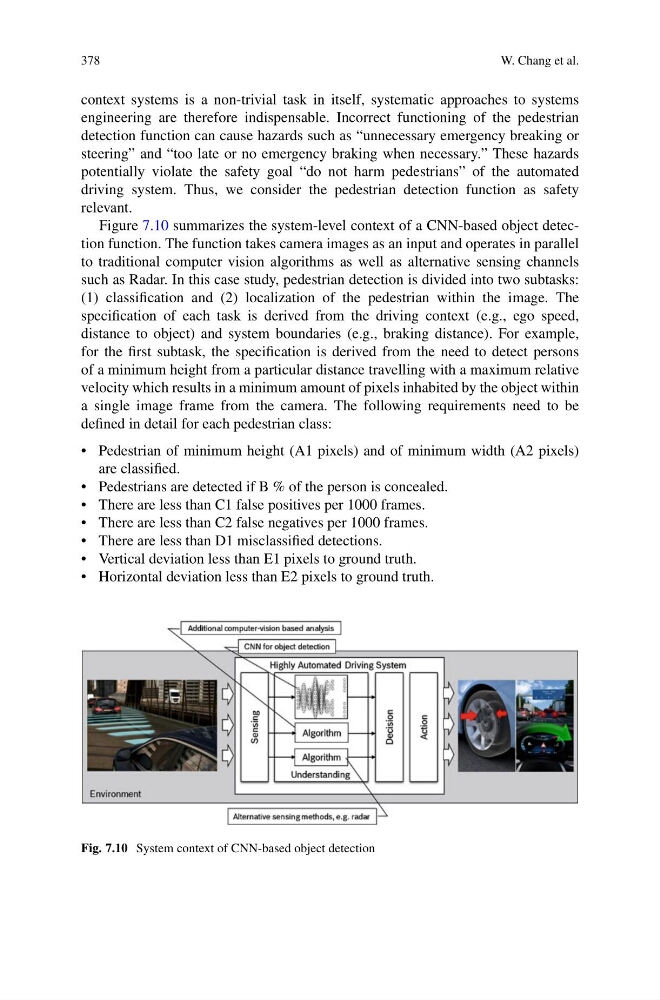
Figure 7.10 summarizes the system-level context of a CNN-based object detection function. The function takes camera images as an input and operates in parallel
to traditional computer vision algorithms as well as alternative sensing channels
such as Radar. In this case study, pedestrian detection is divided into two subtasks:
(1) classification and (2) localization of the pedestrian within the image. The
specification of each task is derived from the driving context (e.g., ego speed,
distance to object) and system boundaries (e.g., braking distance). For example,
for the first subtask, the specification is derived from the need to detect persons
of a minimum height from a particular distance travelling with a maximum relative
velocity which results in a minimum amount of pixels inhabited by the object within
a single image frame from the camera. The following requirements need to be
defined in detail for each pedestrian class:
• Pedestrian of minimum height (A1 pixels) and of minimum width (A2 pixels)
are classified.
• Pedestrians are detected if B % of the person is concealed.
• There are less than C1 false positives per 1000 frames.
• There are less than C2 false negatives per 1000 frames.
• There are less than D1 misclassified detections.
• Vertical deviation less than E1 pixels to ground truth.
• Horizontal deviation less than E2 pixels to ground truth.
Fig. 7.10 System context of CNN-based object detection
W. Chang et al.
context systems is a non-trivial task in itself, systematic approaches to systems
engineering are therefore indispensable. Incorrect functioning of the pedestrian
detection function can cause hazards such as “unnecessary emergency breaking or
steering” and “too late or no emergency braking when necessary.” These hazards
potentially violate the safety goal “do not harm pedestrians” of the automated
driving system. Thus, we consider the pedestrian detection function as safety
relevant.
Figure 7.10 summarizes the system-level context of a CNN-based object detection function. The function takes camera images as an input and operates in parallel
to traditional computer vision algorithms as well as alternative sensing channels
such as Radar. In this case study, pedestrian detection is divided into two subtasks:
(1) classification and (2) localization of the pedestrian within the image. The
specification of each task is derived from the driving context (e.g., ego speed,
distance to object) and system boundaries (e.g., braking distance). For example,
for the first subtask, the specification is derived from the need to detect persons
of a minimum height from a particular distance travelling with a maximum relative
velocity which results in a minimum amount of pixels inhabited by the object within
a single image frame from the camera. The following requirements need to be
defined in detail for each pedestrian class:
• Pedestrian of minimum height (A1 pixels) and of minimum width (A2 pixels)
are classified.
• Pedestrians are detected if B % of the person is concealed.
• There are less than C1 false positives per 1000 frames.
• There are less than C2 false negatives per 1000 frames.
• There are less than D1 misclassified detections.
• Vertical deviation less than E1 pixels to ground truth.
• Horizontal deviation less than E2 pixels to ground truth.
Fig. 7.10 System context of CNN-based object detection