

6 Big Data
353
actionable information from the data. The field of Data Science is one angle from
which to approach the data deluge. Data scientists endeavor to extract meaning and
tell the story of the data in order to provide insight and guidance. Data scientists
have established technologies that uncover relationships and patterns within large
volumes of data that then can be leveraged to predict future behavior and events.
For example, the development of predictive modeling techniques utilizing machine
learning methods was driven by the necessity to address the data explosion. This
technology learns from experience and predicts future outcomes in order to drive
better business decisions. It extracts rules, regularities, patterns, and constraints from
raw data, with the goal of discovering implicit, previously unknown and unexpected,
valuable information from data.
6.5.2 The Cross Industry Standard Process for Data Mining
(CRISP-DM)
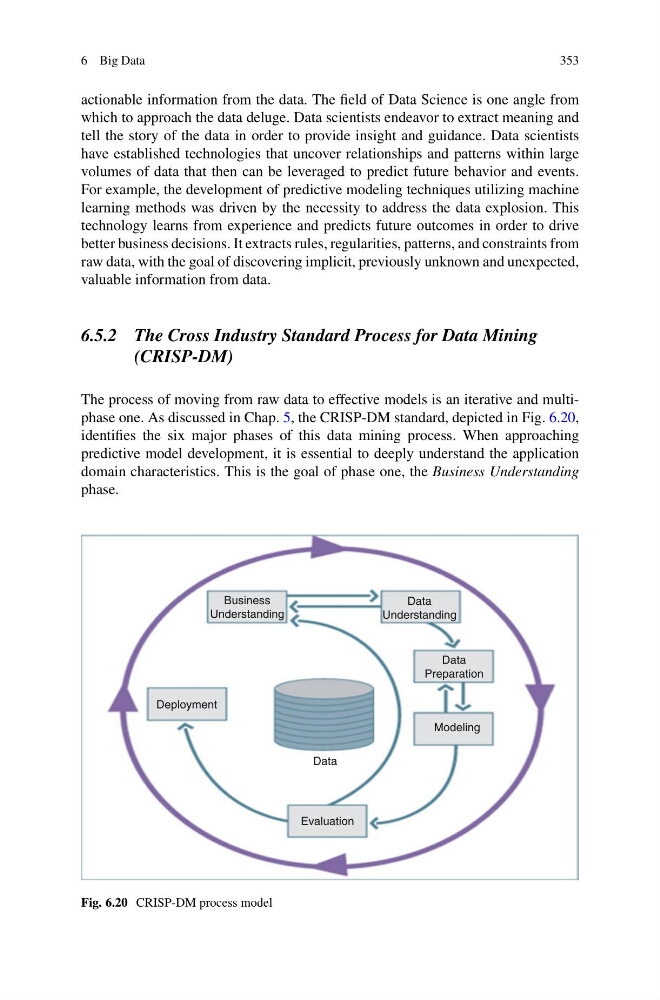
The process of moving from raw data to effective models is an iterative and multiphase one. As discussed in Chap. 5, the CRISP-DM standard, depicted in Fig. 6.20,
identifies the six major phases of this data mining process. When approaching
predictive model development, it is essential to deeply understand the application
domain characteristics. This is the goal of phase one, the Business Understanding
phase.
Deployment
Business
Understanding
Data
Understanding
Data
Preparation
Data
Modeling
Evaluation
Fig. 6.20 CRISP-DM process model
353
actionable information from the data. The field of Data Science is one angle from
which to approach the data deluge. Data scientists endeavor to extract meaning and
tell the story of the data in order to provide insight and guidance. Data scientists
have established technologies that uncover relationships and patterns within large
volumes of data that then can be leveraged to predict future behavior and events.
For example, the development of predictive modeling techniques utilizing machine
learning methods was driven by the necessity to address the data explosion. This
technology learns from experience and predicts future outcomes in order to drive
better business decisions. It extracts rules, regularities, patterns, and constraints from
raw data, with the goal of discovering implicit, previously unknown and unexpected,
valuable information from data.
6.5.2 The Cross Industry Standard Process for Data Mining
(CRISP-DM)
The process of moving from raw data to effective models is an iterative and multiphase one. As discussed in Chap. 5, the CRISP-DM standard, depicted in Fig. 6.20,
identifies the six major phases of this data mining process. When approaching
predictive model development, it is essential to deeply understand the application
domain characteristics. This is the goal of phase one, the Business Understanding
phase.
Deployment
Business
Understanding
Data
Understanding
Data
Preparation
Data
Modeling
Evaluation
Fig. 6.20 CRISP-DM process model