

6 Big Data
317
stark in terms of the sheer volume, speed, and complexity of the data. In parallel,
the value of data is growing in terms of its volume and diversity. Data is emerging as
the world’s newest resource for competitive advantage, as it enables efficient, datadriven decision making. As the value of data continues to grow, new technologies
are emerging to support the new requirements surrounding it.
6.1.1 Defining Big Data
There has been much hype about Big Data in the past several years for various
reasons. Before investigating the major drivers of Big Data’s popularity, we must
first define the meaning of Big Data as a term. Dictionary.com defines Big Data as:
. . . data sets, typically consisting of billions or trillions of records, that are so vast and
complex that they require new and powerful computational resources to process.
The British Dictionary defines Big Data as:
Data held in such large amounts that it can be difficult to process.
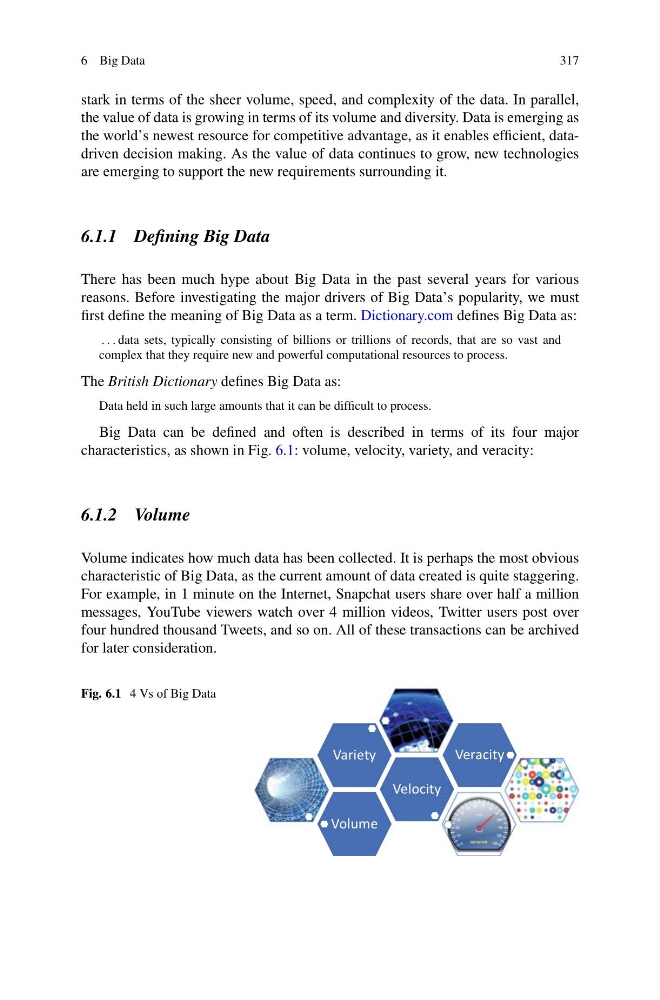
Big Data can be defined and often is described in terms of its four major
characteristics, as shown in Fig. 6.1: volume, velocity, variety, and veracity:
6.1.2 Volume
Volume indicates how much data has been collected. It is perhaps the most obvious
characteristic of Big Data, as the current amount of data created is quite staggering.
For example, in 1 minute on the Internet, Snapchat users share over half a million
messages, YouTube viewers watch over 4 million videos, Twitter users post over
four hundred thousand Tweets, and so on. All of these transactions can be archived
for later consideration.
Fig. 6.1 4 Vs of Big Data
Volume
Velocity
Variety
Veracity
317
stark in terms of the sheer volume, speed, and complexity of the data. In parallel,
the value of data is growing in terms of its volume and diversity. Data is emerging as
the world’s newest resource for competitive advantage, as it enables efficient, datadriven decision making. As the value of data continues to grow, new technologies
are emerging to support the new requirements surrounding it.
6.1.1 Defining Big Data
There has been much hype about Big Data in the past several years for various
reasons. Before investigating the major drivers of Big Data’s popularity, we must
first define the meaning of Big Data as a term. Dictionary.com defines Big Data as:
. . . data sets, typically consisting of billions or trillions of records, that are so vast and
complex that they require new and powerful computational resources to process.
The British Dictionary defines Big Data as:
Data held in such large amounts that it can be difficult to process.
Big Data can be defined and often is described in terms of its four major
characteristics, as shown in Fig. 6.1: volume, velocity, variety, and veracity:
6.1.2 Volume
Volume indicates how much data has been collected. It is perhaps the most obvious
characteristic of Big Data, as the current amount of data created is quite staggering.
For example, in 1 minute on the Internet, Snapchat users share over half a million
messages, YouTube viewers watch over 4 million videos, Twitter users post over
four hundred thousand Tweets, and so on. All of these transactions can be archived
for later consideration.
Fig. 6.1 4 Vs of Big Data
Volume
Velocity
Variety
Veracity