

254
F. Firouzi et al.
Input 1
Input 2
Input 3
Input 4
…
Label
Label
Label
Label
…
Created
Model
New Input
Supervised
Algorithm
Predict the Label
for given input
Input 1
Input 2
Input 3
Input 4
…
Created
Model
New Input
Unsupervised
Algorithm
Likelihood or
cluster/group
ID
Build model
Build model
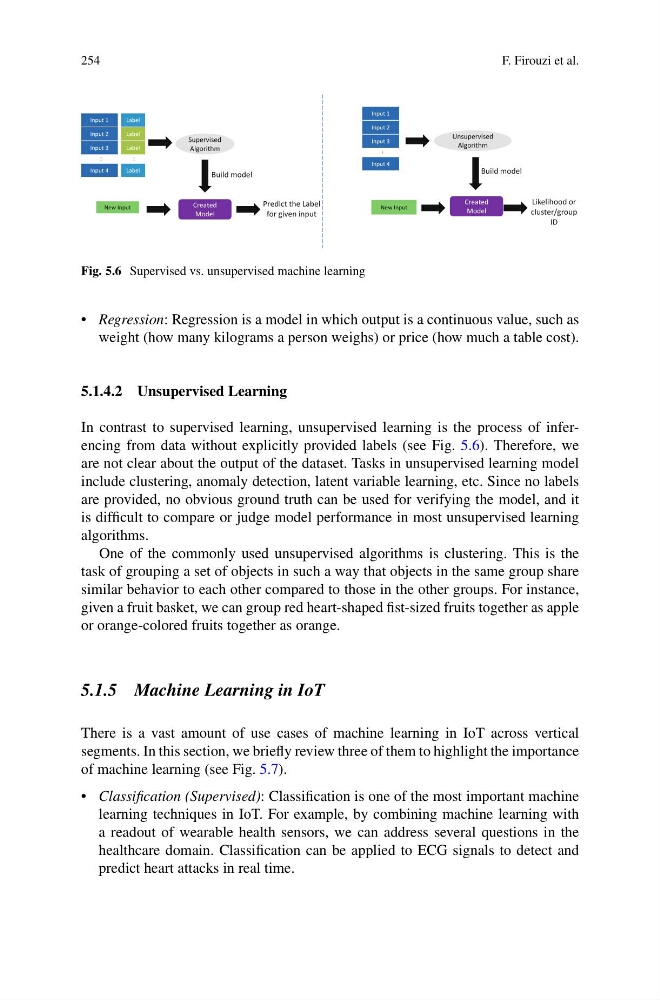
Fig. 5.6 Supervised vs. unsupervised machine learning
• Regression: Regression is a model in which output is a continuous value, such as
weight (how many kilograms a person weighs) or price (how much a table cost).
5.1.4.2 Unsupervised Learning
In contrast to supervised learning, unsupervised learning is the process of inferencing from data without explicitly provided labels (see Fig. 5.6). Therefore, we
are not clear about the output of the dataset. Tasks in unsupervised learning model
include clustering, anomaly detection, latent variable learning, etc. Since no labels
are provided, no obvious ground truth can be used for verifying the model, and it
is difficult to compare or judge model performance in most unsupervised learning
algorithms.
One of the commonly used unsupervised algorithms is clustering. This is the
task of grouping a set of objects in such a way that objects in the same group share
similar behavior to each other compared to those in the other groups. For instance,
given a fruit basket, we can group red heart-shaped fist-sized fruits together as apple
or orange-colored fruits together as orange.
5.1.5 Machine Learning in IoT
There is a vast amount of use cases of machine learning in IoT across vertical
segments. In this section, we briefly review three of them to highlight the importance
of machine learning (see Fig. 5.7).
• Classification (Supervised): Classification is one of the most important machine
learning techniques in IoT. For example, by combining machine learning with
a readout of wearable health sensors, we can address several questions in the
healthcare domain. Classification can be applied to ECG signals to detect and
predict heart attacks in real time.
F. Firouzi et al.
Input 1
Input 2
Input 3
Input 4
…
Label
Label
Label
Label
…
Created
Model
New Input
Supervised
Algorithm
Predict the Label
for given input
Input 1
Input 2
Input 3
Input 4
…
Created
Model
New Input
Unsupervised
Algorithm
Likelihood or
cluster/group
ID
Build model
Build model
Fig. 5.6 Supervised vs. unsupervised machine learning
• Regression: Regression is a model in which output is a continuous value, such as
weight (how many kilograms a person weighs) or price (how much a table cost).
5.1.4.2 Unsupervised Learning
In contrast to supervised learning, unsupervised learning is the process of inferencing from data without explicitly provided labels (see Fig. 5.6). Therefore, we
are not clear about the output of the dataset. Tasks in unsupervised learning model
include clustering, anomaly detection, latent variable learning, etc. Since no labels
are provided, no obvious ground truth can be used for verifying the model, and it
is difficult to compare or judge model performance in most unsupervised learning
algorithms.
One of the commonly used unsupervised algorithms is clustering. This is the
task of grouping a set of objects in such a way that objects in the same group share
similar behavior to each other compared to those in the other groups. For instance,
given a fruit basket, we can group red heart-shaped fist-sized fruits together as apple
or orange-colored fruits together as orange.
5.1.5 Machine Learning in IoT
There is a vast amount of use cases of machine learning in IoT across vertical
segments. In this section, we briefly review three of them to highlight the importance
of machine learning (see Fig. 5.7).
• Classification (Supervised): Classification is one of the most important machine
learning techniques in IoT. For example, by combining machine learning with
a readout of wearable health sensors, we can address several questions in the
healthcare domain. Classification can be applied to ECG signals to detect and
predict heart attacks in real time.