

240
F. Firouzi and B. Farahani
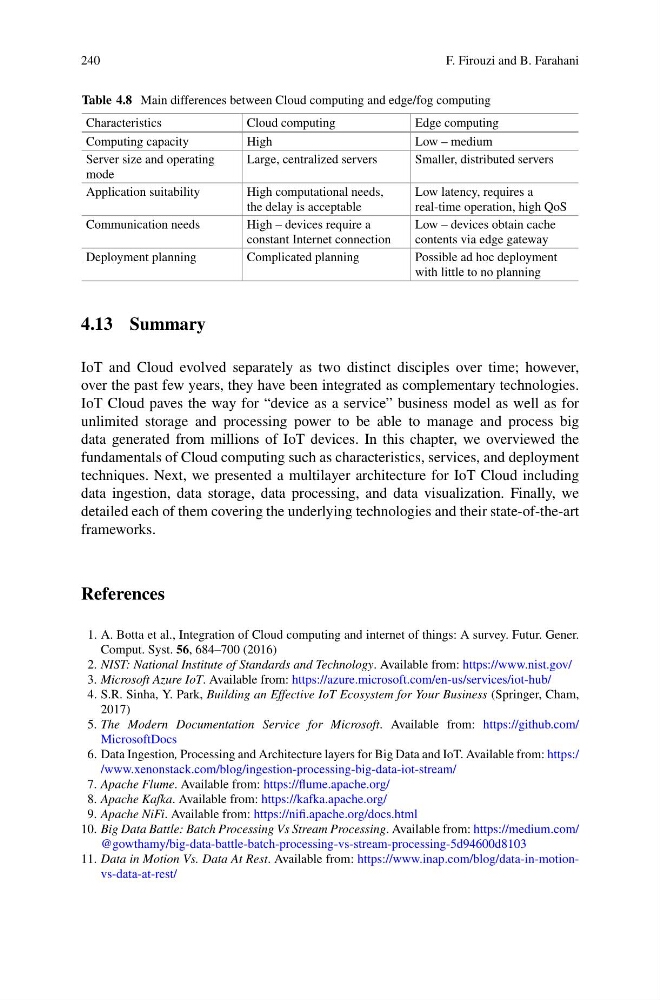
Table 4.8 Main differences between Cloud computing and edge/fog computing
Characteristics
Cloud computing
Edge computing
Computing capacity
High
Low – medium
Server size and operating
mode
Large, centralized servers
Smaller, distributed servers
Application suitability
High computational needs,
the delay is acceptable
Low latency, requires a
real-time operation, high QoS
Communication needs
High – devices require a
constant Internet connection
Low – devices obtain cache
contents via edge gateway
Deployment planning
Complicated planning
Possible ad hoc deployment
with little to no planning
4.13 Summary
IoT and Cloud evolved separately as two distinct disciples over time; however,
over the past few years, they have been integrated as complementary technologies.
IoT Cloud paves the way for “device as a service” business model as well as for
unlimited storage and processing power to be able to manage and process big
data generated from millions of IoT devices. In this chapter, we overviewed the
fundamentals of Cloud computing such as characteristics, services, and deployment
techniques. Next, we presented a multilayer architecture for IoT Cloud including
data ingestion, data storage, data processing, and data visualization. Finally, we
detailed each of them covering the underlying technologies and their state-of-the-art
frameworks.
References
1. A. Botta et al., Integration of Cloud computing and internet of things: A survey. Futur. Gener.
Comput. Syst. 56, 684–700 (2016)
2. NIST: National Institute of Standards and Technology. Available from: https://www.nist.gov/
3. Microsoft Azure IoT. Available from: https://azure.microsoft.com/en-us/services/iot-hub/
4. S.R. Sinha, Y. Park, Building an Effective IoT Ecosystem for Your Business (Springer, Cham,
2017)
5. The Modern Documentation Service for Microsoft. Available from: https://github.com/
MicrosoftDocs
6. Data Ingestion, Processing and Architecture layers for Big Data and IoT. Available from: https:/
/www.xenonstack.com/blog/ingestion-processing-big-data-iot-stream/
7. Apache Flume. Available from: https://flume.apache.org/
8. Apache Kafka. Available from: https://kafka.apache.org/
9. Apache NiFi. Available from: https://nifi.apache.org/docs.html
10. Big Data Battle: Batch Processing Vs Stream Processing. Available from: https://medium.com/
@gowthamy/big-data-battle-batch-processing-vs-stream-processing-5d94600d8103
11. Data in Motion Vs. Data At Rest. Available from: https://www.inap.com/blog/data-in-motionvs-data-at-rest/
F. Firouzi and B. Farahani
Table 4.8 Main differences between Cloud computing and edge/fog computing
Characteristics
Cloud computing
Edge computing
Computing capacity
High
Low – medium
Server size and operating
mode
Large, centralized servers
Smaller, distributed servers
Application suitability
High computational needs,
the delay is acceptable
Low latency, requires a
real-time operation, high QoS
Communication needs
High – devices require a
constant Internet connection
Low – devices obtain cache
contents via edge gateway
Deployment planning
Complicated planning
Possible ad hoc deployment
with little to no planning
4.13 Summary
IoT and Cloud evolved separately as two distinct disciples over time; however,
over the past few years, they have been integrated as complementary technologies.
IoT Cloud paves the way for “device as a service” business model as well as for
unlimited storage and processing power to be able to manage and process big
data generated from millions of IoT devices. In this chapter, we overviewed the
fundamentals of Cloud computing such as characteristics, services, and deployment
techniques. Next, we presented a multilayer architecture for IoT Cloud including
data ingestion, data storage, data processing, and data visualization. Finally, we
detailed each of them covering the underlying technologies and their state-of-the-art
frameworks.
References
1. A. Botta et al., Integration of Cloud computing and internet of things: A survey. Futur. Gener.
Comput. Syst. 56, 684–700 (2016)
2. NIST: National Institute of Standards and Technology. Available from: https://www.nist.gov/
3. Microsoft Azure IoT. Available from: https://azure.microsoft.com/en-us/services/iot-hub/
4. S.R. Sinha, Y. Park, Building an Effective IoT Ecosystem for Your Business (Springer, Cham,
2017)
5. The Modern Documentation Service for Microsoft. Available from: https://github.com/
MicrosoftDocs
6. Data Ingestion, Processing and Architecture layers for Big Data and IoT. Available from: https:/
/www.xenonstack.com/blog/ingestion-processing-big-data-iot-stream/
7. Apache Flume. Available from: https://flume.apache.org/
8. Apache Kafka. Available from: https://kafka.apache.org/
9. Apache NiFi. Available from: https://nifi.apache.org/docs.html
10. Big Data Battle: Batch Processing Vs Stream Processing. Available from: https://medium.com/
@gowthamy/big-data-battle-batch-processing-vs-stream-processing-5d94600d8103
11. Data in Motion Vs. Data At Rest. Available from: https://www.inap.com/blog/data-in-motionvs-data-at-rest/