

202
F. Firouzi and B. Farahani
Row key
c
Column name 1
Value 1
Timestamp 1
Time-to-live 1
Column name n
Value n
Timestamp n
Time-to-live n
Billion of columns
…
s
n
m
u
l
o
c
f
o
n
o
i
l
l
i
B
…
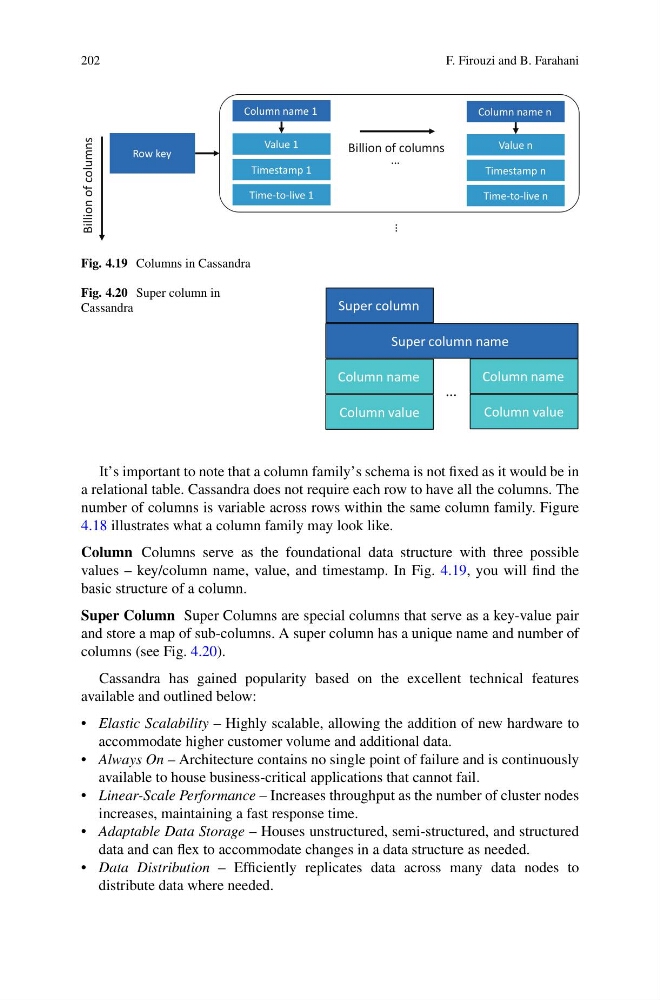
Fig. 4.19 Columns in Cassandra
Fig. 4.20 Super column in
Cassandra
Super column
Super column name
Column name
Column value
Column name
Column value
…
It’s important to note that a column family’s schema is not fixed as it would be in
a relational table. Cassandra does not require each row to have all the columns. The
number of columns is variable across rows within the same column family. Figure
4.18 illustrates what a column family may look like.
Column Columns serve as the foundational data structure with three possible
values – key/column name, value, and timestamp. In Fig. 4.19, you will find the
basic structure of a column.
Super Column Super Columns are special columns that serve as a key-value pair
and store a map of sub-columns. A super column has a unique name and number of
columns (see Fig. 4.20).
Cassandra has gained popularity based on the excellent technical features
available and outlined below:
• Elastic Scalability – Highly scalable, allowing the addition of new hardware to
accommodate higher customer volume and additional data.
• Always On – Architecture contains no single point of failure and is continuously
available to house business-critical applications that cannot fail.
• Linear-Scale Performance – Increases throughput as the number of cluster nodes
increases, maintaining a fast response time.
• Adaptable Data Storage – Houses unstructured, semi-structured, and structured
data and can flex to accommodate changes in a data structure as needed.
• Data Distribution – Efficiently replicates data across many data nodes to
distribute data where needed.
F. Firouzi and B. Farahani
Row key
c
Column name 1
Value 1
Timestamp 1
Time-to-live 1
Column name n
Value n
Timestamp n
Time-to-live n
Billion of columns
…
s
n
m
u
l
o
c
f
o
n
o
i
l
l
i
B
…
Fig. 4.19 Columns in Cassandra
Fig. 4.20 Super column in
Cassandra
Super column
Super column name
Column name
Column value
Column name
Column value
…
It’s important to note that a column family’s schema is not fixed as it would be in
a relational table. Cassandra does not require each row to have all the columns. The
number of columns is variable across rows within the same column family. Figure
4.18 illustrates what a column family may look like.
Column Columns serve as the foundational data structure with three possible
values – key/column name, value, and timestamp. In Fig. 4.19, you will find the
basic structure of a column.
Super Column Super Columns are special columns that serve as a key-value pair
and store a map of sub-columns. A super column has a unique name and number of
columns (see Fig. 4.20).
Cassandra has gained popularity based on the excellent technical features
available and outlined below:
• Elastic Scalability – Highly scalable, allowing the addition of new hardware to
accommodate higher customer volume and additional data.
• Always On – Architecture contains no single point of failure and is continuously
available to house business-critical applications that cannot fail.
• Linear-Scale Performance – Increases throughput as the number of cluster nodes
increases, maintaining a fast response time.
• Adaptable Data Storage – Houses unstructured, semi-structured, and structured
data and can flex to accommodate changes in a data structure as needed.
• Data Distribution – Efficiently replicates data across many data nodes to
distribute data where needed.