

194
F. Firouzi and B. Farahani
• Warm storage – This repository, which usually implemented by data warehouses
or databases, intends to store structured data that is accessed moderately frequently.
• Hot storage – This repository is accessed very frequently and hence should be
implemented by fast in-memory databases.
4.6.1 Database
Databases can be categorized into two different groups, namely, SQL databases and
NoSQL databases.
• What Is SQL?
Structured Query Language, abbreviated as “SQL” and pronounced S-Q-L, is
the standard language used when working with Relational Database Management
Systems (RDBMS) including MySQL, PostgreSQL, Oracle, and MS SQL Server,
etc. SQL can be used to simply insert, update, search, or delete database records, but
it’s also suitable for more complex database maintenance and optimization tasks.
Relational Database Management Systems (RDBMS) are the foundation of many
modern databases such as MS Access, MS SQL Server, IBM DB2, Oracle, and
MySQL. An RDBMS is a database management system (DBMS) established using
a relational model first presented by E.F. Codd. In other words, an RDBMS is a type
of DBMS with a row-based table structure which can be accessed by Structured
Query Language (SQL). Therefore, the difference between SQL and RDBMS is
that RDBMS is the actual database software responsible for handling data storage,
updates, queries, and everything else. On the other hand, SQL is a language used to
interact with the system. To better understand RDBMS and SQL, it is very important
to get familiar with the following terminologies:
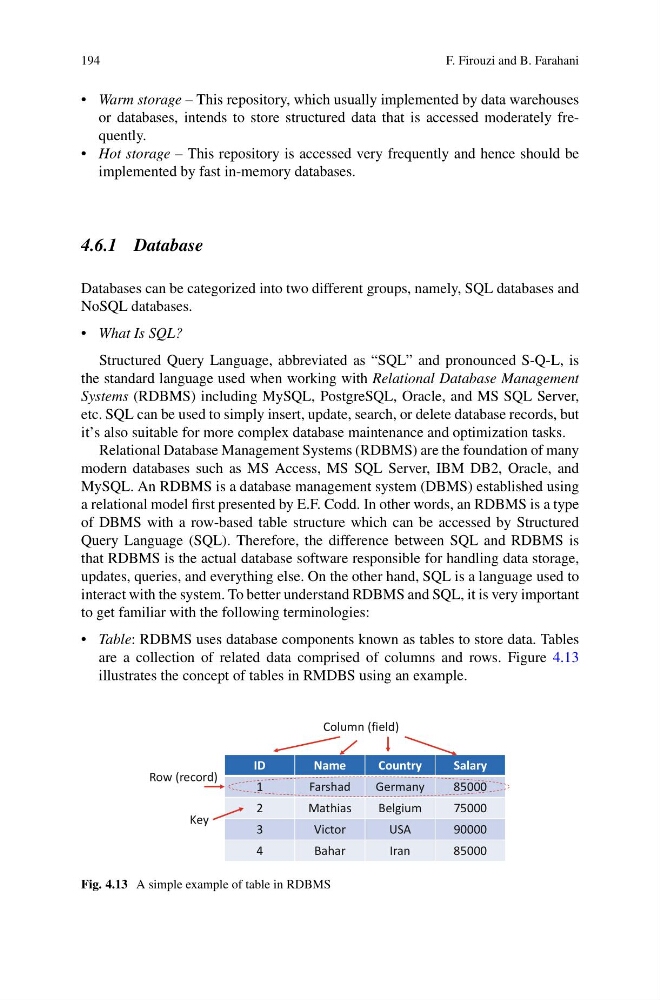
• Table: RDBMS uses database components known as tables to store data. Tables
are a collection of related data comprised of columns and rows. Figure 4.13
illustrates the concept of tables in RMDBS using an example.
ID
Name
Country
Salary
1
Farshad
Germany
85000
2
Mathias
Belgium
75000
3
Victor
USA
90000
4
Bahar
Iran
85000
Row (record)
Column (field)
Key
Fig. 4.13 A simple example of table in RDBMS
F. Firouzi and B. Farahani
• Warm storage – This repository, which usually implemented by data warehouses
or databases, intends to store structured data that is accessed moderately frequently.
• Hot storage – This repository is accessed very frequently and hence should be
implemented by fast in-memory databases.
4.6.1 Database
Databases can be categorized into two different groups, namely, SQL databases and
NoSQL databases.
• What Is SQL?
Structured Query Language, abbreviated as “SQL” and pronounced S-Q-L, is
the standard language used when working with Relational Database Management
Systems (RDBMS) including MySQL, PostgreSQL, Oracle, and MS SQL Server,
etc. SQL can be used to simply insert, update, search, or delete database records, but
it’s also suitable for more complex database maintenance and optimization tasks.
Relational Database Management Systems (RDBMS) are the foundation of many
modern databases such as MS Access, MS SQL Server, IBM DB2, Oracle, and
MySQL. An RDBMS is a database management system (DBMS) established using
a relational model first presented by E.F. Codd. In other words, an RDBMS is a type
of DBMS with a row-based table structure which can be accessed by Structured
Query Language (SQL). Therefore, the difference between SQL and RDBMS is
that RDBMS is the actual database software responsible for handling data storage,
updates, queries, and everything else. On the other hand, SQL is a language used to
interact with the system. To better understand RDBMS and SQL, it is very important
to get familiar with the following terminologies:
• Table: RDBMS uses database components known as tables to store data. Tables
are a collection of related data comprised of columns and rows. Figure 4.13
illustrates the concept of tables in RMDBS using an example.
ID
Name
Country
Salary
1
Farshad
Germany
85000
2
Mathias
Belgium
75000
3
Victor
USA
90000
4
Bahar
Iran
85000
Row (record)
Column (field)
Key
Fig. 4.13 A simple example of table in RDBMS