

4 Architecting IoT Cloud
175
variety, and velocity. An important Cloud/IoT integration motivator is the largescale, long-life data storage made possible by the limitless, cost-effective, highly
available storage capacity of the Cloud. Because Cloud is the most suitable
solution to manage IoT data, it creates new opportunities for data aggregation,
integration, and data sharing. After data has been stored in the Cloud, it can be
treated through simple APIs, guarded by world-class security, and accessed and
visualized remotely at any time.
• Computation – Due to processing and energy resource limitations, IoT devices
cannot process complex data on-site. Collected IoT Data must be transferred
to powerful nodes capable of aggregation and processing; however, scalability
is difficult to attain without the right infrastructure. Cloud provides limitless
processing and on-demand usage. This brings another important Cloud/IoT
motivation to the forefront. With the help of Cloud, IoT processing requirements
can be met (e.g., completing holistic data analysis, utilizing scalable, shared
applications, and handling complex tasks).
• Things as a Service – The Internet of Things can be also be thought of as a
network of networks where countless connections generate several opportunities.
An integrated Cloud/IoT model allows the evolution of smart services and
applications as the Cloud expands through things. This enables the Cloud to
handle new, real-life situations and create a Things as a Service model. This
is another key motivator for Cloud/IoT integration as new business models are
created by this particular driver.
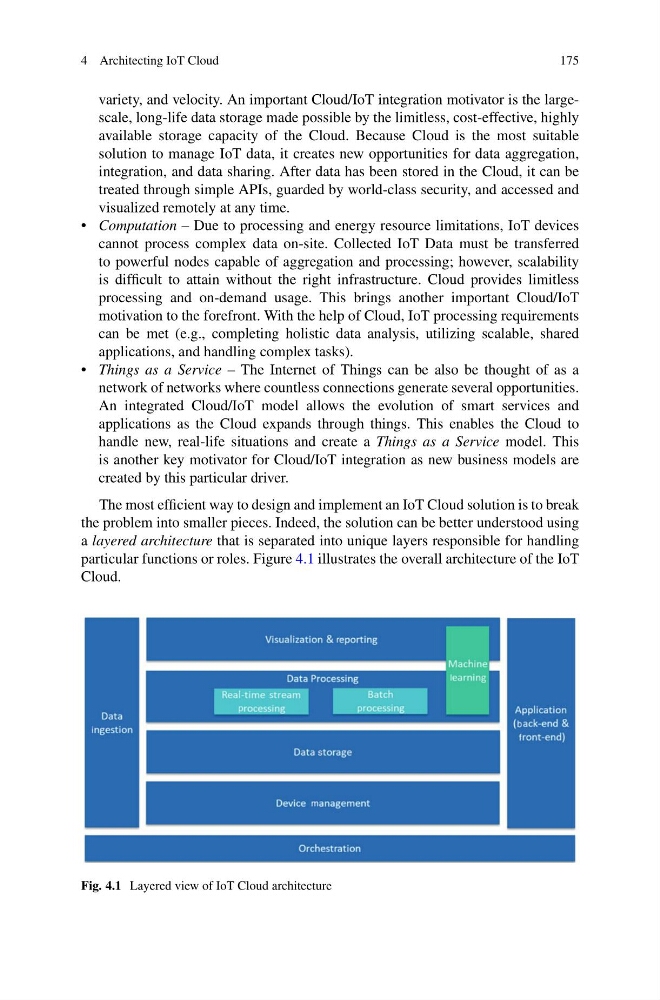
The most efficient way to design and implement an IoT Cloud solution is to break
the problem into smaller pieces. Indeed, the solution can be better understood using
a layered architecture that is separated into unique layers responsible for handling
particular functions or roles. Figure 4.1 illustrates the overall architecture of the IoT
Cloud.
Fig. 4.1 Layered view of IoT Cloud architecture
175
variety, and velocity. An important Cloud/IoT integration motivator is the largescale, long-life data storage made possible by the limitless, cost-effective, highly
available storage capacity of the Cloud. Because Cloud is the most suitable
solution to manage IoT data, it creates new opportunities for data aggregation,
integration, and data sharing. After data has been stored in the Cloud, it can be
treated through simple APIs, guarded by world-class security, and accessed and
visualized remotely at any time.
• Computation – Due to processing and energy resource limitations, IoT devices
cannot process complex data on-site. Collected IoT Data must be transferred
to powerful nodes capable of aggregation and processing; however, scalability
is difficult to attain without the right infrastructure. Cloud provides limitless
processing and on-demand usage. This brings another important Cloud/IoT
motivation to the forefront. With the help of Cloud, IoT processing requirements
can be met (e.g., completing holistic data analysis, utilizing scalable, shared
applications, and handling complex tasks).
• Things as a Service – The Internet of Things can be also be thought of as a
network of networks where countless connections generate several opportunities.
An integrated Cloud/IoT model allows the evolution of smart services and
applications as the Cloud expands through things. This enables the Cloud to
handle new, real-life situations and create a Things as a Service model. This
is another key motivator for Cloud/IoT integration as new business models are
created by this particular driver.
The most efficient way to design and implement an IoT Cloud solution is to break
the problem into smaller pieces. Indeed, the solution can be better understood using
a layered architecture that is separated into unique layers responsible for handling
particular functions or roles. Figure 4.1 illustrates the overall architecture of the IoT
Cloud.
Fig. 4.1 Layered view of IoT Cloud architecture