

138
E. Fraccaroli and D. Quaglia
1. the data exchange between 6LoWPAN devices and the Internet (or other IPv6
network);
2. local data exchange between devices inside the 6LoWPAN;
3. the generation and maintenance of the radio subnet (the 6LoWPAN network).
3.3.15 Thread
Thread is an IPv6-based networking protocol targeted for use in low-power,
embedded consumer, and commercial IoT devices. Thread’s original contribution in
the IoT protocol context is a secure and reliable mesh network with no single point
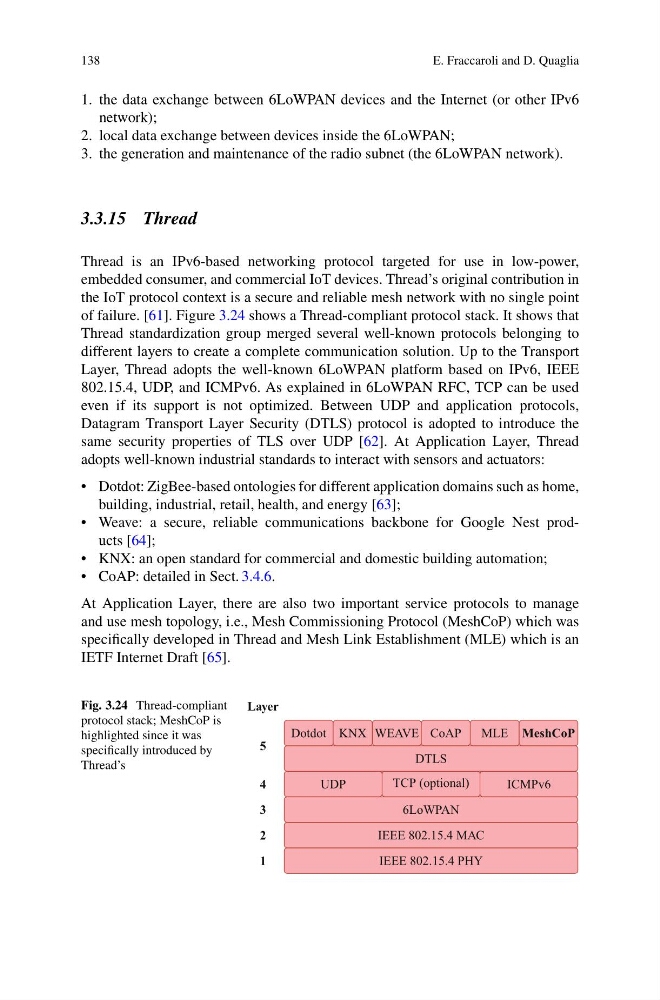
of failure. [61]. Figure 3.24 shows a Thread-compliant protocol stack. It shows that
Thread standardization group merged several well-known protocols belonging to
different layers to create a complete communication solution. Up to the Transport
Layer, Thread adopts the well-known 6LoWPAN platform based on IPv6, IEEE
802.15.4, UDP, and ICMPv6. As explained in 6LoWPAN RFC, TCP can be used
even if its support is not optimized. Between UDP and application protocols,
Datagram Transport Layer Security (DTLS) protocol is adopted to introduce the
same security properties of TLS over UDP [62]. At Application Layer, Thread
adopts well-known industrial standards to interact with sensors and actuators:
• Dotdot: ZigBee-based ontologies for different application domains such as home,
building, industrial, retail, health, and energy [63];
• Weave: a secure, reliable communications backbone for Google Nest products [64];
• KNX: an open standard for commercial and domestic building automation;
• CoAP: detailed in Sect. 3.4.6.
At Application Layer, there are also two important service protocols to manage
and use mesh topology, i.e., Mesh Commissioning Protocol (MeshCoP) which was
specifically developed in Thread and Mesh Link Establishment (MLE) which is an
IETF Internet Draft [65].
Fig. 3.24 Thread-compliant
protocol stack; MeshCoP is
highlighted since it was
specifically introduced by
Thread’s
IEEE 802.15.4 PHY
IEEE 802.15.4 MAC
6LoWPAN
UDP
TCP (optional)
ICMPv6
DTLS
Dotdot KNX WEAVE CoAP
MLE MeshCoP
1
2
3
4
5
Layer
E. Fraccaroli and D. Quaglia
1. the data exchange between 6LoWPAN devices and the Internet (or other IPv6
network);
2. local data exchange between devices inside the 6LoWPAN;
3. the generation and maintenance of the radio subnet (the 6LoWPAN network).
3.3.15 Thread
Thread is an IPv6-based networking protocol targeted for use in low-power,
embedded consumer, and commercial IoT devices. Thread’s original contribution in
the IoT protocol context is a secure and reliable mesh network with no single point
of failure. [61]. Figure 3.24 shows a Thread-compliant protocol stack. It shows that
Thread standardization group merged several well-known protocols belonging to
different layers to create a complete communication solution. Up to the Transport
Layer, Thread adopts the well-known 6LoWPAN platform based on IPv6, IEEE
802.15.4, UDP, and ICMPv6. As explained in 6LoWPAN RFC, TCP can be used
even if its support is not optimized. Between UDP and application protocols,
Datagram Transport Layer Security (DTLS) protocol is adopted to introduce the
same security properties of TLS over UDP [62]. At Application Layer, Thread
adopts well-known industrial standards to interact with sensors and actuators:
• Dotdot: ZigBee-based ontologies for different application domains such as home,
building, industrial, retail, health, and energy [63];
• Weave: a secure, reliable communications backbone for Google Nest products [64];
• KNX: an open standard for commercial and domestic building automation;
• CoAP: detailed in Sect. 3.4.6.
At Application Layer, there are also two important service protocols to manage
and use mesh topology, i.e., Mesh Commissioning Protocol (MeshCoP) which was
specifically developed in Thread and Mesh Link Establishment (MLE) which is an
IETF Internet Draft [65].
Fig. 3.24 Thread-compliant
protocol stack; MeshCoP is
highlighted since it was
specifically introduced by
Thread’s
IEEE 802.15.4 PHY
IEEE 802.15.4 MAC
6LoWPAN
UDP
TCP (optional)
ICMPv6
DTLS
Dotdot KNX WEAVE CoAP
MLE MeshCoP
1
2
3
4
5
Layer