

3 Engineering IoT Networks
133
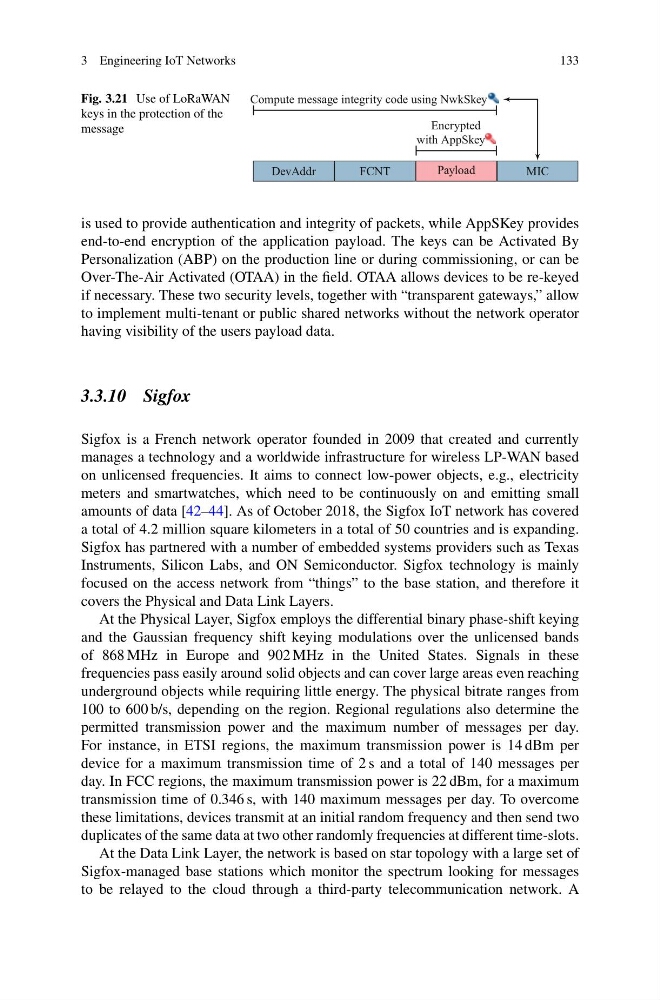
Fig. 3.21 Use of LoRaWAN
keys in the protection of the
message
DevAddr
FCNT
Payload
MIC
Encrypted
with AppSkey
Compute message integrity code using NwkSkey
is used to provide authentication and integrity of packets, while AppSKey provides
end-to-end encryption of the application payload. The keys can be Activated By
Personalization (ABP) on the production line or during commissioning, or can be
Over-The-Air Activated (OTAA) in the field. OTAA allows devices to be re-keyed
if necessary. These two security levels, together with “transparent gateways,” allow
to implement multi-tenant or public shared networks without the network operator
having visibility of the users payload data.
3.3.10 Sigfox
Sigfox is a French network operator founded in 2009 that created and currently
manages a technology and a worldwide infrastructure for wireless LP-WAN based
on unlicensed frequencies. It aims to connect low-power objects, e.g., electricity
meters and smartwatches, which need to be continuously on and emitting small
amounts of data [42–44]. As of October 2018, the Sigfox IoT network has covered
a total of 4.2 million square kilometers in a total of 50 countries and is expanding.
Sigfox has partnered with a number of embedded systems providers such as Texas
Instruments, Silicon Labs, and ON Semiconductor. Sigfox technology is mainly
focused on the access network from “things” to the base station, and therefore it
covers the Physical and Data Link Layers.
At the Physical Layer, Sigfox employs the differential binary phase-shift keying
and the Gaussian frequency shift keying modulations over the unlicensed bands
of 868 MHz in Europe and 902 MHz in the United States. Signals in these
frequencies pass easily around solid objects and can cover large areas even reaching
underground objects while requiring little energy. The physical bitrate ranges from
100 to 600 b/s, depending on the region. Regional regulations also determine the
permitted transmission power and the maximum number of messages per day.
For instance, in ETSI regions, the maximum transmission power is 14 dBm per
device for a maximum transmission time of 2 s and a total of 140 messages per
day. In FCC regions, the maximum transmission power is 22 dBm, for a maximum
transmission time of 0.346 s, with 140 maximum messages per day. To overcome
these limitations, devices transmit at an initial random frequency and then send two
duplicates of the same data at two other randomly frequencies at different time-slots.
At the Data Link Layer, the network is based on star topology with a large set of
Sigfox-managed base stations which monitor the spectrum looking for messages
to be relayed to the cloud through a third-party telecommunication network. A
133
Fig. 3.21 Use of LoRaWAN
keys in the protection of the
message
DevAddr
FCNT
Payload
MIC
Encrypted
with AppSkey
Compute message integrity code using NwkSkey
is used to provide authentication and integrity of packets, while AppSKey provides
end-to-end encryption of the application payload. The keys can be Activated By
Personalization (ABP) on the production line or during commissioning, or can be
Over-The-Air Activated (OTAA) in the field. OTAA allows devices to be re-keyed
if necessary. These two security levels, together with “transparent gateways,” allow
to implement multi-tenant or public shared networks without the network operator
having visibility of the users payload data.
3.3.10 Sigfox
Sigfox is a French network operator founded in 2009 that created and currently
manages a technology and a worldwide infrastructure for wireless LP-WAN based
on unlicensed frequencies. It aims to connect low-power objects, e.g., electricity
meters and smartwatches, which need to be continuously on and emitting small
amounts of data [42–44]. As of October 2018, the Sigfox IoT network has covered
a total of 4.2 million square kilometers in a total of 50 countries and is expanding.
Sigfox has partnered with a number of embedded systems providers such as Texas
Instruments, Silicon Labs, and ON Semiconductor. Sigfox technology is mainly
focused on the access network from “things” to the base station, and therefore it
covers the Physical and Data Link Layers.
At the Physical Layer, Sigfox employs the differential binary phase-shift keying
and the Gaussian frequency shift keying modulations over the unlicensed bands
of 868 MHz in Europe and 902 MHz in the United States. Signals in these
frequencies pass easily around solid objects and can cover large areas even reaching
underground objects while requiring little energy. The physical bitrate ranges from
100 to 600 b/s, depending on the region. Regional regulations also determine the
permitted transmission power and the maximum number of messages per day.
For instance, in ETSI regions, the maximum transmission power is 14 dBm per
device for a maximum transmission time of 2 s and a total of 140 messages per
day. In FCC regions, the maximum transmission power is 22 dBm, for a maximum
transmission time of 0.346 s, with 140 maximum messages per day. To overcome
these limitations, devices transmit at an initial random frequency and then send two
duplicates of the same data at two other randomly frequencies at different time-slots.
At the Data Link Layer, the network is based on star topology with a large set of
Sigfox-managed base stations which monitor the spectrum looking for messages
to be relayed to the cloud through a third-party telecommunication network. A