

114
E. Fraccaroli and D. Quaglia
Active
Device
Passive
Tag
Power
Data
Passive
Device
Active
Reader
Power
Data
Active
Device
Active
Reader
Data
a
b
c
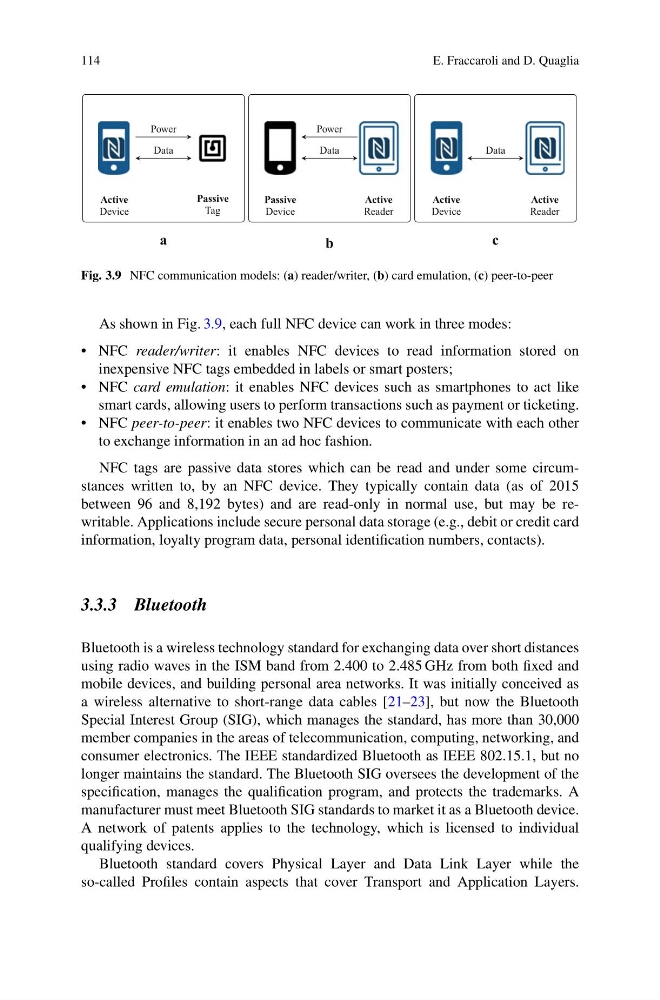
Fig. 3.9 NFC communication models: (a) reader/writer, (b) card emulation, (c) peer-to-peer
As shown in Fig. 3.9, each full NFC device can work in three modes:
• NFC reader/writer: it enables NFC devices to read information stored on
inexpensive NFC tags embedded in labels or smart posters;
• NFC card emulation: it enables NFC devices such as smartphones to act like
smart cards, allowing users to perform transactions such as payment or ticketing.
• NFC peer-to-peer: it enables two NFC devices to communicate with each other
to exchange information in an ad hoc fashion.
NFC tags are passive data stores which can be read and under some circumstances written to, by an NFC device. They typically contain data (as of 2015
between 96 and 8,192 bytes) and are read-only in normal use, but may be rewritable. Applications include secure personal data storage (e.g., debit or credit card
information, loyalty program data, personal identification numbers, contacts).
3.3.3 Bluetooth
Bluetooth is a wireless technology standard for exchanging data over short distances
using radio waves in the ISM band from 2.400 to 2.485 GHz from both fixed and
mobile devices, and building personal area networks. It was initially conceived as
a wireless alternative to short-range data cables [21–23], but now the Bluetooth
Special Interest Group (SIG), which manages the standard, has more than 30,000
member companies in the areas of telecommunication, computing, networking, and
consumer electronics. The IEEE standardized Bluetooth as IEEE 802.15.1, but no
longer maintains the standard. The Bluetooth SIG oversees the development of the
specification, manages the qualification program, and protects the trademarks. A
manufacturer must meet Bluetooth SIG standards to market it as a Bluetooth device.
A network of patents applies to the technology, which is licensed to individual
qualifying devices.
Bluetooth standard covers Physical Layer and Data Link Layer while the
so-called Profiles contain aspects that cover Transport and Application Layers.
E. Fraccaroli and D. Quaglia
Active
Device
Passive
Tag
Power
Data
Passive
Device
Active
Reader
Power
Data
Active
Device
Active
Reader
Data
a
b
c
Fig. 3.9 NFC communication models: (a) reader/writer, (b) card emulation, (c) peer-to-peer
As shown in Fig. 3.9, each full NFC device can work in three modes:
• NFC reader/writer: it enables NFC devices to read information stored on
inexpensive NFC tags embedded in labels or smart posters;
• NFC card emulation: it enables NFC devices such as smartphones to act like
smart cards, allowing users to perform transactions such as payment or ticketing.
• NFC peer-to-peer: it enables two NFC devices to communicate with each other
to exchange information in an ad hoc fashion.
NFC tags are passive data stores which can be read and under some circumstances written to, by an NFC device. They typically contain data (as of 2015
between 96 and 8,192 bytes) and are read-only in normal use, but may be rewritable. Applications include secure personal data storage (e.g., debit or credit card
information, loyalty program data, personal identification numbers, contacts).
3.3.3 Bluetooth
Bluetooth is a wireless technology standard for exchanging data over short distances
using radio waves in the ISM band from 2.400 to 2.485 GHz from both fixed and
mobile devices, and building personal area networks. It was initially conceived as
a wireless alternative to short-range data cables [21–23], but now the Bluetooth
Special Interest Group (SIG), which manages the standard, has more than 30,000
member companies in the areas of telecommunication, computing, networking, and
consumer electronics. The IEEE standardized Bluetooth as IEEE 802.15.1, but no
longer maintains the standard. The Bluetooth SIG oversees the development of the
specification, manages the qualification program, and protects the trademarks. A
manufacturer must meet Bluetooth SIG standards to market it as a Bluetooth device.
A network of patents applies to the technology, which is licensed to individual
qualifying devices.
Bluetooth standard covers Physical Layer and Data Link Layer while the
so-called Profiles contain aspects that cover Transport and Application Layers.