

3 Engineering IoT Networks
111
Layer 5
Application
Layer 4
Transport
Layer 3
Network
Layer 2
Data Link
Layer 1
Physical
Z-Wave
Wireless M-Bus
Classic Bluetooth, Bluetooth 4.0, Bluetooth 5.0
IEEE 802.15.4
ZigBee
WirelessHART
6LoWPAN
UDP
Thread (MeshCoP)
IPv4, IPv6
TCP
UDP
MQTT, AMQP
CoAP
XMPP
Websocket
OPC-UA
HTTP
HTTPS
SOAP
REST
TCP/IP/Ethernet, Serial Link (RS-232, RS-485)
Modbus
ISA100.11a
SigFox
Wi-Fi (IEEE 802.11 family)
LoRa
LoRaWAN
Cellular Networks (2G/3G/4G/5G)
NB-IoT, LTE Cat M1
NFC / RFID
Optical Wireless Communications
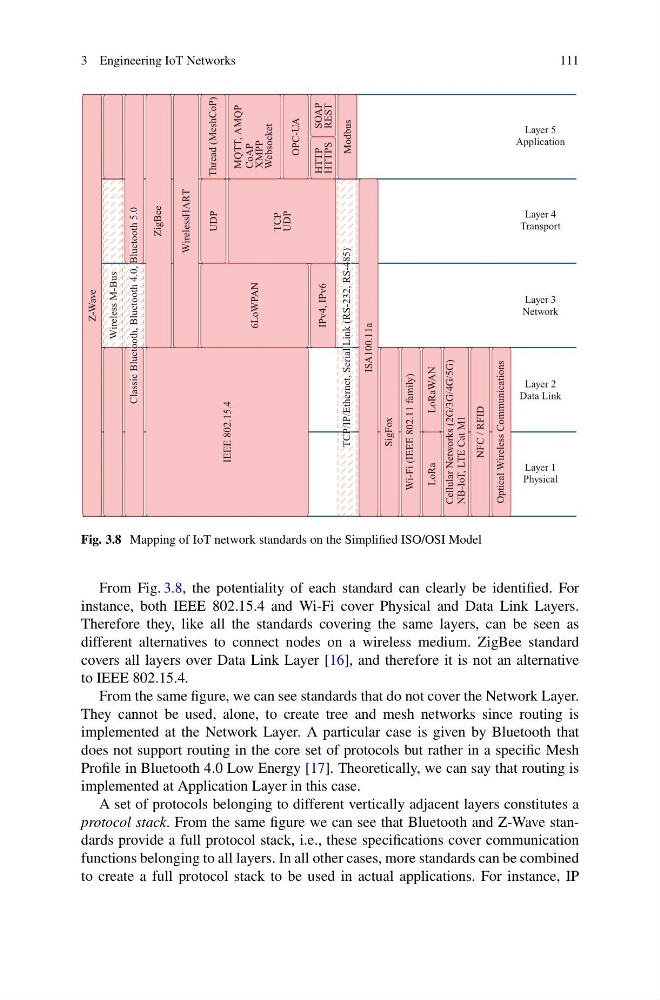
Fig. 3.8 Mapping of IoT network standards on the Simplified ISO/OSI Model
From Fig. 3.8, the potentiality of each standard can clearly be identified. For
instance, both IEEE 802.15.4 and Wi-Fi cover Physical and Data Link Layers.
Therefore they, like all the standards covering the same layers, can be seen as
different alternatives to connect nodes on a wireless medium. ZigBee standard
covers all layers over Data Link Layer [16], and therefore it is not an alternative
to IEEE 802.15.4.
From the same figure, we can see standards that do not cover the Network Layer.
They cannot be used, alone, to create tree and mesh networks since routing is
implemented at the Network Layer. A particular case is given by Bluetooth that
does not support routing in the core set of protocols but rather in a specific Mesh
Profile in Bluetooth 4.0 Low Energy [17]. Theoretically, we can say that routing is
implemented at Application Layer in this case.
A set of protocols belonging to different vertically adjacent layers constitutes a
protocol stack. From the same figure we can see that Bluetooth and Z-Wave standards provide a full protocol stack, i.e., these specifications cover communication
functions belonging to all layers. In all other cases, more standards can be combined
to create a full protocol stack to be used in actual applications. For instance, IP
111
Layer 5
Application
Layer 4
Transport
Layer 3
Network
Layer 2
Data Link
Layer 1
Physical
Z-Wave
Wireless M-Bus
Classic Bluetooth, Bluetooth 4.0, Bluetooth 5.0
IEEE 802.15.4
ZigBee
WirelessHART
6LoWPAN
UDP
Thread (MeshCoP)
IPv4, IPv6
TCP
UDP
MQTT, AMQP
CoAP
XMPP
Websocket
OPC-UA
HTTP
HTTPS
SOAP
REST
TCP/IP/Ethernet, Serial Link (RS-232, RS-485)
Modbus
ISA100.11a
SigFox
Wi-Fi (IEEE 802.11 family)
LoRa
LoRaWAN
Cellular Networks (2G/3G/4G/5G)
NB-IoT, LTE Cat M1
NFC / RFID
Optical Wireless Communications
Fig. 3.8 Mapping of IoT network standards on the Simplified ISO/OSI Model
From Fig. 3.8, the potentiality of each standard can clearly be identified. For
instance, both IEEE 802.15.4 and Wi-Fi cover Physical and Data Link Layers.
Therefore they, like all the standards covering the same layers, can be seen as
different alternatives to connect nodes on a wireless medium. ZigBee standard
covers all layers over Data Link Layer [16], and therefore it is not an alternative
to IEEE 802.15.4.
From the same figure, we can see standards that do not cover the Network Layer.
They cannot be used, alone, to create tree and mesh networks since routing is
implemented at the Network Layer. A particular case is given by Bluetooth that
does not support routing in the core set of protocols but rather in a specific Mesh
Profile in Bluetooth 4.0 Low Energy [17]. Theoretically, we can say that routing is
implemented at Application Layer in this case.
A set of protocols belonging to different vertically adjacent layers constitutes a
protocol stack. From the same figure we can see that Bluetooth and Z-Wave standards provide a full protocol stack, i.e., these specifications cover communication
functions belonging to all layers. In all other cases, more standards can be combined
to create a full protocol stack to be used in actual applications. For instance, IP