

3 Engineering IoT Networks
105
1
2
3
4
5
Layer
H 2 H 3 H 4 M 1 T 2
H 2 H 3 M 2 T 2
H 2 H 3 H 4 M 1 T 2
H 2 H 3 M 2 T 2
H 3 H 4 M 1
H 3 M 2
H 3 H 4 M 1
H 3 M 2
H 4
M
H 4
M
M
M
Layer 2
protocol
Layer 3
protocol
Layer 4
protocol
Layer 5
protocol
Source End Node
Destination End Node
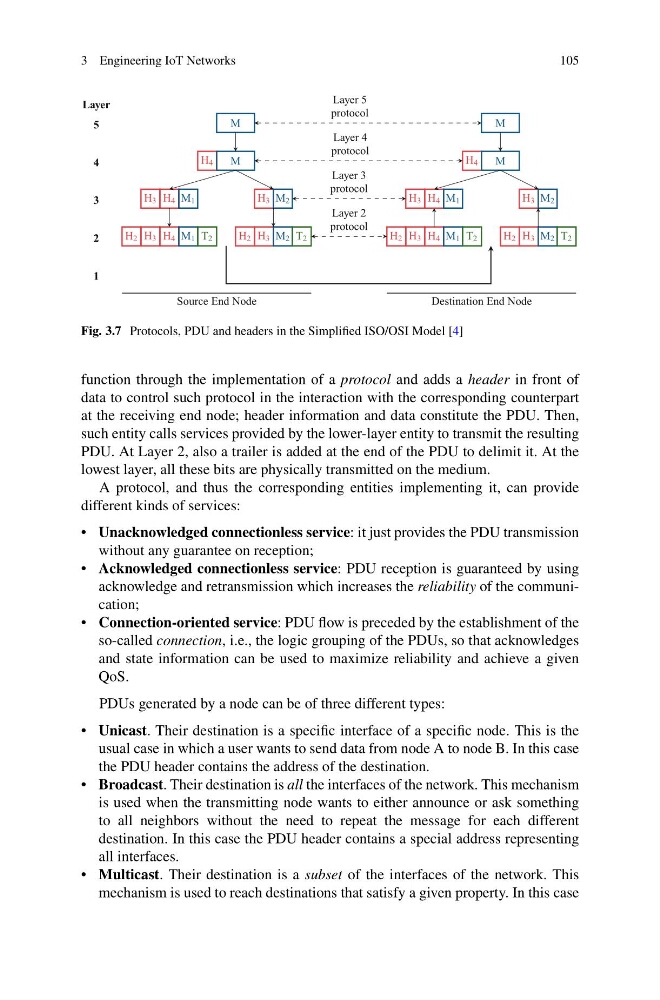
Fig. 3.7 Protocols, PDU and headers in the Simplified ISO/OSI Model [4]
function through the implementation of a protocol and adds a header in front of
data to control such protocol in the interaction with the corresponding counterpart
at the receiving end node; header information and data constitute the PDU. Then,
such entity calls services provided by the lower-layer entity to transmit the resulting
PDU. At Layer 2, also a trailer is added at the end of the PDU to delimit it. At the
lowest layer, all these bits are physically transmitted on the medium.
A protocol, and thus the corresponding entities implementing it, can provide
different kinds of services:
• Unacknowledged connectionless service: it just provides the PDU transmission
without any guarantee on reception;
• Acknowledged connectionless service: PDU reception is guaranteed by using
acknowledge and retransmission which increases the reliability of the communication;
• Connection-oriented service: PDU flow is preceded by the establishment of the
so-called connection, i.e., the logic grouping of the PDUs, so that acknowledges
and state information can be used to maximize reliability and achieve a given
QoS.
PDUs generated by a node can be of three different types:
• Unicast. Their destination is a specific interface of a specific node. This is the
usual case in which a user wants to send data from node A to node B. In this case
the PDU header contains the address of the destination.
• Broadcast. Their destination is all the interfaces of the network. This mechanism
is used when the transmitting node wants to either announce or ask something
to all neighbors without the need to repeat the message for each different
destination. In this case the PDU header contains a special address representing
all interfaces.
• Multicast. Their destination is a subset of the interfaces of the network. This
mechanism is used to reach destinations that satisfy a given property. In this case
105
1
2
3
4
5
Layer
H 2 H 3 H 4 M 1 T 2
H 2 H 3 M 2 T 2
H 2 H 3 H 4 M 1 T 2
H 2 H 3 M 2 T 2
H 3 H 4 M 1
H 3 M 2
H 3 H 4 M 1
H 3 M 2
H 4
M
H 4
M
M
M
Layer 2
protocol
Layer 3
protocol
Layer 4
protocol
Layer 5
protocol
Source End Node
Destination End Node
Fig. 3.7 Protocols, PDU and headers in the Simplified ISO/OSI Model [4]
function through the implementation of a protocol and adds a header in front of
data to control such protocol in the interaction with the corresponding counterpart
at the receiving end node; header information and data constitute the PDU. Then,
such entity calls services provided by the lower-layer entity to transmit the resulting
PDU. At Layer 2, also a trailer is added at the end of the PDU to delimit it. At the
lowest layer, all these bits are physically transmitted on the medium.
A protocol, and thus the corresponding entities implementing it, can provide
different kinds of services:
• Unacknowledged connectionless service: it just provides the PDU transmission
without any guarantee on reception;
• Acknowledged connectionless service: PDU reception is guaranteed by using
acknowledge and retransmission which increases the reliability of the communication;
• Connection-oriented service: PDU flow is preceded by the establishment of the
so-called connection, i.e., the logic grouping of the PDUs, so that acknowledges
and state information can be used to maximize reliability and achieve a given
QoS.
PDUs generated by a node can be of three different types:
• Unicast. Their destination is a specific interface of a specific node. This is the
usual case in which a user wants to send data from node A to node B. In this case
the PDU header contains the address of the destination.
• Broadcast. Their destination is all the interfaces of the network. This mechanism
is used when the transmitting node wants to either announce or ask something
to all neighbors without the need to repeat the message for each different
destination. In this case the PDU header contains a special address representing
all interfaces.
• Multicast. Their destination is a subset of the interfaces of the network. This
mechanism is used to reach destinations that satisfy a given property. In this case