

1 Introduction to Laser Micro-to-Nano Manufacturing
55
1.6.3 1D (Nanowire and Nanotube) and 2D Material
in Molecular Electrodes
1D and 2D materials are very promising building blocks for molecular electronics;
especially, the carbon-based material plays a significant role in the design process
and device fabrication. The first demonstration of carbon nanotubes (CNT) used in a
field-effect transistor has been reported in 1998 [220]. A single wall CNT (SWCNT)
was positioned on top to bridge two gold electrodes, which were fabricated on a
SiO 2 film grown on a silicon wafer. Two gold electrodes act as source and drain
electrodes, and the wafer itself was used as the gate electrode (“back-gate”). These
CNT-FETs behaved as p-type FETs with ON/OFF current ratio of ≈10
5 [221]. The
further improvement of current conductance across the metal -molecule interface is a
great technical challenge in a molecular transistor [222, 223]. It has been proved that
the Schottky barrier between nanotube and metal contact leads to limit the current
flow, which reduces molecular conductivity [224]. In terms of this issue, Javey et al.
provided a valuable idea to reduce the barrier by placing a palladium contact with
SWCNT [225]. The research shows that palladium has a high work function and an
exceptional wetting interaction with CNTs, these properties can effectively reduce
the contact resistance. Furthermore, metallic and semiconductor property of CNTs
can be strengthened by controlling its geometric features during growth [226].
CNT has also become an indispensable material in other molecular devices. In
2004, Dragoman et al. discussed the possibility of using semi-conductive SWCNT
for a molecular diode. As reported, the semi-conductive SWCNT yields better performance than the usual semiconductor hetero-structured RTD [227]. In their design,
the barrier height was controlled by the DC voltage applied to the gate and the gap of
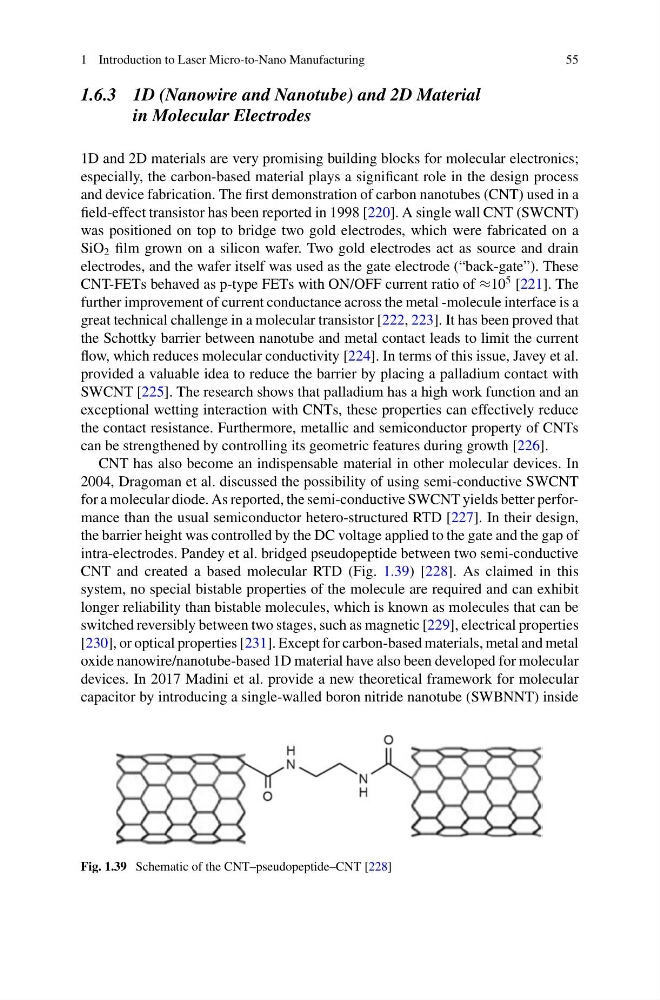
intra-electrodes. Pandey et al. bridged pseudopeptide between two semi-conductive
CNT and created a based molecular RTD (Fig. 1.39) [228]. As claimed in this
system, no special bistable properties of the molecule are required and can exhibit
longer reliability than bistable molecules, which is known as molecules that can be
switched reversibly between two stages, such as magnetic [229], electrical properties
[230], or optical properties [231]. Except for carbon-based materials, metal and metal
oxide nanowire/nanotube-based 1D material have also been developed for molecular
devices. In 2017 Madini et al. provide a new theoretical framework for molecular
capacitor by introducing a single-walled boron nitride nanotube (SWBNNT) inside
Fig. 1.39 Schematic of the CNT–pseudopeptide–CNT [228]
55
1.6.3 1D (Nanowire and Nanotube) and 2D Material
in Molecular Electrodes
1D and 2D materials are very promising building blocks for molecular electronics;
especially, the carbon-based material plays a significant role in the design process
and device fabrication. The first demonstration of carbon nanotubes (CNT) used in a
field-effect transistor has been reported in 1998 [220]. A single wall CNT (SWCNT)
was positioned on top to bridge two gold electrodes, which were fabricated on a
SiO 2 film grown on a silicon wafer. Two gold electrodes act as source and drain
electrodes, and the wafer itself was used as the gate electrode (“back-gate”). These
CNT-FETs behaved as p-type FETs with ON/OFF current ratio of ≈10
5 [221]. The
further improvement of current conductance across the metal -molecule interface is a
great technical challenge in a molecular transistor [222, 223]. It has been proved that
the Schottky barrier between nanotube and metal contact leads to limit the current
flow, which reduces molecular conductivity [224]. In terms of this issue, Javey et al.
provided a valuable idea to reduce the barrier by placing a palladium contact with
SWCNT [225]. The research shows that palladium has a high work function and an
exceptional wetting interaction with CNTs, these properties can effectively reduce
the contact resistance. Furthermore, metallic and semiconductor property of CNTs
can be strengthened by controlling its geometric features during growth [226].
CNT has also become an indispensable material in other molecular devices. In
2004, Dragoman et al. discussed the possibility of using semi-conductive SWCNT
for a molecular diode. As reported, the semi-conductive SWCNT yields better performance than the usual semiconductor hetero-structured RTD [227]. In their design,
the barrier height was controlled by the DC voltage applied to the gate and the gap of
intra-electrodes. Pandey et al. bridged pseudopeptide between two semi-conductive
CNT and created a based molecular RTD (Fig. 1.39) [228]. As claimed in this
system, no special bistable properties of the molecule are required and can exhibit
longer reliability than bistable molecules, which is known as molecules that can be
switched reversibly between two stages, such as magnetic [229], electrical properties
[230], or optical properties [231]. Except for carbon-based materials, metal and metal
oxide nanowire/nanotube-based 1D material have also been developed for molecular
devices. In 2017 Madini et al. provide a new theoretical framework for molecular
capacitor by introducing a single-walled boron nitride nanotube (SWBNNT) inside
Fig. 1.39 Schematic of the CNT–pseudopeptide–CNT [228]