

1 Introduction to Laser Micro-to-Nano Manufacturing
33
In summary of this section, fs pulses trigger a nonthermal ablation mechanism
since both the electron-lattice thermal coupling and thermal diffusion to the lattice
take longer time than the pulse width. ns pulses allow thermal equilibrium to occur
between the electrons and the lattice.
Comparative Study Between Ultrashort Laser and Continue Wave Laser Interacted with 1-D Nanowire Due to the size effect, thermal diffusion in a nanoscale
will be quite different from the aforementioned macroscale. Besides, the energy
radiation, reflection and dissipation to the environment have to be considered. To
understand the local melting of a Cu nanowire (Cu NW) using a focused laser beam,
we recently conducted a comparative study with 1030 nm FS laser and 532 nm
continuous-wave (CW) green laser at different power and atmosphere conditions
[6]. To support the experimental observation and explain the difference between two
types of laser irradiation, we examined computational modeling of the temperature
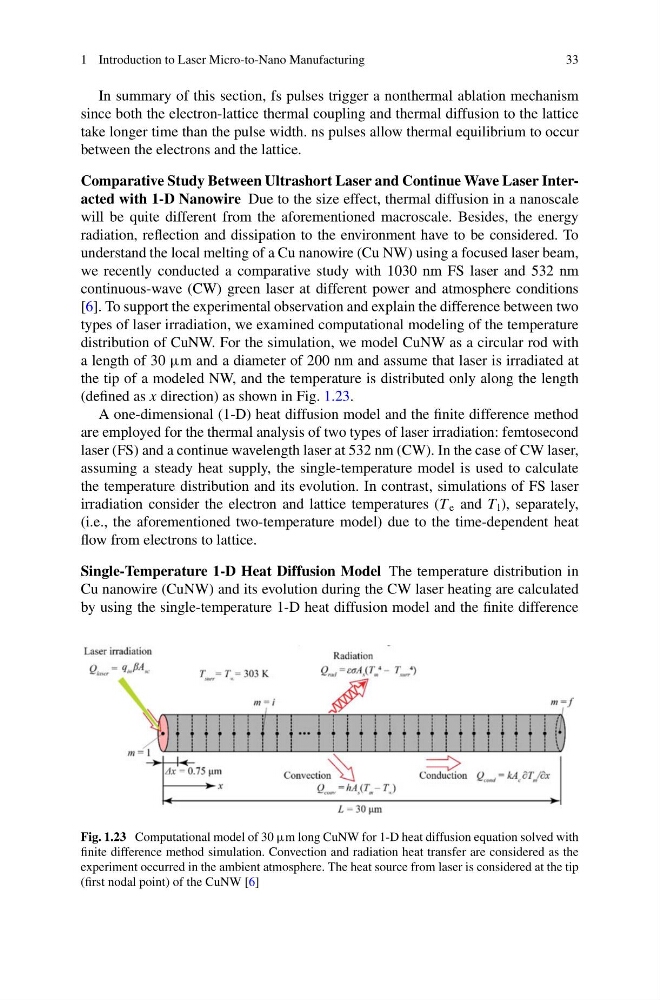
distribution of CuNW. For the simulation, we model CuNW as a circular rod with
a length of 30 μm and a diameter of 200 nm and assume that laser is irradiated at
the tip of a modeled NW, and the temperature is distributed only along the length
(defined as x direction) as shown in Fig. 1.23.
A one-dimensional (1-D) heat diffusion model and the finite difference method
are employed for the thermal analysis of two types of laser irradiation: femtosecond
laser (FS) and a continue wavelength laser at 532 nm (CW). In the case of CW laser,
assuming a steady heat supply, the single-temperature model is used to calculate
the temperature distribution and its evolution. In contrast, simulations of FS laser
irradiation consider the electron and lattice temperatures (T e and T l ), separately,
(i.e., the aforementioned two-temperature model) due to the time-dependent heat
flow from electrons to lattice.
Single-Temperature 1-D Heat Diffusion Model The temperature distribution in
Cu nanowire (CuNW) and its evolution during the CW laser heating are calculated
by using the single-temperature 1-D heat diffusion model and the finite difference
Fig. 1.23 Computational model of 30 μm long CuNW for 1-D heat diffusion equation solved with
finite difference method simulation. Convection and radiation heat transfer are considered as the
experiment occurred in the ambient atmosphere. The heat source from laser is considered at the tip
(first nodal point) of the CuNW [6]
33
In summary of this section, fs pulses trigger a nonthermal ablation mechanism
since both the electron-lattice thermal coupling and thermal diffusion to the lattice
take longer time than the pulse width. ns pulses allow thermal equilibrium to occur
between the electrons and the lattice.
Comparative Study Between Ultrashort Laser and Continue Wave Laser Interacted with 1-D Nanowire Due to the size effect, thermal diffusion in a nanoscale
will be quite different from the aforementioned macroscale. Besides, the energy
radiation, reflection and dissipation to the environment have to be considered. To
understand the local melting of a Cu nanowire (Cu NW) using a focused laser beam,
we recently conducted a comparative study with 1030 nm FS laser and 532 nm
continuous-wave (CW) green laser at different power and atmosphere conditions
[6]. To support the experimental observation and explain the difference between two
types of laser irradiation, we examined computational modeling of the temperature
distribution of CuNW. For the simulation, we model CuNW as a circular rod with
a length of 30 μm and a diameter of 200 nm and assume that laser is irradiated at
the tip of a modeled NW, and the temperature is distributed only along the length
(defined as x direction) as shown in Fig. 1.23.
A one-dimensional (1-D) heat diffusion model and the finite difference method
are employed for the thermal analysis of two types of laser irradiation: femtosecond
laser (FS) and a continue wavelength laser at 532 nm (CW). In the case of CW laser,
assuming a steady heat supply, the single-temperature model is used to calculate
the temperature distribution and its evolution. In contrast, simulations of FS laser
irradiation consider the electron and lattice temperatures (T e and T l ), separately,
(i.e., the aforementioned two-temperature model) due to the time-dependent heat
flow from electrons to lattice.
Single-Temperature 1-D Heat Diffusion Model The temperature distribution in
Cu nanowire (CuNW) and its evolution during the CW laser heating are calculated
by using the single-temperature 1-D heat diffusion model and the finite difference
Fig. 1.23 Computational model of 30 μm long CuNW for 1-D heat diffusion equation solved with
finite difference method simulation. Convection and radiation heat transfer are considered as the
experiment occurred in the ambient atmosphere. The heat source from laser is considered at the tip
(first nodal point) of the CuNW [6]